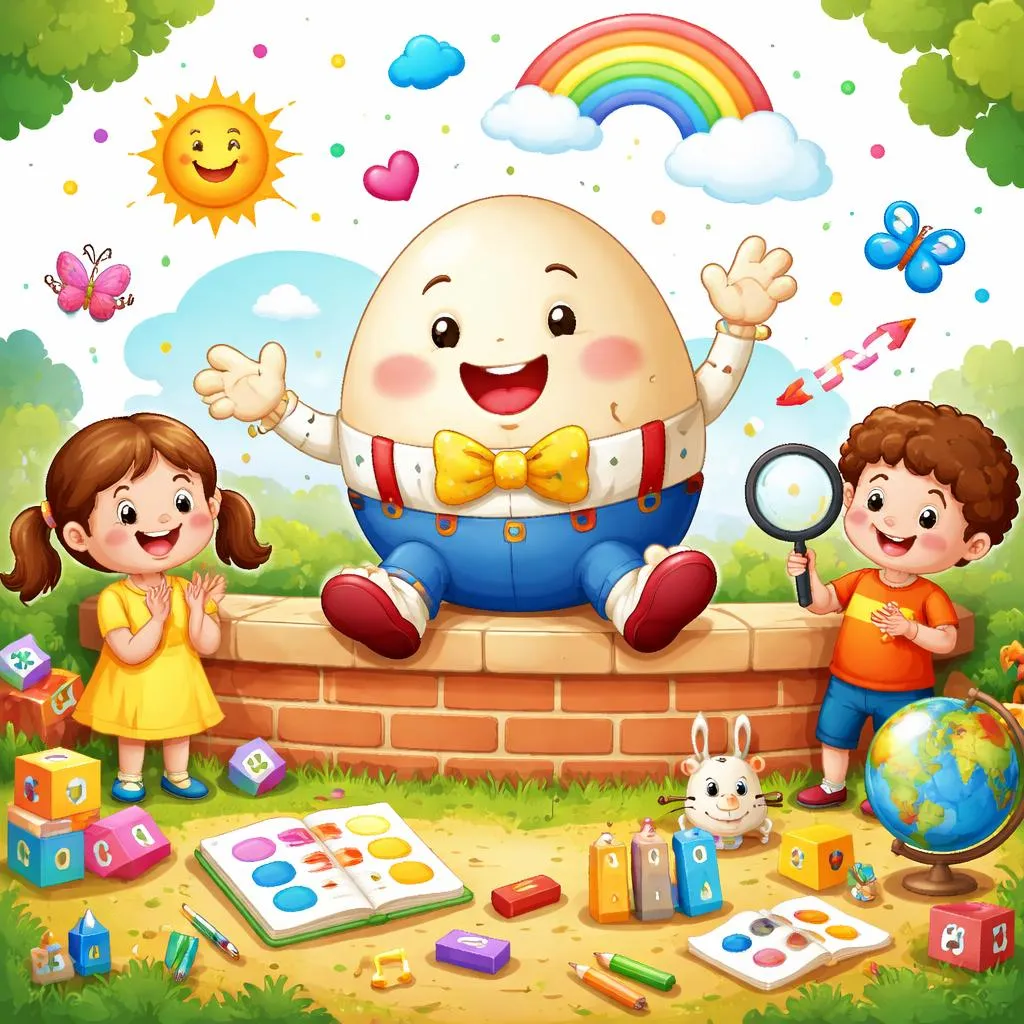

What Is “humpty dumpty humpty”?
“Humpty Dumpty” is one of the most famous nursery rhymes in English. The phrase “humpty dumpty humpty” often appears in playful variations and songs inspired by the classic rhyme. The rhyme tells a short story about a character who sits on a wall and falls down. The rhythm and repetition make it easy to remember. The story sounds simple, but it opens many doors for language learning.
This rhyme has traveled through many generations. It appears in books, cartoons, songs, and learning materials. It helps young learners hear English sounds in a natural and joyful way. It also introduces storytelling in a gentle and memorable style.
The lyrics of nursery rhymes (The Lyrics of the Rhyme)
Humpty Dumpty sat on a wall, Humpty Dumpty had a great fall. All the king’s horses and all the king’s men Couldn’t put Humpty together again.
Some playful versions repeat the name in songs, such as “humpty dumpty humpty,” to make the rhythm more musical. These variations keep the core story but add fun repetition.
Vocabulary Learning with “humpty dumpty humpty”
This rhyme offers many useful words. Each word connects to clear images. Short sentences make meaning easy to grasp.
“Sat” means to sit. It is the past form of “sit.” “Wall” means a tall structure that divides spaces. “Fall” means to drop down. “Horses” are animals that people ride. “Men” refers to people in the king’s group. “Put together” means to fix or rebuild something.
Each word appears in a clear story. Pictures of a wall, a fall, and horses help build understanding. Stories make vocabulary stick in memory.
The name “Humpty Dumpty” sounds funny and rhythmic. It helps practice stress and intonation. It also shows that names in stories can be playful and imaginative.
Phonics Points in “humpty dumpty humpty”
Phonics learning becomes natural with rhymes. Sounds repeat in patterns. “Humpty Dumpty” includes many useful sounds.
The short vowel sound in “Humpty” helps practice the /ʌ/ sound. The “mp” blend in “Humpty” shows how consonants work together. The “wall” sound shows the /ɔː/ vowel. The word “fall” rhymes with “wall.” Rhyming builds sound awareness. The “king” word shows the /ɪŋ/ sound. The “men” word shows the short /e/ sound.
Repeating the rhyme aloud supports phonemic awareness. Rhythm guides pronunciation. Intonation becomes natural through singing and chanting.
Grammar Patterns in the Rhyme
This rhyme introduces basic grammar in context. Short sentences show clear structure.
“Humpty Dumpty sat on a wall” shows past tense with a subject and verb. “Humpty Dumpty had a great fall” shows the verb “had” in past tense. “All the king’s horses and all the king’s men” shows possessive form with “king’s.” “Couldn’t put Humpty together again” shows negative form and modal verb usage.
These patterns appear in many everyday sentences. Exposure through stories builds intuitive grammar understanding.
Learning Activities with “humpty dumpty humpty”
Story retelling supports speaking skills. Pictures of Humpty on a wall can guide retelling. Simple prompts help structure speech.
Acting out the rhyme builds comprehension. One child can be Humpty. Others can be horses and men. Movement supports memory and engagement.
Drawing activities help connect language with creativity. Drawing Humpty, the wall, and the fall reinforces vocabulary. Labeling pictures builds word recognition.
Song and chant activities improve fluency. Clapping to the rhythm adds kinesthetic learning. Singing strengthens pronunciation and rhythm.
Sentence building activities use words from the rhyme. Short sentence frames guide structure. For example, “Humpty sat on a wall.” “The horses ran.” This supports early writing skills.
Printable Materials for “humpty dumpty humpty”
Flashcards with key words such as “wall,” “fall,” “king,” and “horse” support visual learning. Each card can include a simple picture and the word.
Mini storybooks with pictures of the rhyme help with reading practice. Each page can show one line of the rhyme. Large font and clear images support early readers.
Coloring sheets with Humpty and the wall add creative practice. Labeling parts of the picture builds vocabulary.
Matching worksheets connect words to images. For example, match “fall” with a picture of Humpty falling. These materials support recognition and recall.
Educational Games Inspired by “humpty dumpty humpty”
Memory games use rhyme words and pictures. Cards with “wall,” “fall,” and “horse” can be matched. This supports vocabulary recall.
Role-play games allow storytelling. One player tells the story. Others act it out. This supports speaking and listening skills.
Rhyming games build phonological awareness. Find words that rhyme with “wall” or “fall.” This strengthens sound recognition.
Sentence scramble games support grammar practice. Mix words from the rhyme and build correct sentences. This encourages syntax awareness.
Storytelling and Creative Extensions
“Humpty Dumpty” invites creative thinking. What happens after the fall? New endings can be invented. Humpty could meet new friends or find a new home.
Alternate settings can be created. Humpty could sit on a tree or a tower. This expands vocabulary and imagination.
Character development activities add depth. Humpty can have feelings, hobbies, and favorite foods. Simple descriptions build descriptive language.
Story maps help structure narrative. Beginning, middle, and end can be mapped with pictures and words. This supports narrative skills.
Cultural and Historical Notes
“Humpty Dumpty” comes from English folklore. It has existed for hundreds of years. It appears in books like “Alice in Wonderland.” This shows how rhymes travel across literature and time.
Different countries have their own versions and adaptations. Music, cartoons, and books reinterpret the rhyme. This shows how stories evolve and stay relevant.
Learning about classic rhymes connects learners with global culture. It builds curiosity and appreciation for stories from other places.
Listening and Speaking Practice
Listening to recordings of “humpty dumpty humpty” helps with accent and rhythm. Repetition improves comprehension.
Choral reading supports confidence. Everyone reads or sings together. This reduces pressure and increases participation.
Call-and-response activities build interaction. One line is spoken, and the next line is repeated by others. This supports listening and speaking coordination.
Reading and Writing Practice
Reading the rhyme aloud supports fluency. Short lines make it approachable.
Writing simple sentences about Humpty builds early writing skills. For example, “Humpty is an egg.” “Humpty sits on a wall.” Short sentences encourage accuracy.
Creating a mini book with drawings and sentences supports literacy development. Each page can show one event from the story.
Cross-Curricular Connections
Art activities include painting Humpty and the wall. This supports creativity and fine motor skills.
Math activities can include counting horses or men in pictures. This integrates language with numeracy.
Science discussions can explore why things fall. Gravity can be explained in simple terms. This connects language with real-world concepts.
Emotional and Social Learning
The story includes a fall and an attempt to fix Humpty. This opens discussion about helping others and problem-solving.
Role-play activities can explore feelings. How did Humpty feel after the fall? How did the king’s men feel? This builds empathy and emotional vocabulary.
Digital Learning Ideas
Interactive apps can show animated versions of “humpty dumpty humpty.” Tapping on words can reveal pronunciation and meaning.
Online quizzes can test vocabulary and comprehension. Simple multiple-choice questions support self-assessment.
Recording activities allow learners to record their voice reading the rhyme. This supports pronunciation practice and self-reflection.
Language Patterns and Repetition
Repetition is key in nursery rhymes. “Humpty Dumpty” repeats structure and rhythm. This repetition supports memory and automaticity.
The parallel structure of lines supports pattern recognition. Recognizing patterns supports language acquisition.
Expanding Vocabulary Beyond the Rhyme
The rhyme can lead to new words. “Wall” can lead to “brick,” “stone,” and “fence.” “Horse” can lead to “farm,” “stable,” and “ride.” “King” can lead to “queen,” “castle,” and “crown.”
Building word webs expands vocabulary networks. Pictures and semantic maps support understanding.
Simple Comprehension Questions
Who is Humpty Dumpty? Where did Humpty sit? What happened to Humpty? Who tried to help Humpty? Could they fix Humpty?
These questions guide understanding. Short answers support early learners.
Creative Writing Prompts
Imagine Humpty did not fall. What happens next? Imagine Humpty meets a dragon. What happens? Imagine the king’s men invent a machine to help Humpty. What happens?
Creative prompts encourage imagination and language production.
Integrating Music and Movement
Singing “humpty dumpty humpty” with actions supports total physical response. Sitting, falling, and fixing actions connect language to movement.
Dancing or acting out the story builds engagement and memory. Music supports rhythm and pronunciation.
Assessment and Progress Tracking
Observation of reading and singing shows pronunciation progress. Retelling the story shows comprehension. Drawing and labeling show vocabulary understanding. Sentence writing shows grammar development.
These informal assessments support learning without pressure.
Supporting Diverse Learners
Visual aids support visual learners. Songs and chants support auditory learners. Actions and role-play support kinesthetic learners.
Differentiation ensures access for all learners.
Building a Learning Routine with “humpty dumpty humpty”
Start with listening. Move to speaking and singing. Add reading with text and pictures. Finish with writing and creative activities.
This routine supports balanced language development.
“humpty dumpty humpty” offers a rich foundation for English learning. The rhyme brings rhythm, story, and language together. Through songs, stories, and creative tasks, English becomes joyful and meaningful.