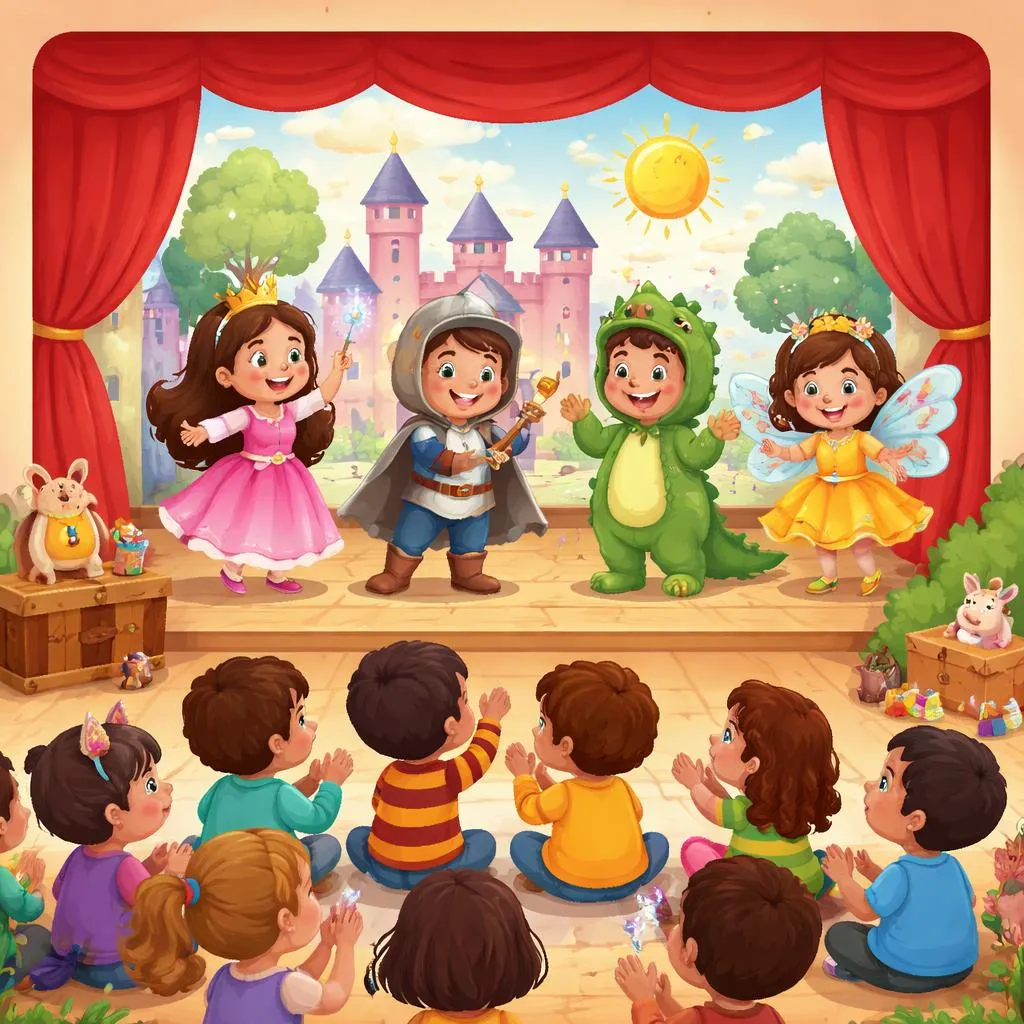

Hello, little word actor! Do you know about a stage play? In a play, actors have roles. Sometimes, the actor does the action. "The knight saves the day!" Sometimes, the action happens to the actor. "The day is saved by the knight!" Also, the actor can say different types of lines. They can tell a fact, give a command, or ask a question. In sentences, we have roles and line types too! This is called voice and mood. Voice shows who is the star. Mood shows the type of line. Today, we will put on a play with sixty wonderful sentences. Our guide is Penny the Play Director. She will help us with voice and mood at home, the playground, school, and on stage. Let's start the show!
What Are Voice and Mood? Voice and mood are your tools for a word play. They help you act out sentences in different ways.
First, voice. Voice is about the star of the sentence. Who is doing the action? There are two main voices.
Active voice: The subject is the star doing the action. "The dog chases the ball." The dog (subject) is the star chaser.
Passive voice: The subject is the one the action happens to. "The ball is chased by the dog." The ball (subject) is the one being chased. The star (the dog) is after "by". We use this less, but it's good to know.
Next, mood. Mood is the type of line in your play. It is the feeling or job of the sentence. We will learn three main moods.
Indicative mood: This is for facts and statements. It tells something. "I have a toy."
Imperative mood: This is for commands and requests. It tells someone to do something. "Give me the toy, please."
Interrogative mood: This is for questions. It asks something. "Do you have a toy?"
Learning these must-know sentences helps you be a versatile word actor.
Why Do We Need a Word Play? Voice and mood are your expression tools! They help your ears listen. You can hear who is acting and what type of line it is. They help your mouth speak. You can be the star of your action or talk about what happened. You can state, command, and ask. They help your eyes read. You will see these different roles and line types in all your books. They help your hand write. You can write stories and notes that are clear and full of variety. Putting on a word play makes you a powerful and expressive communicator.
How Can You Spot the Star and the Line Type? Spotting voice and mood is a backstage game. For voice, look at the subject. Ask: "Is the subject doing the action?" If yes, it's active voice. "Is the subject receiving the action?" If yes, it's passive voice. For mood, look at the end mark and the sentence's job. A period (.) is often indicative or imperative. A question mark (?) is interrogative. An exclamation mark (!) can be indicative or imperative with strong feeling. Also, listen to the speaker's intent. Are they telling? (Indicative). Commanding? (Imperative). Asking? (Interrogative). Penny says, "Find the verb. Then ask, 'Who is doing this?' That tells you the voice!"
How Do We Use Our Acting Tools? Using voice and mood is about choosing the right role and line. For active voice, start with the doer. Pattern: Doer + Action + Receiver. "The cat drinks milk." For passive voice, start with the receiver. Pattern: Receiver + is/are/was/were + Action (past participle) + by + Doer. "Milk is drunk by the cat." For mood, choose your purpose. To tell: use a statement. To command: start with a verb. To ask: use a question word or invert the subject and verb. Penny shows us. Active/Indicative: "I eat an apple." Passive/Indicative: "The apple is eaten by me." Active/Imperative: "Eat the apple." Active/Interrogative: "Did you eat the apple?" Start with simple active voice sentences in the indicative mood.
Let's Fix Some Stage Mistakes. Sometimes our play has a small mistake. Let's fix that. A common mistake is using passive voice when active is clearer. A child might say "The toy was broken by me." It's okay, but active is stronger: "I broke the toy." Another mistake is using the wrong mood. Writing a command as a statement. "You will sit down" is a statement. "Sit down" is a command. Also, in passive voice, don't forget the "by" phrase if the doer is important. "The window was broken" (passive, doer unknown) is fine. "The window was broken by the ball" adds the doer.
Can You Be the Director? You are a great director! Let's play the "Change the Role" game. I will say an active voice sentence. You change it to passive. "The girl reads the book." You say: "The book is read by the girl." Now, change the mood. Make it a command: "Read the book!" Make it a question: "Does the girl read the book?" Great! Here is a harder challenge. Take a simple action. Say it in active and passive voice. "The teacher helps the student." (Active) "The student is helped by the teacher." (Passive)
Your Script Book of 60 Must-Know Sentences. Ready for the script? Here are sixty wonderful sentences showing voice and mood. Penny the Director uses them. They are grouped by the scene. Each group has active and passive voice, and the three moods.
Home Play (15 Lines). Active Voice, Indicative (Fact): Mom washes the dishes. I make my bed. The dog chews the bone. Passive Voice, Indicative (Fact): The dishes are washed by Mom. The bed is made by me. The bone is chewed by the dog. Active Voice, Imperative (Command): Wash the dishes, please. Make your bed. Chew your bone. Active Voice, Interrogative (Question): Does Mom wash the dishes? Did I make my bed? Is the dog chewing the bone? Mixed: The cookies were baked by Grandma. (Passive/Indicative) Eat your vegetables. (Active/Imperative) Is the room cleaned by you? (Passive/Interrogative)
Playground Play (15 Lines). Active/Indicative: The boy kicks the ball. The wind moves the swing. We play a game. Passive/Indicative: The ball is kicked by the boy. The swing is moved by the wind. A game is played by us. Active/Imperative: Kick the ball. Push the swing. Play a game with me. Active/Interrogative: Did the boy kick the ball? Does the wind move the swing? Shall we play a game? Mixed: The rules are followed by everyone. (Passive/Indicative) Follow the rules. (Active/Imperative) Are the rules followed? (Passive/Interrogative)
School Play (15 Lines). Active/Indicative: The teacher opens the book. The student writes the answer. The bell ends recess. Passive/Indicative: The book is opened by the teacher. The answer is written by the student. Recess is ended by the bell. Active/Imperative: Open your book. Write the answer. Listen for the bell. Active/Interrogative: Does the teacher open the book? Did the student write the answer? Will the bell end recess? Mixed: The song is sung by the class. (Passive/Indicative) Sing the song. (Active/Imperative) Is the song sung? (Passive/Interrogative)
Nature and Animal Play (15 Lines). Active/Indicative: The rain waters the flowers. The spider spins a web. The sun warms the earth. Passive/Indicative: The flowers are watered by the rain. A web is spun by the spider. The earth is warmed by the sun. Active/Imperative: Look at the flowers. Watch the spider. Feel the sun. Active/Interrogative: Does the rain water the flowers? Is the spider spinning a web? Will the sun warm the earth? Mixed: The nest was built by the bird. (Passive/Indicative) Protect the nest. (Active/Imperative) Was the nest built here? (Passive/Interrogative)
Putting on the Full Play. Now, let's act out a short scene using different voices and moods. Narrator (Indicative): The snack is prepared by Mom. (Passive) Child (Interrogative): May I eat it? (Active) Mom (Imperative): Eat your snack. (Active) Child (Indicative): I ate the snack! (Active) Narrator (Indicative): The snack was eaten. (Passive)
These sixty sentences are your must-know examples of voice and mood. Use them to make your word plays exciting.
Directing Your Own Word Plays. You did it! You are now familiar with voice and mood. You know voice is about who is the star (active or passive). You know mood is about the type of line (indicative, imperative, interrogative). You can start to spot them and use them. Penny the Play Director is proud of your performance. Now you can think about how to structure your sentences for different effects. Your communication will be more dynamic and clear.
Here is what you can learn from our play. You will know the difference between active and passive voice. You will understand the three basic moods. You can identify the voice and mood in simple sentences. You can use active voice for clear, strong sentences most of the time. You have a script book of sixty key sentences showing voice and mood.
Now, let's do some life practice! Your mission is today. Be a word actor. Say three sentences about one action. Use active voice, passive voice, and a command. Tell your grown-up: "I am drawing a picture. (Active) The picture is drawn by me. (Passive) Look at my picture! (Command)" You just used voice and mood! Keep putting on your word plays every day. Have fun, little actor!