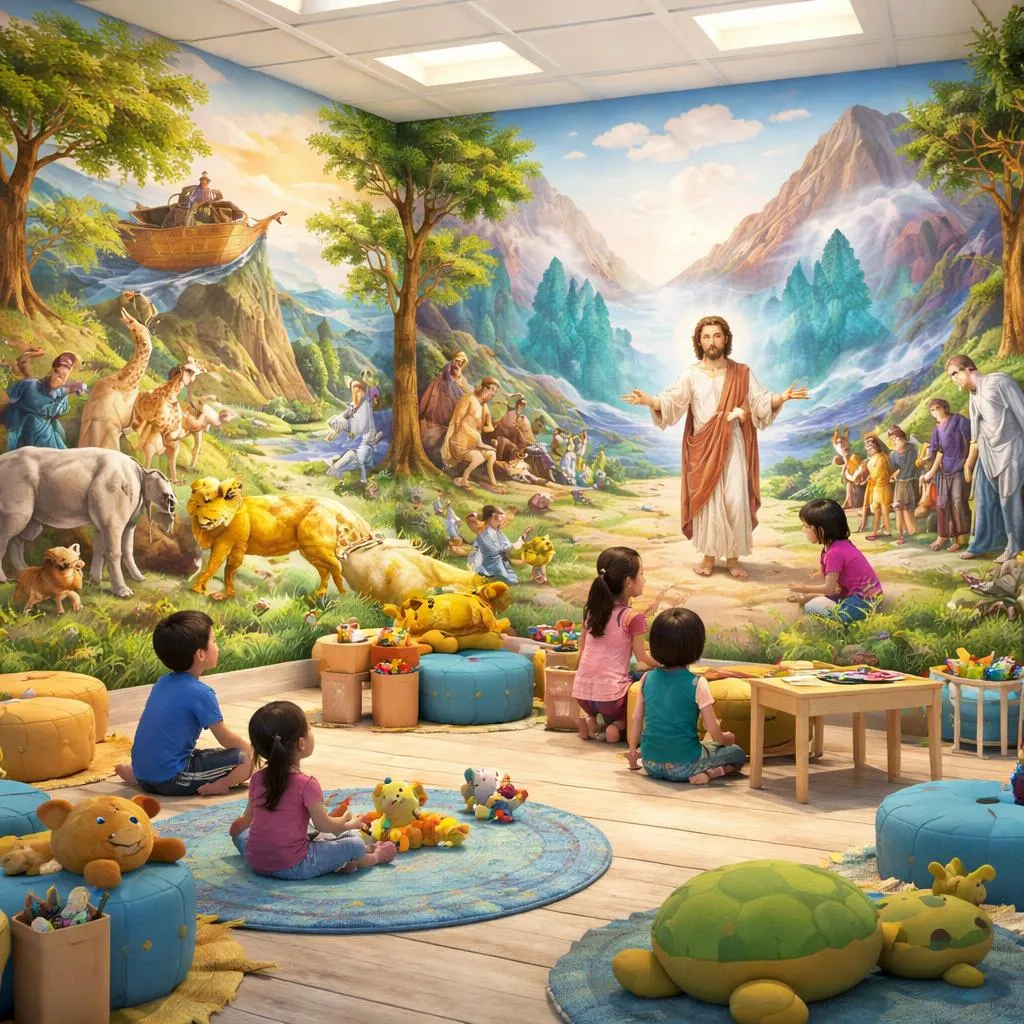

A blank wall waits in a Sunday school room. A long hallway needs color in a children's wing. A bedroom could tell stories instead of just showing them. Children's Bible story murals offer a beautiful way to surround young ones with Scripture every day. These large paintings do more than decorate. They teach. They inspire. They create spaces where faith feels natural and near.
Let us explore together how murals can bring Bible stories to life on walls and how families can create their own sacred art.
<h2>What is the story?</h2> Children's Bible story murals tell tales through pictures spread across walls. Unlike a single painting, a mural covers a large area. It might show Noah building the ark on one end, animals entering in the middle, and the rainbow appearing at the other end. Children can walk along the wall and follow the story step by step.Some murals focus on a single story in great detail. A mural of Daniel in the lions' den might show Daniel praying at his window, the king watching sadly, Daniel in the pit with lions, and the angel closing the lions' mouths. All these moments appear together, inviting children to find each part.
Other murals show many stories from the Bible. The Old Testament might flow along one wall, from creation to the prophets. The New Testament might cover another wall, from Jesus's birth to his ascension. Children can stand in one spot and see the whole story of God's love.
Murals appear in many places. Churches paint them in children's areas. Schools create them in hallways. Some families paint them in bedrooms or playrooms. Libraries sometimes have Bible story murals in children's sections. Each mural creates a holy space where stories live.
<h2>The message of the story</h2> Children's Bible story murals carry messages beyond the stories themselves. A mural surrounding a room says, These stories matter. They are worth looking at every day. They belong in our space.Murals also say, Faith is beautiful. Artists use color and composition to make Scripture lovely. Children absorb this beauty. They learn that the Bible is not just words on a page but a world of color and life.
A mural invites interaction. Children point at characters. They ask questions about what they see. They notice details they missed before. The mural becomes a conversation starter between children and parents, teachers, and friends.
Murals also create memory. A child who grows up with Noah's ark on the wall will always connect that story with home and safety. The image sinks deep and stays forever.
We can ask our children as we look at murals together, Which part of this picture makes you want to know more? What do you think the people in this story are feeling?
<h2>Vocabulary learning</h2> Children's Bible story murals build vocabulary naturally. When children see a mural of the Exodus, they learn words like Egypt, Pharaoh, Moses, Red Sea, and wilderness just by looking and talking.Murals teach specific words from Bible times. A detailed mural might show a shepherd with his staff and sheepfold. Children learn these words by seeing them. A mural of Jesus teaching might show a boat, a crowd, a hillside, and the Sea of Galilee.
Artists include objects that add vocabulary. A mural of the tabernacle teaches words like altar, lampstand, showbread, and curtain. A mural of Jerusalem teaches words like temple, wall, gate, and mountain.
Murals also teach action words. A mural of David and Goliath shows running, slinging, falling, and standing. Children see the actions and learn the words for them.
After looking at a mural together, we can name what we see. That is the Jordan River. Those are priests carrying the ark. That is the pile of stones they made to remember. The mural anchors the words in visual memory.
<h2>Phonics points</h2> Children's Bible story murals support phonics learning when we use them intentionally. A mural section showing the ark can start conversations about the letter A and its sound. A lion in Daniel's mural leads to L and its sound.Many murals include labels or simple words painted right on the wall. Children can practice matching letters and sounds to the words they see. A label saying RED SEA helps children find R and S and practice their sounds.
Some families create alphabet walks using their murals. Find something that starts with A. Angel! Something that starts with B. Boat! Children walk along the wall, finding pictures for each letter.
Murals also help with sound blending. A picture of a fish helps children practice F-I-SH. A picture of a lamb helps with L-A-M. Seeing the image while saying the sounds strengthens the connection between letters and meaning.
We can play simple games while looking at murals. I see something in this mural that starts with K. Can you find it? The king! What sound does king start with? Kkk-king.
<h2>Grammar patterns</h2> Children's Bible story murals help teach grammar through conversation. When we talk about what we see, we naturally use different sentence structures.We use present tense to describe what is happening in the mural. Jesus holds the little lamb. The people walk around the walls of Jericho. The angels sing to the shepherds.
We use past tense to tell what happened in the story. David threw the stone. The walls fell down. The baby cried in the basket.
We use questions to explore the mural together. Where is Moses? Why is the bush burning? What is the woman holding? Questions model question formation for children.
We use descriptive language with adjectives. See the big fish. Look at the bright star. The tall giant. The soft clouds. Children learn to add describing words to their own speech.
After looking at a mural, we can write simple sentences about what we see. The mural shows Jesus feeding the people. A boy shares his lunch. Everyone eats and is full.
<h2>Learning activities</h2> Children's Bible story murals inspire many hands-on activities that deepen learning.Create a mural walk. Walk slowly along the whole mural. Stop at each section. Ask your child to tell you what is happening in that part. This builds narrative skills and comprehension.
Play I Spy with the mural. I spy something round and colorful. The rainbow! I spy someone holding a staff. Moses! I spy something furry. The lamb! This builds observation and vocabulary.
Make a small copy of part of the mural. Give your child paper and crayons. Let them choose their favorite section to draw. Display their artwork near the mural.
Create stories about the people in the mural. What do you think this shepherd boy is thinking? What might the woman at the well say to her friends after meeting Jesus? Imagination builds empathy and understanding.
<h2>Printable materials</h2> Many wonderful printable materials connect to children's Bible story murals.Look for printable coloring pages that match scenes from your mural. Children can color while sitting near the mural, comparing their work to the larger art.
Find printable guides that explain the stories in the mural. These can include simple summaries and questions for each section. Families can use them during mural walks.
Some websites offer printable activity sheets with mural themes. Find the hidden objects. Connect the dots to reveal a Bible character. Match the story to the picture.
You might also find printable verse cards with words from stories in the mural. Display these near the matching section so children connect words to images.
<h2>Educational games</h2> Games based on children's Bible story murals make learning active and fun.Play mural bingo. Create bingo cards with images or words from the mural. Call out descriptions. Find someone walking on water. Children cover that spot on their cards.
Create a mural scavenger hunt. Make a list of things to find in the mural. Find a boat. Find a lion. Find a crown. Find a basket. Children search and check off each item.
Play what comes next using the mural. Start at the beginning of the story sequence. Ask your child what happens next based on what they see ahead. Walk along and check.
For younger children, play a simple pointing game. Show me the baby Moses. Show me the princess. Show me Miriam watching. Children point and build story knowledge.
These games show that murals offer endless opportunities for learning through play. Children absorb the stories while having fun together.
<h2>Creating your own mural</h2> Families can create their own children's Bible story murals together. This becomes a project that teaches while it creates.Start by choosing a story or theme. Perhaps your family loves Noah's ark. Maybe you want all the stories about Jesus. Pick something meaningful to your children.
Plan the mural on paper first. Sketch where each part will go. Decide what colors to use. Let children contribute ideas. What should we include? What is most important in this story?
Gather supplies. Paint works well for walls. Chalk works for temporary murals on chalkboard walls. Even large paper sheets taped together can become a mural.
Paint together as a family. Each person can contribute something. Younger children can paint simple things like sun or grass. Older children can work on characters. Parents can oversee and fill in.
Talk while you paint. Retell the story together. Discuss why each part matters. The creating becomes learning.
When finished, step back and admire. You have made something beautiful together. Every time you pass that wall, you will remember not just the story but the time you spent telling it as a family.
<h2>The history of Bible murals</h2> Children's Bible story murals continue a very old tradition. For thousands of years, people have painted Bible stories on walls. Early Christians painted in catacombs where they worshiped secretly. Medieval churches covered every wall with Bible scenes because most people could not read.These old murals taught the faith to everyone who entered. People walked through the church and saw the whole story of salvation. They learned Scripture through their eyes.
Today's children's murals do the same thing. They teach through beauty. They surround children with truth. They make the Bible visible and present.
When we create or enjoy children's Bible story murals, we join this long tradition. We add our own brushstrokes to the great story of God's people painting God's story.
<h2>The gift of sacred walls</h2> Children's Bible story murals give children something special. Walls that tell stories. Spaces that speak of faith. Surroundings that remind them every day that God's love is as close as the wall beside them.A child who grows up with a mural of Jesus calming the storm will remember that image when life feels stormy. A child who sees David facing Goliath every day will remember courage when facing fears. A child who falls asleep looking at Noah's rainbow will rest under God's promise.
These murals do not replace reading the Bible. They invite it. They make children want to know more about the people and stories they see. They create hunger for the words behind the pictures.
When we share children's Bible story murals with our children, we give them gifts that last. We give them beauty. We give them memory. We give them a space soaked in Scripture. We give them walls that preach without words.
So look at the walls in your home, your church, your children's spaces. Could they tell stories? Could they become galleries of faith? Whether you paint a grand mural or hang a single picture, you surround your children with the stories that shape their souls.