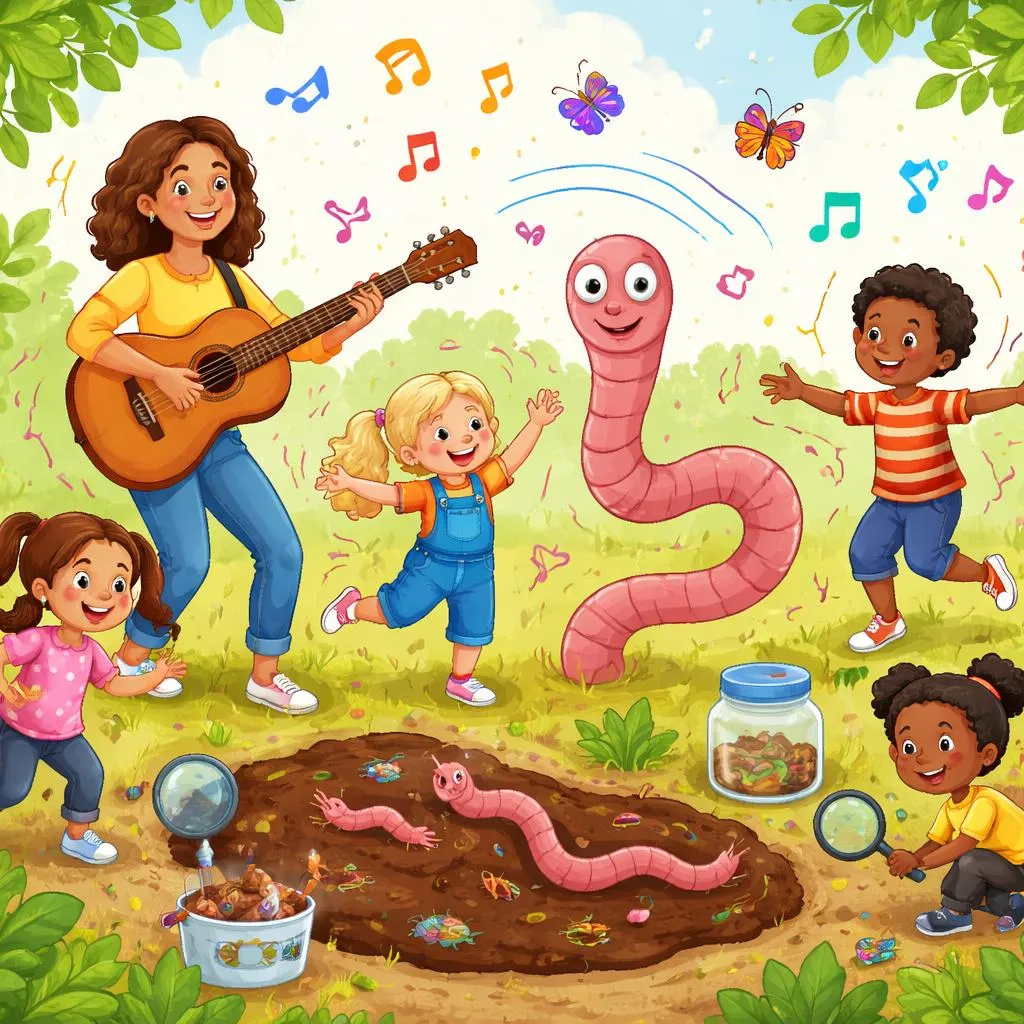

Hello and welcome, teaching friends! Today, we are going to get our hands a little dirty—in the best way possible—by digging into the wonderful world of the worm song. This isn't about one specific song, but rather a whole category of playful, wiggly tunes about our underground friends. Using a worm song in your lessons is a fantastic way to combine music, movement, and early science. Let’s explore how these simple, engaging songs can help young learners squirm their way into new language skills and knowledge.
What is the rhyme? A worm song is typically a short, repetitive children's rhyme or chant that focuses on the actions and characteristics of a worm. These songs often involve mimicry. Learners use their fingers or whole bodies to wiggle, dig, and squirm like a worm. The appeal lies in the playful physical movement paired with descriptive language. This combination helps cement new vocabulary in a highly memorable and joyful way. It transforms a simple science topic into an interactive language experience.
The lyrics of nursery rhymes While many worm song versions exist, let’s look at a popular and adaptable example that’s perfect for teaching. Its simple structure allows for easy customization.
Wiggle, wiggle, little worm, Deep down in the ground. Wiggle, wiggle, little worm, Without a single sound. Digging tunnels here and there, Digging tunnels everywhere!
We can create endless variations. For instance: “Squirm, squirm, little worm, in the morning light…” or add verses about what worms eat or feel. The core of the worm song is its action-focused, descriptive nature. This flexibility is what makes it such a powerful teaching tool across different themes.
Vocabulary learning A worm song naturally introduces rich, descriptive action verbs. Words like “wiggle,” “squirm,” “dig,” and “crawl” are central. We can demonstrate these actions physically, creating a strong mind-body connection to the word’s meaning. This is far more effective than passive listening.
The song also builds noun vocabulary. Key words include “worm,” “ground,” “dirt,” “soil,” and “tunnel.” We can introduce adjectives like “little,” “soft,” “wet,” and “brown” to describe the worm and its home. Using a worm song as a starting point, we can expand into a whole thematic unit about gardens, composting, or underground animals, seamlessly growing the child’s word bank.
Phonics points The repetitive lines in a worm song are perfect for highlighting specific sounds. The initial /w/ sound in “wiggle,” “worm,” and “without” appears frequently. We can emphasize this by singing those words slowly, asking learners to watch how our lips form the sound.
The song also offers great opportunities for rhyming practice. Pairs like “ground”/”sound” and “there”/”everywhere” create a natural rhythm. We can pause and ask, “Which words sound the same at the end?” This builds crucial phonemic awareness. The soft /g/ in “digging” and the final /l/ in “tunnel” are other consonant sounds we can gently spotlight during a sing-along.
Grammar patterns We can find simple but useful grammar patterns within a worm song. The song often uses imperative verbs for instructions, like “Wiggle!” or “Dig!” This form is common in games and daily instructions, making it highly practical to learn in a fun context.
The lyrics also model present continuous tense, which describes ongoing actions. Phrases like “digging tunnels” show this tense in a clear, actionable way. We can contrast it with simple present by saying, “The worm digs” versus “The worm is digging.” The song makes the grammar feel natural and connected to real movement, not just a rule on a page.
Learning activities A “Worm Wiggle Race” is a fantastic, energy-burning activity. Use masking tape to create two winding “tunnel” paths on the floor. Learners crouch down and wiggle their way from start to finish, just like a worm. We can chant the worm song as they move, linking the language to the action.
Create a “Sensory Dig” bin. Fill a large container with soil (or brown sensory rice). Hide plastic letters or laminated picture cards of related words (worm, dirt, leaf) inside. As learners dig to find them, we sing the song. When they find an item, they say the word aloud. This combines tactile learning, vocabulary retrieval, and musical reinforcement.
Printable materials A “Worm Action Wheel” printable is engaging. Create a circular cut-out divided into sections. Each section has a different action verb from the worm song: wiggle, squirm, dig, crawl. Attach a spinner. Learners spin and then everyone performs that action while singing a modified verse of the song. This makes vocabulary practice dynamic.
We can also offer a “Worm’s Journey” sequencing worksheet. Provide four pictures: a worm in an apple core, a worm in the soil, a worm making a tunnel, a bird looking at the worm. Ask learners to put them in an order and tell a simple story. This encourages narrative thinking and reinforces the habitat vocabulary introduced by the worm song.
Educational games “Simon Says: Worm Edition” is a wonderful listening comprehension game. Use the action verbs from the worm song. “Simon says wiggle like a worm!” “Simon says dig a tunnel!” If you give a command without “Simon says,” learners must freeze. This sharpens listening skills and vocabulary recall in a playful, high-energy setting.
For a calmer tabletop game, try “Worm Word Bingo.” Create Bingo cards with images of key nouns and verbs from the lesson (worm, soil, leaf, wiggle, dig). Instead of calling the word, describe it or perform the action. Learners must listen or watch and identify the correct picture on their card. This moves beyond simple word recognition to true comprehension.
The magic of a worm song is its ability to make learning felt. It’s not just about hearing words; it’s about becoming the word through movement and play. When we see learners giggling as they wiggle across the floor, confidently using words like “tunnel” or “squirm,” and making connections to the natural world, we see holistic learning in action. So, let’s embrace the wiggle, celebrate the squirm, and watch language skills grow as joyfully and naturally as a garden after the rain. Ready to dig in? Let’s sing!