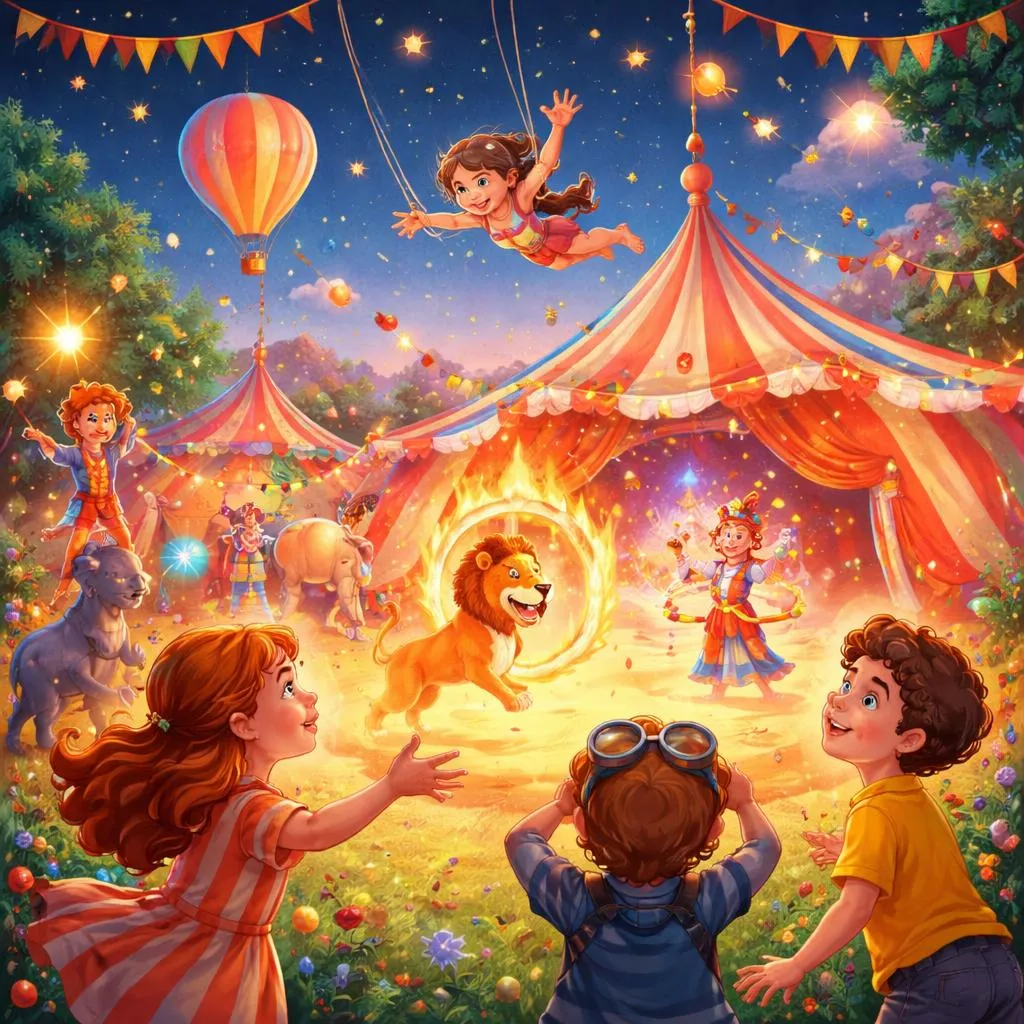

The tent rises like a colorful mountain. Music plays. Lights flash. Acrobats fly through the air. Clowns make everyone laugh. Animals perform amazing tricks. Children's circus stories capture all the wonder and excitement of the big top. They take young readers into a world where ordinary people do extraordinary things.
Let us step under the tent together and meet the performers who tumble, juggle, and soar through some of the best-loved circus stories.
<h2>What is the story?</h2> Children's circus stories come in many forms. One beloved tale tells of a tiny mouse with a big dream. The mouse lives in a small village. Every night, he watches the stars and wishes he could fly.One day a circus comes to town. The mouse sneaks under the tent. He sees trapeze artists swinging high above. He sees tightrope walkers crossing with grace. He sees jugglers keeping many balls in the air.
The mouse knows what he must do. He begs the circus performers to teach him. They laugh at first. A mouse cannot fly, they say. But the mouse does not give up.
A kind acrobat sees the mouse's determination. She teaches him to balance. She shows him how to swing. She helps him practice every day.
The mouse falls many times. He gets bruised and tired. But he keeps trying. Finally, the night comes when he performs. He swings on a tiny trapeze made just for him. The crowd gasps. A flying mouse! They cheer and clap.
Another circus story features an elephant who cannot remember his tricks. The other elephants stomp and trumpet on cue. Dumbo just trips over his own feet. The circus owner wants to send him away.
But Dumbo has one friend, a tiny mouse who believes in him. The mouse discovers that Dumbo's enormous ears can help him fly. With a feather for courage, Dumbo flaps his ears and soars through the air. He becomes the star of the circus.
A different story tells of a clown who feels sad inside. He makes everyone laugh, but he himself feels lonely. One day a little girl comes to the circus. She does not laugh at his jokes. She sees the sadness in his eyes.
The girl visits the clown after the show. They become friends. She teaches him that true happiness comes from real connection, not just making people laugh. The clown learns to share his true self.
<h2>The message of the story</h2> Children's circus stories carry powerful messages about believing in yourself. The tiny mouse believed he could fly even when others laughed. Dumbo believed he could soar with help from a friend. The clown learned that being real matters more than being funny.These stories also teach that practice matters. The mouse fell many times before he could fly. Dumbo had to trust his ears. The clown had to learn to be vulnerable. Nothing worthwhile comes easy.
Circus stories celebrate differences too. Dumbo's big ears made him different. That difference became his greatest gift. Children learn that what makes them different might be what makes them special.
Friendship appears in many circus tales. The mouse needed the acrobat. Dumbo needed his mouse friend. The clown needed the little girl. We cannot succeed alone.
We can ask our children, What dream feels too big for you? Who helps you keep trying when things are hard? What makes you different and special?
<h2>Vocabulary learning</h2> Children's circus stories introduce wonderful words from the magical world of the big top.Circus itself means a traveling show with performers, animals, and clowns. The word comes from a Latin word meaning circle, like the ring where performers appear.
Trapeze is a swinging bar high above the ground where acrobats fly through the air. Aerialists perform on trapeze.
Acrobat means someone who performs amazing feats of balance and agility. Acrobats tumble, flip, and soar.
Juggler means someone who keeps multiple objects in the air at once. Jugglers practice for thousands of hours.
Ringmaster is the person who introduces each act. The ringmaster wears a bright coat and uses a microphone or whistle.
Menagerie means a collection of wild animals kept for exhibition. Old circuses had menageries.
After reading, we can use these words naturally. When your child balances on a curb, you might say, Look at the acrobat! When they keep multiple toys in the air, you might say, You are juggling!
<h2>Phonics points</h2> The words in children's circus stories give us wonderful phonics practice.Circus has two syllables. Cir-cus. The C at the beginning can sound like S. Sss-circus. The R curls. The US at the end makes a short us sound. Cir-cus.
Trapeze has two syllables. Tra-peze. The TR blend requires pushing T and R together. The A is long. The P pops. The EZE at the end makes a long E and Z sound. Tra-peze.
Juggler has two syllables. Jug-gler. The J pushes air through teeth. The U is short. The G is hard. The LER at the end requires lifting tongue. Jug-gler.
Elephant has three syllables. El-e-phant. The E at the beginning is short. The L lifts tongue. The PH makes an F sound. The ANT at the end is short. El-e-phant.
We can play with these sounds by finding other words with the same patterns. Circus and circle both start with Cir. Trapeze and travel both start with Tra. Juggler and jump both start with Ju.
<h2>Grammar patterns</h2> Children's circus stories use language patterns that create excitement and wonder.Action verbs bring the circus alive. Swing, soar, tumble, juggle, balance, fly. These verbs show what circus performers do.
Descriptive words paint pictures. Daring acrobats. Funny clowns. Graceful tightrope walkers. Majestic elephants. Children learn to add detail to their own descriptions.
Sound words make readers hear the circus. The crowd cheers. The music plays. The drums roll. The tent flaps. These onomatopoeic words bring the scene to life.
Commands appear in performance scenes. Watch this! Look up! Hold tight! These short commands create excitement.
After reading, we can notice these patterns. The story said the acrobat soared through the air. Soared is a stronger word than flew. What other strong verbs can we think of? Zoomed, raced, dashed.
<h2>Learning activities</h2> Children's circus stories inspire wonderful hands-on activities that bring the magic home.Create a circus in your living room. Use blankets to make a tent. Chairs become seats. Stuffed animals become the audience. Family members become performers. Take turns doing tricks, telling jokes, and being ringmaster.
Practice juggling with scarves or soft balls. Start with one, then two, then three. Talk about how jugglers practice for hours. Falling is part of learning.
Make clown faces on paper plates. Use crayons, markers, yarn for hair, and pom-poms for noses. Talk about how clowns make people laugh but have feelings too.
Balance like tightrope walkers. Use masking tape to make a line on the floor. Walk across slowly. Try holding something for balance. Talk about how tightrope walkers practice to stay steady.
<h2>Printable materials</h2> Many wonderful printable materials exist for children's circus stories.Look for coloring pages showing circus scenes. Trapeze artists flying. Clowns juggling. Elephants balancing. Ringmaster announcing. Children can color while you talk about each act.
Find printable circus masks. Elephant masks. Lion masks. Clown faces. Cut them out and attach sticks. Use them for circus play.
Some websites offer printable circus tickets. Children can design tickets for their family circus show. They can sell or give them to audience members.
You might also find printable circus mazes. Help the clown find his way to the ring. Help the acrobat reach the trapeze. These build problem-solving skills.
<h2>Educational games</h2> Games based on circus stories make learning active and fun.Play circus charades. Act out different circus performers without speaking. Acrobat, juggler, clown, tightrope walker, lion tamer, ringmaster. Others guess who you are.
Create a circus memory game. Print two copies of circus pictures. Turn them over and find matches. When you find a match, name the performer and something they do.
Play what comes next in the circus parade. Line up circus performers in a certain order. Clown, elephant, acrobat, juggler. Have your child repeat the order. Add more as they improve.
For younger children, play a simple matching game matching performers to their props. Clown to red nose. Juggler to balls. Acrobat to trapeze. Tightrope walker to umbrella.
These games show that circus stories offer endless opportunities for learning through play. Children absorb the wonder while having fun together.
<h2>The magic of the circus</h2> Children's circus stories capture something special. The circus is a world apart. Under the big top, ordinary rules do not apply. People fly through the air. Animals dance. Clowns turn sadness into laughter.This magic speaks to something deep in children. They too are learning to balance, to take risks, to try again after falling. The circus shows them that practice leads to amazing things.
The circus also shows that many different people create something beautiful together. Acrobats need the strong shoulders of catchers. Jugglers need space and trust. Clowns need audiences who laugh. Everyone depends on everyone else.
When we share children's circus stories with our children, we give them a world of wonder. We show them that dreams can come true with practice and friends. We teach them that differences can be gifts. We let them soar through the air with flying mice and flying elephants.
<h2>What we learn from circus stories</h2> Circus stories teach us to dream big. The tiny mouse dreamed of flying. Dumbo dreamed of being loved. The clown dreamed of true friendship. Their dreams came true because they kept believing.Circus stories teach us to practice. No one becomes an acrobat overnight. Every performer falls many times. They get up and try again. Children learn that falling is not failing. Stopping is failing.
Circus stories teach us that everyone belongs. The circus brings together people and animals of all kinds. Different talents create one amazing show. Every performer matters.
When we share children's circus stories with our children, we invite them under the big top. We let them swing on the trapeze, laugh with the clowns, and marvel at the animals. And when the story ends, we remind them that they too can do amazing things. They too can fly.