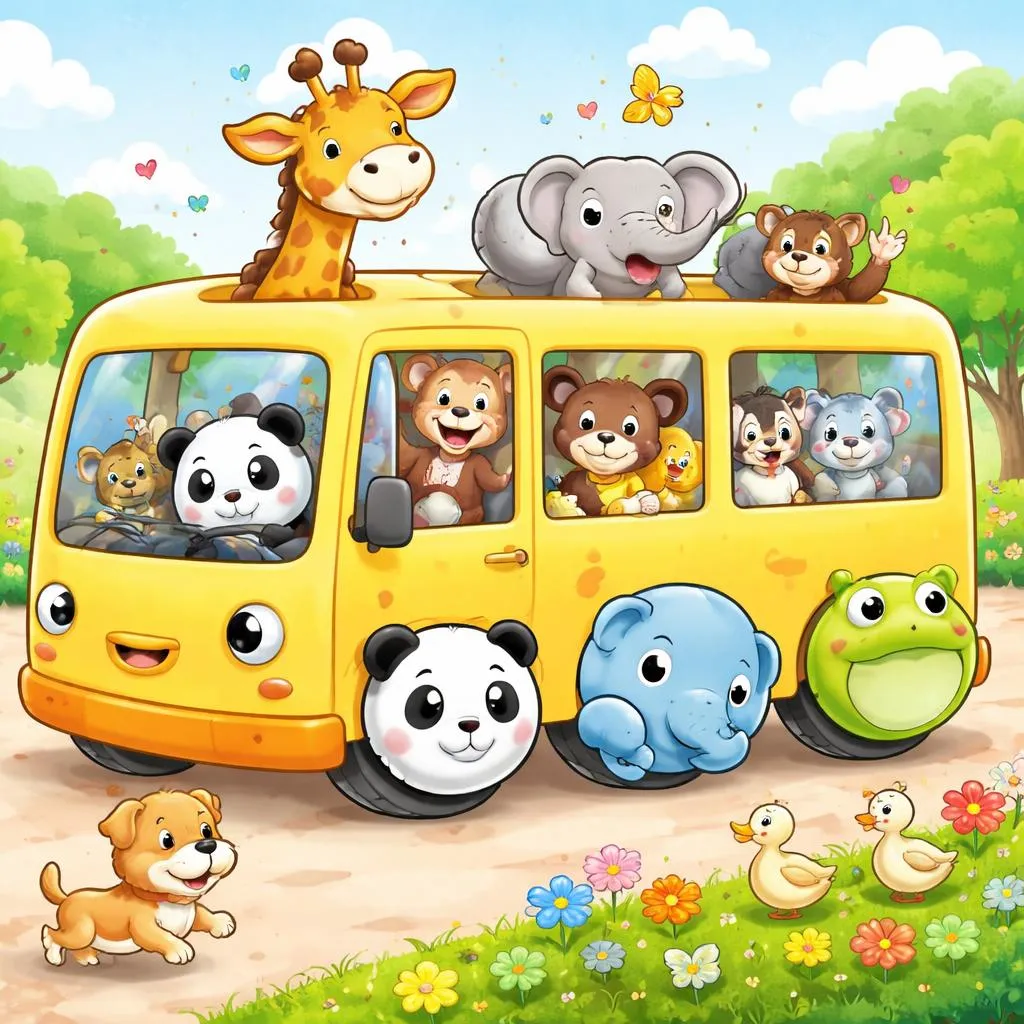

Hello, joyful teachers and happy young singers! Today we explore a delightful twist on a classic favorite. The beloved bus is back, but this time it is full of animals! The animal wheels on the bus version brings farm friends along for the ride. Children love making animal sounds. They love the silly combinations. This song teaches animal names and sounds. It builds vocabulary and phonemic awareness. It adds fun actions to a familiar tune. Let us discover this animal adventure together. Let us meet the cows, ducks, pigs, and more on board the busy bus.
What Is the Animal Wheels on the Bus Rhyme? The Animal Wheels on the Bus is a fun variation of the classic children's song "The Wheels on the Bus." Instead of people on the bus, this version has animals. Each animal makes its own special sound. The cows go moo. The ducks go quack. The pigs go oink. The sheep go baa.
This version combines two things children love: animals and music. The familiar tune makes it easy to learn. The animal sounds add variety and fun. Children can act out each animal as they sing.
The song keeps the same structure as the original. The wheels still go round and round. The wipers still go swish. But now different animals ride along. This flexibility lets teachers add any animals children suggest.
The Lyrics of the Nursery Rhyme Let us look at a common animal wheels on the bus lyrics. Many versions exist. Here is one that children enjoy.
The wheels on the bus go round and round, Round and round, round and round. The wheels on the bus go round and round, All through the town.
The cows on the bus go moo, moo, moo, Moo, moo, moo, moo, moo, moo. The cows on the bus go moo, moo, moo, All through the town.
The ducks on the bus go quack, quack, quack, Quack, quack, quack, quack, quack, quack. The ducks on the bus go quack, quack, quack, All through the town.
The pigs on the bus go oink, oink, oink, Oink, oink, oink, oink, oink, oink. The pigs on the bus go oink, oink, oink, All through the town.
The sheep on the bus go baa, baa, baa, Baa, baa, baa, baa, baa, baa. The sheep on the bus go baa, baa, baa, All through the town.
The chickens on the bus go cluck, cluck, cluck, Cluck, cluck, cluck, cluck, cluck, cluck. The chickens on the bus go cluck, cluck, cluck, All through the town.
The horses on the bus go neigh, neigh, neigh, Neigh, neigh, neigh, neigh, neigh, neigh. The horses on the bus go neigh, neigh, neigh, All through the town.
The wheels on the bus go round and round, Round and round, round and round. The wheels on the bus go round and round, All through the town.
Vocabulary Learning from the Song This animal version teaches many useful words. Let us explore them together.
Animal words: The song introduces different farm animals. Cows, ducks, pigs, sheep, chickens, horses. Children learn to name these common animals. Each animal has a name to remember.
Animal sounds: The song teaches what sounds each animal makes. Moo, quack, oink, baa, cluck, neigh. Children learn that animals communicate with different sounds. This builds phonemic awareness.
Vehicle words: The song retains the original vehicle vocabulary. Wheels, bus, town. Children review these words while enjoying the animal twist.
Action words: The song uses "go" with each animal. "The cows go moo." This simple pattern teaches that animals produce sounds.
Repetition: Each verse repeats the animal sound three times. This builds memory and anticipation. Children love joining in on the sounds.
Phonics Points in the Rhyme The animal sounds offer wonderful phonics practice. Let us look at some important sounds.
Listen to the "m" sound in "moo." The "m" sound is made with closed lips. Practice together. "M-m-moo." This sound appears in many animal words.
Listen to the "k" sound in "quack." The "k" sound is a quick, sharp sound. Practice together. "K-k-quack." This sound appears at the beginning of the duck's sound.
Listen to the "oi" sound in "oink." This is a special vowel combination. Practice together. "Oi-oi-oink." This sound is fun for children to make.
Listen to the "b" sound in "baa." The "b" sound is a quick popping sound. Practice together. "B-b-baa." Sheep say this soft sound.
The animal sounds are natural phonics practice. Each sound highlights different letter combinations. Children learn through playful repetition.
Grammar Patterns in the Song The song contains useful grammar patterns for young learners.
Plural nouns: The song uses plural animal names. Cows, ducks, pigs, sheep, chickens, horses. Children learn that we add -s to make most plurals. "Sheep" stays the same, which is a special case.
Present tense: The song uses present tense throughout. "The cows go moo." This describes what animals do. Children learn to talk about animal sounds.
Repetitive structure: Each verse follows the same pattern. This helps children predict language. They can create new verses using the structure.
Prepositional phrases: The song uses "on the bus" and "through the town." These show location and movement. Children learn to describe where things happen.
Learning Activities for the Song The song lends itself to many activities. Here are some ideas to extend learning.
Animal Puppets: Create simple animal puppets for each animal in the song. Cows, ducks, pigs, sheep, chickens, horses. Children hold up the matching puppet when that animal's verse comes. This makes the song visual and interactive.
Animal Sound Practice: Before singing, practice each animal sound. Make the sounds together. Talk about how each sound is made. This builds phonemic awareness and fun.
Animal Actions: Add movements for each animal. Flap arms like wings for chickens. Waddle like ducks. Gallop like horses. This adds physical activity to the singing.
Animal Parade: Line up like animals on a bus. March around the room while singing. When each animal's verse comes, that animal steps forward and makes its sound.
Printable Materials for the Song Printable resources support learning from the song. They provide visual reinforcement.
Animal Flashcards: Create flashcards for each animal in the song. Cow, duck, pig, sheep, chicken, horse. Each card has a picture and the word. Also include the sound each animal makes.
Animal Sound Matching Cards: Create cards with animal pictures and separate cards with sound words. Moo, quack, oink, baa, cluck, neigh. Children match each animal to its sound.
Bus Animal Cut-Outs: Create a bus template and animal cut-outs. Children place the animals on the bus as they sing. This builds fine motor skills and animal recognition.
Lyrics Poster: Create a colorful poster with the full lyrics. Add pictures of the animals on the bus. Display it during singing time.
Educational Games for the Song Games make learning from the song even more fun.
Animal Sound Bingo: Create bingo cards with animal pictures. Play animal sounds. Children cover the animal that makes that sound. This builds listening and animal recognition.
What Animal Am I?: Make an animal sound. Children guess which animal it is. "Moo!" "It's a cow!" This builds sound-animal association.
Animal Memory Game: Place animal picture cards face down. Children flip two trying to find matches. When they find a match, they make that animal's sound.
Animal Parade Game: Children choose an animal to be. They line up like on a bus. When their animal's verse comes, they make their sound and do their action. This builds listening and turn-taking.
New Animal Verses: Challenge children to create new verses with different animals. "The cats on the bus go meow, meow, meow!" "The dogs on the bus go woof, woof, woof!" This builds creativity and extends vocabulary.
Animal Sorting: Sort animal cards by different categories. Farm animals vs. pets. Animals with fur vs. animals with feathers. This builds classification skills.
Through this animal version, a classic song becomes new again. Children learn animal names and sounds. They practice phonics through playful noises. They move and act like their favorite farm friends. The animal wheels on the bus creates joy and learning together. Every animal adds a new sound and a new chance to participate. The bus becomes a friendly place where cows, ducks, and pigs ride along. Children want to sing it again and again.