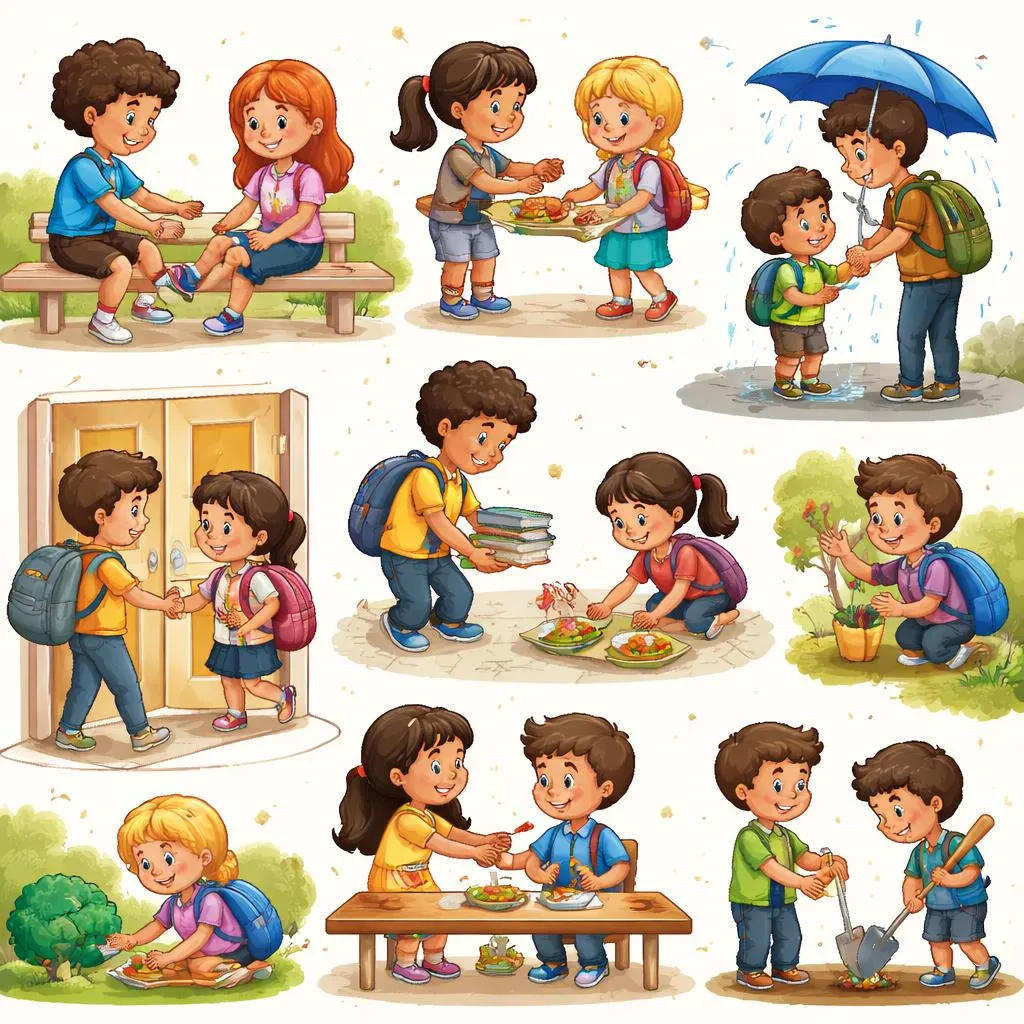

Fun Introduction
Last Monday, Mia saw a new girl. She felt kind to invite her to play. Mia walked over slowly. She smiled big. Later, Mia helped her dad fold laundry. She felt nice to sort socks. Both actions were good. But kind made her think of others. Nice made her feel happy inside. Mia asked her dad. Dad smiled and explained. Kind is like sharing your toys. Nice is like saying please and thank you. Let’s learn together.
Mia held out a jump rope. The girl joined in. Then Mia matched socks pairs. Her dad watched. He said kind helps people feel included. Nice helps people feel respected. Mia understood now. She skipped to the kitchen.
Word Breakdown
Core Principle
We reject boring dictionary definitions. We use pictures in your mind. We add functions and memory hooks. This helps you remember forever.
Kind To Do
Image: Imagine being kind to a lonely classmate. You sit beside them. That is kind to do. It means caring about feelings.
Function: It is for helping others. Like kind to share your lunch. Or kind to include someone.
Sensory Description: You hear soft words. You feel your heart warm. Your hands reach out.
Memory Anchor: A child offering a toy. See the gentle smile? That is kind to do.
Nice To Do
Image: Think of being nice to your teacher. You say “Have a great day.” That is nice to do. It means being polite and pleasant.
Function: It is for good manners. Like nice to hold the door. Or nice to say thank you.
Sensory Description: You hear cheerful tones. You feel a light bounce. Your lips curve up.
Memory Anchor: A kid waving goodbye. See the friendly wave? That is nice to do.
Advanced Comparison
Kind is deep and caring. Nice is light and polite. Kind helps hearts. Nice helps interactions. Use kind for empathy. Use nice for courtesy.
Scene Comparison
Scene One happens at school. Mia is kind to help Leo with math. She explains patiently. Leo understands. This is kind to do—caring support.
Scene Two takes place at home. Mia is nice to greet grandma. She hugs and smiles. Grandma beams. This is nice to do—polite warmth.
Scene Three occurs at the park. Ben is kind to include a new boy. He shares his ball. Mia is nice to thank the coach. She claps loudly. Notice the shift. Kind builds bridges. Nice smooths paths.
Pitfalls Deep Reminder
Mistake One is saying “I was kind to say excuse me.” Why wrong? Saying excuse me is polite. Kind is deeper care. Funny result? You write a long essay about manners. Correct phrase is I was nice to say it. Memory trick: Manners equal nice.
Mistake Two is saying “I was nice to donate my old toys.” Why wrong? Donating helps others deeply. Nice is too surface. Funny result? You just say “no problem.” Correct phrase is I was kind to donate. Memory trick: Deep help equals kind.
Mistake Three is saying “I was kind to hold the door.” Why wrong? Holding door is polite. Kind is for bigger care. Funny result? You expect a medal. Correct phrase is I was nice to hold it. Memory trick: Small politeness equals nice.
Mistake Four is saying “I was nice to comfort a crying friend.” Why wrong? Comforting needs deep care. Nice is too light. Funny result? You pat their shoulder and walk away. Correct phrase is I was kind to comfort them. Memory trick: Emotional support equals kind.
Interactive Exercises
Read each sentence. Think of the right phrase.
I was ___ to share my crayons. (kind/nice)
She was ___ to say good morning. (kind/nice)
We were ___ to help the lost toddler. (kind/nice)
He was ___ to thank the bus driver. (kind/nice)
They were ___ to include everyone in the game. (kind/nice)
Act with a friend. Use the phrases.
Scene A: Being Kind
A: I am kind to help you carry that.
B: Thank you for being so kind.
Scene B: Being Nice
A: I am nice to say hello to your mom.
B: My mom says you are very nice.
Spot the Mistake
Which sentence sounds odd? Explain why.
Sentence: I was kind to say please.
Reason: Please is polite. Use nice instead.
Sentence: I was nice to volunteer at the shelter.
Reason: Volunteering is deep care. Use kind instead.
Sentence: I was kind to smile at the neighbor.
Reason: Smiling is polite. Use nice instead.
Create Sentences
Use both phrases.
Kind to do: I am kind to stand up for my friend.
Nice to do: I am nice to say thank you.
Bonus Challenge
Your friend falls and scrapes their knee. Do you feel kind or nice? Answer: Kind. You help them feel better.
Rhyme Time
Kind is deep, nice is light.
One helps hearts, one helps right.
Deep care? Choose kind.
Polite words? Nice, defined.
Homework Task
Pick one activity. Complete it this week. Share with family.
Option One: Observation Journal. Get a small notebook. Draw three pictures. Write a sentence under each.
Picture One: You feel kind. Sentence: I was kind to help my sister.
Picture Two: You feel nice. Sentence: I was nice to say goodnight.
Picture Three: You feel kind. Sentence: I was kind to share my snack.
Show your journal to a parent. Explain the differences.
Option Two: Role Play. With a parent, act out moments. Use phrases correctly.
You: Mom, I am kind to listen to you.
Parent: That makes me feel loved.
You: Dad, I am nice to hold the door.
Parent: Good manners, well done.
Practice until it feels natural.
Option Three: Sharing Time. Tomorrow at school, tell a friend. Describe one kind and one nice. Say: Yesterday I was kind to help Leo. I was nice to greet the teacher. Ask your friend about theirs.
Life Practice
Week Challenge: Try one task. Complete within seven days. Share your success.
Task One: Observation Log. For three days, note kind and nice moments. Draw icons.
Day One: Kind moment. Draw a helping hand.
Day Two: Nice moment. Draw a smiling face.
Day Three: Kind moment. Draw a heart.
Show your log to your teacher. Place it on the classroom wall.
Task Two: Action Demo. Use both phrases in real actions.
Step One: Show kind gently. Say: I am kind to help you.
Step Two: Show nice cheerfully. Say: I am nice to say hi.
Demonstrate to a sibling. Explain the difference.
Task Three: Social Mission. Use phrases with others.
Feel kind to help a friend. Say: I am kind to stand by you.
Feel nice to help a friend. Say: I am nice to say good job.
Record a short voice message. Send it to your teacher.
Task Four: Creative Story. Write a short tale. Include both phrases.
Title: The Playground Hero.
Story: I was kind to include the new girl. Then I was nice to thank the coach. We all laughed.
Share your story in class.
Remember, practice makes perfect. Use these phrases often. Soon they will feel easy.