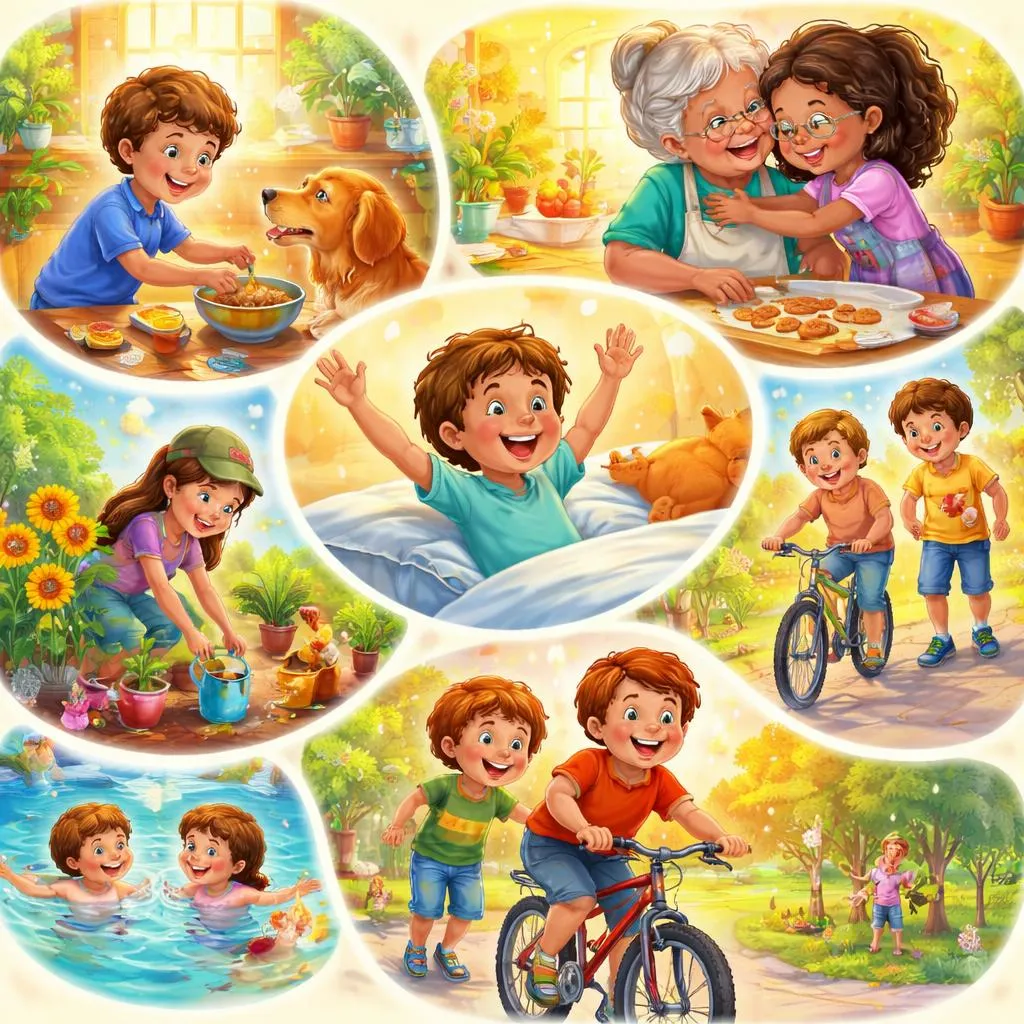

Fun Introduction
Last weekend, Mia got a surprise package. It was a new art set. She felt thankful to open it. Her eyes sparkled. Later, Mia’s grandma helped her with homework. She felt grateful to have such a kind grandma. Her heart felt warm. Both felt good. But thankful made her smile quickly. Grateful made her feel deep inside. Mia asked her dad. Dad smiled and explained. Thankful is like a quick thank you. Grateful is like a warm hug. Let’s learn together.
Mia ripped the paper. Colors burst out. She hugged the box. Then grandma showed a math trick. Mia understood easily. Her dad watched. He said thankful is for gifts. Grateful is for people. Mia understood now. She drew a picture.
Word Breakdown
Core Principle
We reject boring dictionary definitions. We use pictures in your mind. We add functions and memory hooks. This helps you remember forever.
Thankful To Do
Image: Imagine being thankful to get a cookie. You say “Thanks” with a big smile. That is thankful to do. It means feeling happy for something nice.
Function: It is for small nice things. Like thankful to get a toy. Or thankful to eat ice cream.
Sensory Description: You hear cheerful words. You feel a light bounce. Your lips curl up.
Memory Anchor: A kid holding a gift. See the bright smile? That is thankful to do.
Grateful To Do
Image: Think of being grateful to have a friend. You hug them tightly. That is grateful to do. It means feeling deep thanks for important things.
Function: It is for big life supports. Like grateful to have a family. Or grateful to stay healthy.
Sensory Description: You hear soft words. You feel a warm glow. Your heart feels full.
Memory Anchor: A child hugging a grandparent. See the peaceful look? That is grateful to do.
Advanced Comparison
Thankful is quick and light. Grateful is deep and lasting. Thankful uses smiles. Grateful uses hugs. Use thankful for small joys. Use grateful for big blessings.
Scene Comparison
Scene One happens at home. Mia is thankful to get a new book. She flips pages fast. She reads aloud. This is thankful to do—quick joy.
Scene Two takes place at grandma’s house. Mia is grateful to have grandma’s help. She listens carefully. She nods slowly. This is grateful to do—deep thanks.
Scene Three occurs at school. Ben is thankful to get extra recess. He runs outside. Mia is grateful to have a friend help her. She shares her snack. Notice the shift. Thankful celebrates moments. Grateful cherishes people.
Pitfalls Deep Reminder
Mistake One is saying “I was grateful to get a lollipop.” Why wrong? Lollipop is small. Grateful is too deep. Funny result? You write a long essay about candy. Correct phrase is I was thankful to get it. Memory trick: Small treats equal thankful.
Mistake Two is saying “I was thankful to have a safe home.” Why wrong? Home is huge. Thankful is too light. Funny result? You just say “cool” and play. Correct phrase is I was grateful to have it. Memory trick: Big supports equal grateful.
Mistake Three is saying “I was grateful to win a game.” Why wrong? Winning is fun. Grateful is for deep needs. Funny result? You cry tears of joy. Correct phrase is I was thankful to win. Memory trick: Fun wins equal thankful.
Mistake Four is saying “I was thankful to have my mom’s love.” Why wrong? Mom’s love is precious. Thankful is too quick. Funny result? You say “thanks” and run off. Correct phrase is I was grateful for her love. Memory trick: Precious gifts equal grateful.
Interactive Exercises
Read each sentence. Think of the right phrase.
I was ___ to get a new bicycle. (thankful/grateful)
She was ___ to have a loyal friend. (thankful/grateful)
We were ___ to eat warm soup. (thankful/grateful)
He was ___ to stay healthy all year. (thankful/grateful)
They were ___ to receive a birthday card. (thankful/grateful)
Act with a friend. Use the phrases.
Scene A: Feeling Thankful
A: I am thankful to play with you.
B: I am thankful too.
Scene B: Feeling Grateful
A: I am grateful for your help.
B: I am grateful to be your friend.
Spot the Mistake
Which sentence sounds odd? Explain why.
Sentence: I was grateful to get a sticker.
Reason: Sticker is small. Use thankful instead.
Sentence: I was thankful to have clean water.
Reason: Clean water is vital. Use grateful instead.
Sentence: I was grateful to win a prize.
Reason: Prize is fun. Use thankful instead.
Create Sentences
Use both phrases.
Thankful to do: I am thankful to eat pizza.
Grateful to do: I am grateful to have my family.
Bonus Challenge
Your friend shares their lunch. Do you feel thankful or grateful? Answer: Thankful. It is a kind act.
Rhyme Time
Thankful smiles, grateful hugs.
One is quick, one is snug.
Small joy? Choose thankful.
Big blessing? Grateful, full.
Homework Task
Pick one activity. Complete it this week. Share with family.
Option One: Observation Journal. Get a small notebook. Draw three pictures. Write a sentence under each.
Picture One: You feel thankful. Sentence: I was thankful to get a comic.
Picture Two: You feel grateful. Sentence: I was grateful to have my dad.
Picture Three: You feel thankful. Sentence: I was thankful to eat cookies.
Show your journal to a parent. Explain the differences.
Option Two: Role Play. With a parent, act out moments. Use phrases correctly.
You: Mom, I am thankful to have this snack.
Parent: You are welcome, dear.
You: Dad, I am grateful for your help.
Parent: I am always here for you.
Practice until it feels natural.
Option Three: Sharing Time. Tomorrow at school, tell a friend. Describe one thankful and one grateful. Say: Yesterday I was thankful to play soccer. I was grateful to have my friend. Ask your friend about theirs.
Life Practice
Week Challenge: Try one task. Complete within seven days. Share your success.
Task One: Observation Log. For three days, note thankful and grateful moments. Draw icons.
Day One: Thankful moment. Draw a smiling face.
Day Two: Grateful moment. Draw a heart.
Day Three: Thankful moment. Draw a jumping figure.
Show your log to your teacher. Place it on the classroom wall.
Task Two: Action Demo. Use both phrases in real actions.
Step One: Show thankful brightly. Say: I am thankful to do this.
Step Two: Show grateful warmly. Say: I am grateful to have this.
Demonstrate to a sibling. Explain the difference.
Task Three: Social Mission. Use phrases with others.
Feel thankful to help a friend. Say: I am thankful to play with you.
Feel grateful to help a friend. Say: I am grateful for your friendship.
Record a short voice message. Send it to your teacher.
Task Four: Creative Story. Write a short tale. Include both phrases.
Title: The Special Day.
Story: I was thankful to get a gift. Then I was grateful to share it with grandma. We laughed together.
Share your story in class.
Remember, practice makes perfect. Use these phrases often. Soon they will feel easy.