
Fun Introduction
Last Saturday, Mia flew her kite in the park. The wind pulled it into a tree. A branch tore a big hole. Mia patched the hole with colorful tape. The kite flew again quickly. Later, Mia repaired her broken toy robot. She used glue and tiny screws. The robot walked perfectly. Both actions fixed things. But patching was fast and simple. Repairing took time and tools. Mia wondered about the difference. She asked her dad. Dad smiled and explained. Patching covers damage temporarily. Repairing restores fully. Let’s learn together.
Mia felt happy in the sunlight. She held the patched kite. The tape shimmered. Then she wound the robot’s key. It marched across the floor. Her dad clapped. He said patching is like a band-aid. Repairing is like a doctor’s work. Mia understood now.
Word Breakdown
Core Principle
We reject boring dictionary definitions. We use pictures in your mind. We add functions and memory hooks. This helps you remember forever.
Patch To Do
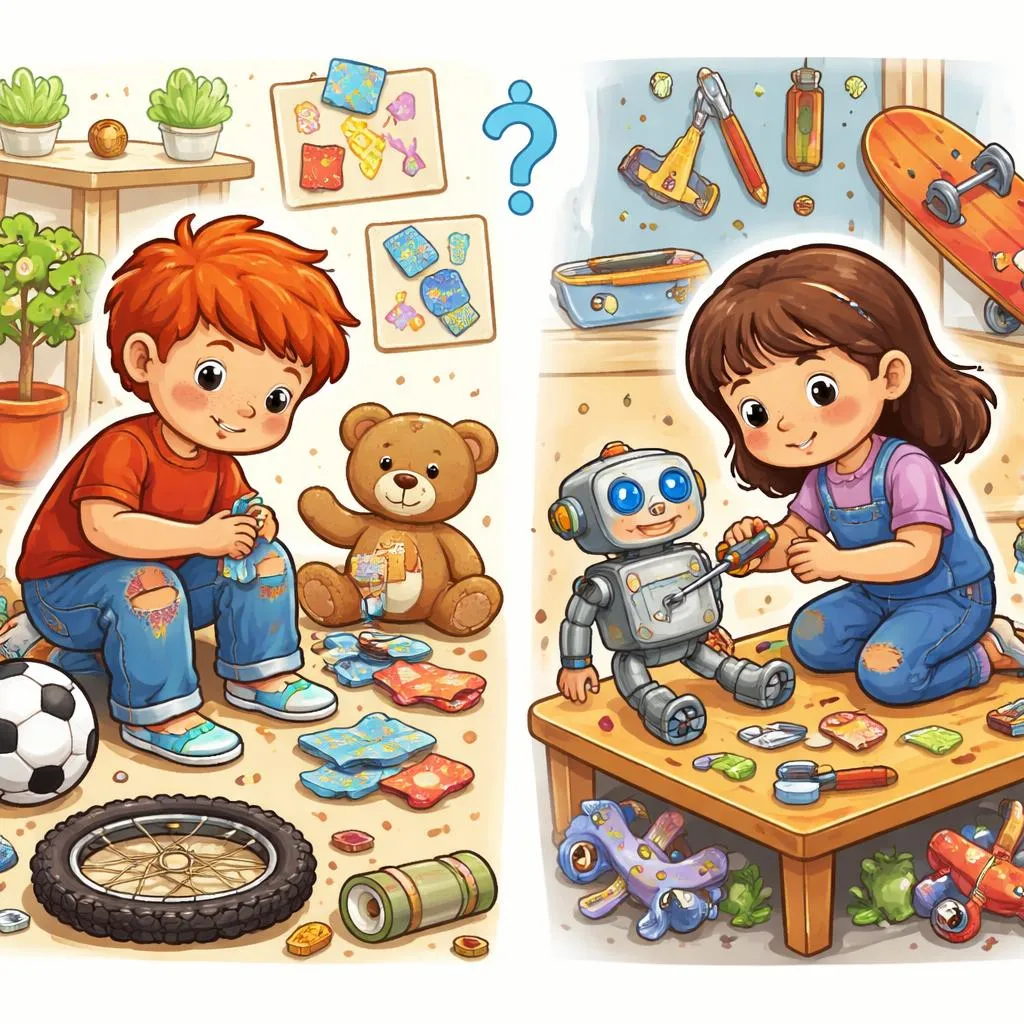
Image: Imagine patching a hole in your jeans. You stick a funny cartoon patch over it. That is patch to do. It means covering damage quickly.
Function: It is for temporary fixes. Like patch a tire. Or patch a wall.
Sensory Description: You see bright colors. You feel sticky tape. Your fingers move fast.
Memory Anchor: A knee with a band-aid. See the quick cover? That is patch to do.
Repair To Do
Image: Think of repairing a broken bicycle. You tighten bolts and oil chains. That is repair to do. It means fixing completely.
Function: It is for thorough restoration. Like repair a toy. Or repair a roof.
Sensory Description: You hear tools clinking. You feel sturdy parts. Your hands work carefully.
Memory Anchor: A mechanic fixing a car engine. See the serious work? That is repair to do.
Advanced Comparison
Patch covers quickly. Repair restores fully. Patch uses simple materials. Repair uses proper tools. Use patch for emergencies. Use repair for lasting fixes.
Scene Comparison
Scene One happens in the bedroom. Leo patches a torn comic book. He uses clear tape. The story continues. This is patch to do—quick cover.
Scene Two takes place in the garage. Emma repairs her skateboard. She replaces a cracked wheel. The board rolls smoothly. This is repair to do—full restoration.
Scene Three occurs at school. Ben patches a ripped poster. He adds a star sticker. Mia repairs a wobbly chair. She tightens screws. Notice the shift. Patching is fast. Repairing is thorough.
Pitfalls Deep Reminder
Mistake One is saying “I repaired my ripped sock with a band-aid.” Why wrong? Socks need patching. Repairing uses complex methods. Funny result? Band-aid falls off. Correct phrase is I patched my sock. Memory trick: Patch clothes.
Mistake Two is saying “I patched my broken bike chain with tape.” Why wrong? Bikes need repair. Patching is too weak. Funny result? Chain snaps again. Correct phrase is I repaired my bike chain. Memory trick: Repair machines.
Mistake Three is saying “I repaired the hole in my tent with a sticker.” Why wrong? Tents need patching. Repairing is overkill. Funny result? Sticker blows away. Correct phrase is I patched the tent. Memory trick: Patch fabric holes.
Mistake Four is saying “I patched the leaky faucet with gum.” Why wrong? Faucets need repair. Patching is temporary. Funny result? Gum washes out. Correct phrase is I repaired the faucet. Memory trick: Repair plumbing.
Interactive Exercises
Read each sentence. Think of the right word.
I will ___ my torn backpack with a cool patch. (patch/repair)
She ___ the broken lamp with a new cord. (patch/repair)
We ___ the hole in the wall with putty. (patch/repair)
He ___ the ripped kite with tape. (patch/repair)
They ___ the damaged toy with glue and screws. (patch/repair)
Act with a friend. Use the phrases.
Scene A: Patching Quickly
A: I need to patch this now.
B: Grab the tape and cover it.
Scene B: Repairing Thoroughly
A: I will repair this properly.
B: Get the right tools.
Spot the Mistake
Which sentence sounds odd? Explain why.
Sentence: I repaired my sock with a band-aid.
Reason: Socks need patching. Use patch instead.
Sentence: I patched my bike chain with tape.
Reason: Bike chains need repair. Use repair instead.
Sentence: I repaired the tent hole with a sticker.
Reason: Tent holes need patching. Use patch instead.
Create Sentences
Use both phrases.
Patch to do: I patch my jeans when they tear.
Repair to do: I repair my toys when they break.
Bonus Challenge
Your balloon pops. Do you patch or repair it? Answer: Patch. Quick cover.
Rhyme Time
Patch it fast, repair it right.
One covers quick, one makes it tight.
Quick fix? Choose patch.
Lasting fix? Repair, do not botch.
Homework Task
Pick one activity. Complete it this week. Share with family.
Option One: Observation Journal. Get a small notebook. Draw three pictures. Write a sentence under each.
Picture One: You patch something. Sentence: I patched my kite with tape.
Picture Two: You repair something. Sentence: I repaired my toy car with glue.
Picture Three: You patch something else. Sentence: I patched my book cover.
Show your journal to a parent. Explain the differences.
Option Two: Role Play. With a parent, act out moments. Use phrases correctly.
You: Mom, I will patch this hole in my shirt.
Parent: Use a fun patch that matches.
You: Dad, I will repair the loose wheel on my truck.
Parent: Tighten the screws firmly.
Practice until it feels natural.
Option Three: Sharing Time. Tomorrow at school, tell a friend. Describe one patch and one repair. Say: Yesterday I patched my poster. I repaired my pencil box. Ask your friend about theirs.
Life Practice
Week Challenge: Try one task. Complete within seven days. Share your success.
Task One: Observation Log. For three days, note patch and repair moments. Draw icons.
Day One: Patch a stuffed animal. Draw a teddy icon.
Day Two: Repair a toy. Draw a toy icon.
Day Three: Patch a piece of clothing. Draw a shirt icon.
Show your log to your teacher. Place it on the classroom wall.
Task Two: Action Demo. Use both phrases in real actions.
Step One: Patch quickly. Say: I patch to cover damage fast.
Step Two: Repair thoroughly. Say: I repair to fix completely.
Demonstrate to a sibling. Explain the difference.
Task Three: Social Mission. Use phrases with others.
Patch to help a friend. Say: I patch your torn book cover.
Repair to help a friend. Say: I repair your broken toy.
Record a short voice message. Send it to your teacher.
Task Four: Creative Story. Write a short tale. Include both phrases.
Title: The Fixed Kite.
Story: I patched my kite with tape. Then I repaired the string. It flew high again.
Share your story in class.
Remember, practice makes perfect. Use these phrases often. Soon they will feel easy.