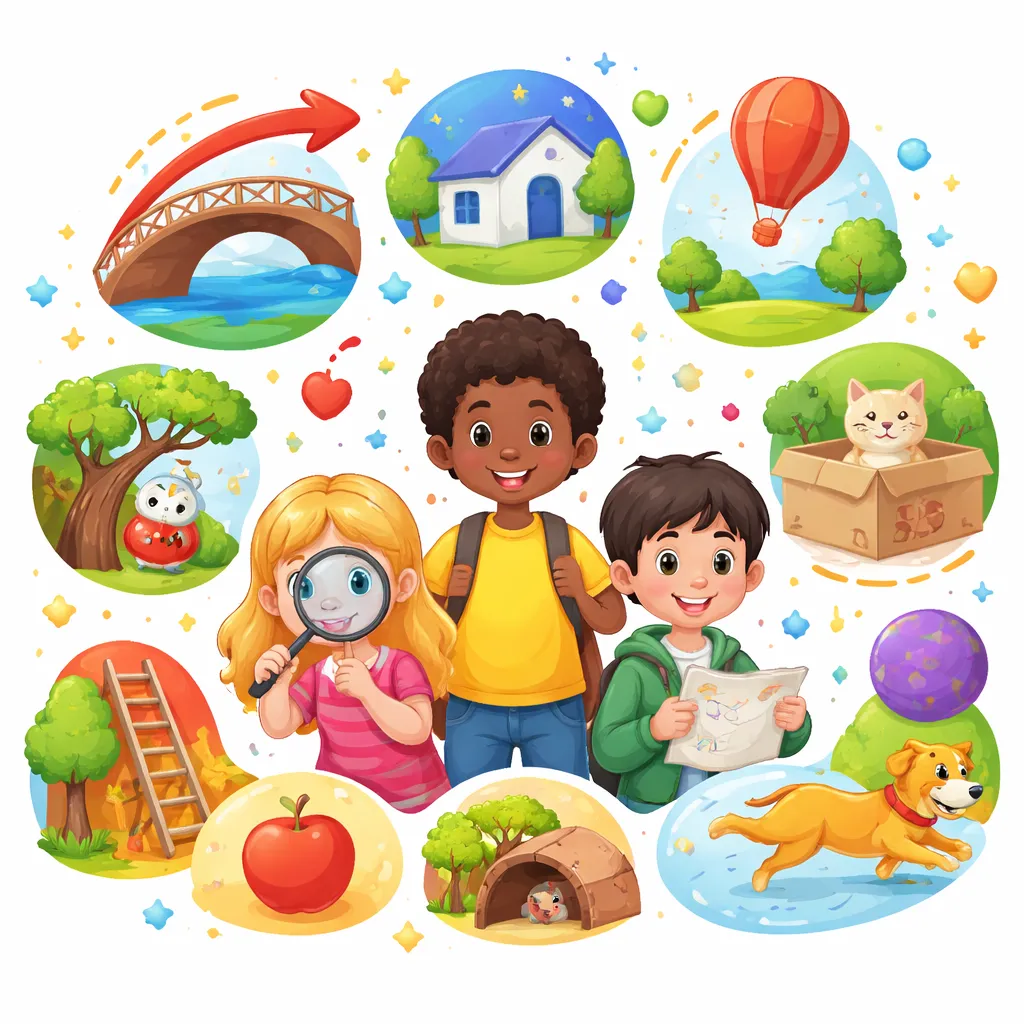

Your child uses prepositions constantly. Words like in, on, at, to, and for appear in almost every sentence. Prepositions show relationships between words. They tell where things are, when things happen, and how things connect. Mastering the top 100 prepositions for elementary students helps children use these essential little words correctly. This guide will explain what prepositions are, list the most important ones, and show how to practice them at home.
What Is a Preposition? A preposition is a word that shows the relationship between a noun or pronoun and another word in the sentence. Prepositions often tell us where something is, when something happens, or how things are connected. They are usually small words, but they carry important meaning.
Think about location prepositions. "The book is on the table." "The cat is under the bed." "She walked to the store." These prepositions tell us where things are in relation to other things.
Think about time prepositions. "I will see you at 3 o'clock." "We go to the park on Saturdays." "She was born in July." These prepositions tell us when things happen.
Prepositions are always part of a phrase. The preposition plus its noun or pronoun is called a prepositional phrase. On the table, under the bed, to the store are prepositional phrases. The top 100 prepositions for elementary students include the most common prepositions children need.
Meaning and Explanation: Why Prepositions Matter Prepositions are essential for clear communication. They tell us exactly where things are, when things happen, and how things relate. Without prepositions, sentences would be confusing and incomplete.
Think about giving directions without prepositions. "Put the book the table." That does not make sense. Add a preposition. "Put the book on the table." Now it is clear. Prepositions make the difference between understanding and confusion.
In stories, prepositions create scenes. "The treasure was hidden under the old oak tree, behind the big rock, near the flowing river." Without prepositions, we would not know where anything is.
In conversations, children need prepositions to express themselves. "I am going to Grandma's house." "The toy is under my bed." "I will be ready in five minutes." These little words carry big meaning. The top 100 prepositions for elementary students give children these essential tools.
Categories or Lists: The Top 100 Prepositions Here are the top 100 prepositions for elementary students, grouped by category. These are the words children use and encounter most often.
Prepositions of Place (25): These tell where something is. in, on, at, under, over, above, below, beneath, beside, between, among, behind, in front of, next to, near, far from, inside, outside, within, without, through, throughout, around, across, against. "The cat is under the chair." "She sat beside me."
Prepositions of Time (20): These tell when something happens. at, on, in, before, after, during, since, until, till, by, from, to, past, within, throughout, about, around, between, for, through. "We leave at noon." "I will wait until you come."
Prepositions of Direction (15): These tell where something is going. to, toward, into, onto, from, off, out of, through, across, along, past, up, down, around, throughout. "She walked into the room." "He fell off the bike."
Prepositions of Manner (10): These tell how something happens. with, without, like, as, by, in, on, through, via, per. "He wrote with a pencil." "She came without her coat."
Prepositions of Cause or Purpose (10): These tell why something happens. for, because of, due to, owing to, thanks to, through, from, out of, with, on account of. "We cancelled because of the rain." "She cried from happiness."
Compound Prepositions (10): These are made of two or more words. according to, in spite of, instead of, in addition to, in front of, on top of, next to, because of, in between, out of. "We played in spite of the rain." "Instead of pizza, we had pasta."
Other Common Prepositions (10): about, above, across, after, against, along, among, around, as, at. These are very common and have multiple uses.
The top 100 prepositions for elementary students include these essential words. Children will use them every day.
Daily Life Examples: Prepositions All Around Us Prepositions appear everywhere in daily life. Pointing them out helps children see that these little words are part of the real world, not just schoolwork.
In morning routines, we use prepositions constantly. "Put your feet in your shoes." "Sit at the table." "Pour milk into your bowl." "Your backpack is under the chair." "We leave after breakfast." Every direction uses prepositions.
During meals, prepositions tell us about food. "There is sauce on your shirt." "Put the napkin beside your plate." "The juice is in the refrigerator." "Save room for dessert."
In car rides, prepositions help us navigate. "We are going to the park." "Turn left at the light." "The store is across from the school." "We will be there in ten minutes."
At school, prepositions appear in instructions. "Write your name at the top." "Put your books in your desk." "Stand in a line." "Walk quietly down the hall."
In stories, prepositions create settings. "The princess lived in a castle by the sea." "The dragon slept under the mountain." "The knight rode through the forest." Without prepositions, we would not know where anything is.
The top 100 prepositions for elementary students help children notice and use these essential words.
Printable Flashcards: Visual Tools for Learning Flashcards make prepositions concrete. Creating and using them together turns learning into an activity. Here are some ways to use flashcards for preposition practice.
Create cards with prepositions on one side and example sentences on the other. "in" on front. Back: "The toy is in the box." "on" on front. Back: "The book is on the table." "under" on front. Back: "The cat is under the chair."
Create picture cards showing relationships. Draw a box and a ball. Show the ball in the box. Show the ball on the box. Show the ball under the box. Show the ball beside the box. Your child identifies the preposition for each picture.
Create opposite cards that pair prepositions with their opposites. Match "in" with "out." Match "on" with "off." Match "above" with "below." Match "before" with "after." This builds vocabulary through relationships.
Create sentence cards with the preposition missing. "The cat is ___ the table." (under, on, beside) "We will go ___ the store." (to, into) "She arrived ___ noon." (at, before, after) Your child fills in possible prepositions.
Learning Activities or Games: Making Prepositions Fun Games turn grammar into play. Here are some games that help children practice the top 100 prepositions for elementary students in enjoyable ways.
Where Is It Game: Hide an object and give clues using prepositions. "It is under something." "It is behind the couch." "It is next to the lamp." Your child follows the clues to find it. Then switch roles.
Simon Says with Prepositions: Play Simon Says using prepositions. "Simon says put your hand on your head." "Simon says put your foot under your chair." "Put your pencil in your book." If Simon didn't say it, don't do it. This practices listening and following directions with prepositions.
Preposition Hunt: Read a book together and search for prepositions. Each time you find one, write it down. See how many different prepositions you can find in one page. Talk about what relationship each one shows.
Draw It Game: Give your child instructions using prepositions and have them draw. "Draw a tree in the middle of the page." "Draw a bird on the tree." "Draw a dog under the tree." "Draw clouds above the tree." Compare drawings to see if they followed the prepositions correctly.
Opposite Game: Say a preposition and have your child say its opposite. "in" becomes "out." "on" becomes "off." "above" becomes "below." "before" becomes "after." This builds vocabulary through contrast.
Preposition Bingo: Create bingo cards with prepositions in each square. Call out sentences. "The cat is sleeping on the bed." Your child covers "on." "We will meet at noon." Your child covers "at." First to get five in a row wins.
Moving Around Game: Practice movement prepositions by actually moving. "Go to the door." "Walk through the doorway." "Stand beside the table." "Crawl under the table." "Jump over this line." Physical movement makes prepositions memorable.
Story Building with Prepositions: Build a story together using prepositional phrases. "Once upon a time, in a faraway kingdom, there lived a dragon under a mountain." "A knight rode through the forest toward the mountain." "He climbed up the rocks and looked into the cave." The story grows while preposition practice happens.
As your child becomes familiar with the top 100 prepositions for elementary students, their sentences become clearer and more precise. They can tell exactly where things are and when things happen. They can follow directions and give them. Prepositions are small words, but they do big work. Keep practice connected to real locations and movements. Talk about where things are around the house. Give directions using prepositions. Celebrate when your child uses a new preposition correctly. These relationship words help them understand and describe the world.