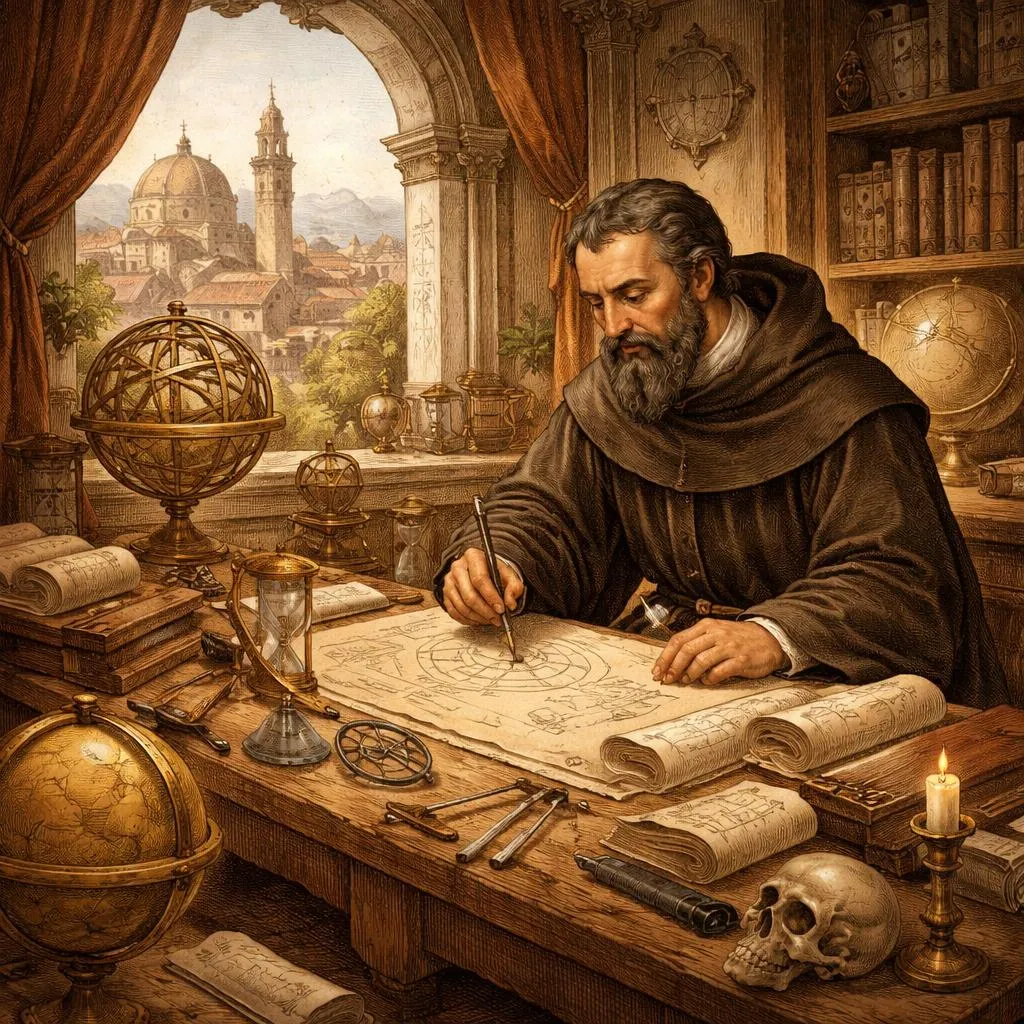

Almost contemporaneously with the publication in 1637 of Descartes' geometry, the principles of the integral calculus, so far as they are concerned with summation, were being worked out in Italy. This was effected by what was called the principle of indivisibles, and was the invention of Cavalieri. It was applied by him and his contemporaries to numerous problems connected with the quadrature of curves and surfaces, the determination on volumes, and the positions of centres of mass. It served the same purpose as the tedious method of exhaustions used by the Greeks; in principle the methods are the same, but the notation of indivisibles is more concise and convenient. It was, in its turn, superceded at the beginning of the eighteenth century by the integral calculus.
Bonaventura Cavalieri was born at Milan in 1598, and died at Bologna on November 27, 1647. He became a Jesuit at an early age; on the recommendation of the Order he was in 1629 made professor of mathematics at Bologna; and he continued to occupy the chair there until his death. I have already mentioned Cavalieri's name in connection with the introduction of the use of logarithms into Italy, and have alluded to his discovery of the expression for the area of a spherical triangle in terms of the spherical excess. He was one of the most influential mathematicians of his time, but his subsequent reputation rests mainly on his invention of the principle of indivisibles.
The principle of indivisibles had been used by Kepler in 1604 and 1615 in a somewhat crude form. It was first stated by Cavalieri in 1629, but he did not publish his results till 1635. In his early enunciation of the principle in 1635 Cavalieri asserted that a line was made up of an infinite number of points (each without magnitude), a surface of infinite number of lines (each without breadth), and a volume of an infinite number of surfaces (each without thickness). To meet the objections of Guldinus and others, the statement was recast, and in its final form as used by the mathematicians of the seventeenth century it was published in Cavalieri's Exercitationes Geometricae in 1647; the third exercise is devoted to a defence of the theory. This book contains the earliest demonstration of the properties of Pappus. Cavalieri's works on indivisibles were reissued with his later corrections in 1653.
The method of indivisibles rests, in effect, on the assumption that any magnitude may be divided into an infinite number of small quantities which can be made to bear any required ratios ( ex. gr. equality) one to the other. The analysis given by Cavalieri is hardly worth quoting except as being one of the first steps taken towards the formation of an infinitesimal calculus. One example will suffice. Suppose it be required to find the area of a right-angled triangle. Let the base be made up of, or contain n points (or indivisibles), and similarly let the other side contain na points, then the ordinates at the successive points of the base will contain a , 2 a ..., na points. Therefore the number of points in the area is a + 2 a + ... + na ; the sum of which is 1/2 n 2 a + 1/2 na . Since n is very large, we may neglect 1/2 na for it is inconsiderable compared with 1/2 n 2 a . Hence the area is equal to 1/2( na ) n , that is, 1/2 x altitude x base. There is no difficulty in criticizing such a proof, but, although the form in which it is presented is indefensible, the substance of it is correct.
It would be misleading to give the above as the only specimen of the method of indivisibles, and I therefore quote another example, taken from a later writer, which will fairly illustrate the use of the method when modified and corrected by the method of limits.
Let it be required to find the area outside a parabola APC and bounded by the curve, the tangent at A , and a line DC parallel to AB the diameter at A . Complete the parallelogram ABCD . Divide AD into n equal parts, let AM contain r of them, and let MN be the ( r + 1)th part. Draw MP and NQ parallel to AB , and draw PR parallel to AD . Then when n becomes indefinitely large, the curvilinear area APCD will be the the limit of the sum of all parallelograms like PN . Now
area PN : area BD = MP . MN : DC . AD .
But by the properties of the parabola
MP : DC = AM 2 : AD 2 = r 2 : n 2 ,
and MN : AD = 1 : n . Hence MP . MN : DC . AD = r 2 : n 3 . Therefore area PN : area BD = r 2 : n 3 . Therefore, ultimately,
area APCD : area BD = 1 2 + 2 2 + ... + (n-1) 2 : n 3 = 1/6 n (n-1)(2n-1) : n 3
which, in the limit, = 1 : 3.
It is perhaps worth noticing that Cavalieri and his successors always used the method to find the ratio of two areas, volumes, or magnitudes of the same kind and dimensions, that is, they never thought of an area as containing so many units of area. The idea of comparing a magnitude with a unit of the same kind seems to have been due to Wallis.
It is evident that in its direct form the method is applicable to only a few curves. Cavalieri proved that, if m be a positive integer, then the limit, when n is infinite, of (1 m + 2 m + ... + n m )/ n m+1 is 1/( m +1), which is equivalent to saying that he found the integral of x to x m from x = 0 to x = 1; he also discussed the quadrature of the hyperbola.
背景與作者介紹
本文介紹了 Bonaventura Cavalieri 的先驅性工作,他是十七世紀初期數學史上的重要人物。 Cavalieri 於 1598 年出生於米蘭,是一位耶穌會神父,也是博洛尼亞大學的數學教授。 他的工作為積分學奠定了基礎,積分學是數學的一個分支,涉及將無窮多個小量相加,以求得面積、體積和其他量。 Cavalieri 的不可分量原理是一個革命性的想法,幫助數學家超越古希臘的窮竭法,提供了一種更簡單、更靈活的方法來計算面積和體積。
理解不可分量原理
Cavalieri 的原理指出,一條線由無窮多個點組成,一個面由無窮多條線組成,一個體積由無窮多個面組成。 乍一看,這個想法可能聽起來很抽象,甚至令人困惑,但它是現代微積分中積分概念的關鍵一步。 通過將形狀想像成由無窮薄的切片或點組成,Cavalieri 可以通過比較不同形狀之間的這些切片來計算面積和體積。
例如,為了找到一個直角三角形的面積,Cavalieri 想像底邊由許多點組成,高度包含成比例的點數。 通過將這些點相加,他得出了三角形面積的熟悉公式:底邊乘以高度的一半。 儘管他的方法缺乏我們今天所期望的嚴謹性,但其基本思想是正確的,並為未來的數學家鋪平了道路。
重要性和影響
Cavalieri 的工作之所以重要,是因為它引入了一種新的思考幾何和測量的方法,這種方法比以前的方法更直觀,也更不笨拙。 他的不可分量原理預示了後來牛頓和萊布尼茨發展的積分學。 這種方法使數學家能夠解決以前非常困難或不可能處理的涉及曲線和曲面的問題。
他的工作也影響了對拋物線、球體和雙曲線的研究,擴展了對這些形狀及其性質的理解。 Cavalieri 的方法幫助彌合了幾何學和代數學之間的差距,從而產生了今天科學和工程中使用的強大的數學工具。
學生可以學到什麼
-
數學創造力和創新: Cavalieri 的故事表明新想法如何經常建立在舊想法之上。 他採用了古希臘的窮竭法,並通過將形狀想像成由不可分割的部分組成來改進它。 這教導學生創造性思維的價值,並從新的角度看待問題。
-
微積分的基礎: 雖然微積分可能看起來很複雜,但 Cavalieri 的原理提供了一個簡單的介紹,介紹了將無窮多個小部分相加來找到整體的概念。 理解這一原理有助於學生欣賞微積分的起源和重要性。
-
歷史背景: 學習 Cavalieri 有助於學生了解數學是如何隨著時間的推移發展的,以及不同的文化如何為知識做出貢獻。 它還表明科學和宗教是如何共存的,因為 Cavalieri 是一位耶穌會神父和數學家。
-
解決問題: 給出的例子,例如找到拋物線下的面積,說明了數學推理如何解決實際問題。 學生可以學習應用邏輯步驟並使用近似值來處理複雜的問題。
在生活和學習中應用這些課程
-
在學校: 學生可以使用 Cavalieri 的原理作為理解微積分課程中積分的墊腳石。 它鼓勵將複雜的問題分解成更小、更容易管理的部分,這是一項在任何科目中都有用的技能。
-
在日常生活中: 將小部分相加來理解整體的想法可以應用於預算、烹飪或規劃項目。 例如,通過將任務劃分為更小的部分來管理時間,這反映了不可分割的方法。
-
在社交場合: Cavalieri 對信仰和科學的奉獻表明了平衡生活不同方面和尊重不同知識領域的重要性。 學生可以學會欣賞多種觀點並跨學科合作。
從 Cavalieri 的工作中培養積極的特質
-
好奇心和開放的心態: Cavalieri 探索新想法的意願鼓勵學生保持好奇心並樂於學習,即使概念看起來很困難或不熟悉。
-
毅力: 他的工作最初受到批評,並且沒有被完全接受,但他繼續完善他的想法。 這教導了在面對挑戰時堅持不懈的價值。
-
分析性思維: 不可分量的方法需要仔細的分析和邏輯推理,這些技能在學術和日常決策中都很有價值。
結論
Bonaventura Cavalieri 的不可分量原理不僅僅是一種數學技術;它是一個關於創新、毅力和人類理解演變的故事。 對於學生來說,它提供了對微積分起源和不同思考力量的一瞥。 通過研究他的工作,年輕的學習者可以深入了解解決問題、科學史以及將創造力與邏輯相結合的重要性。 這些課程超越了數學,鼓勵一種好奇、堅持和分析的心態——這些品質將在他們生活的各個方面為他們提供幫助。
