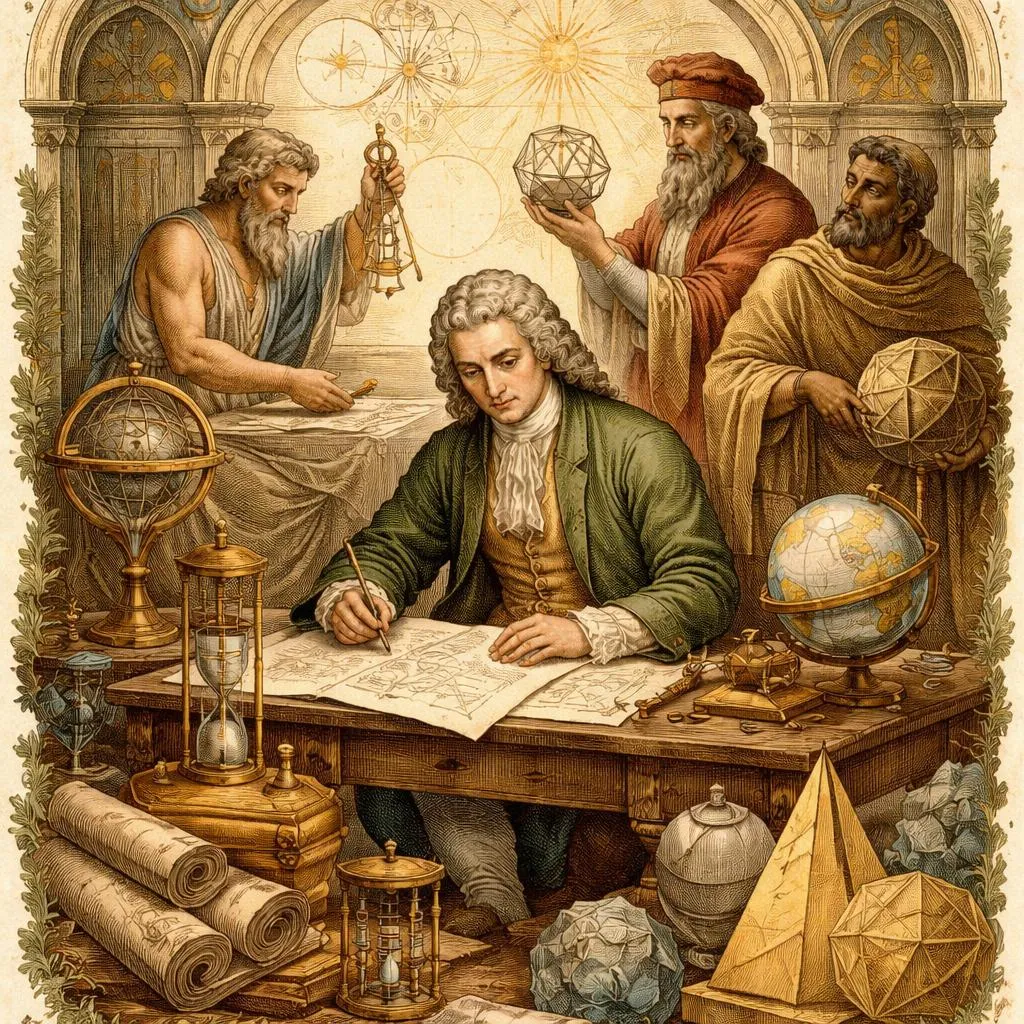

Brook Taylor, born at Edmonton on August 18, 1685, and died in London on December 29, 1731, was educated at St. John's College, Cambridge, and was among the most enthusiastic of Newton's admirers. From the year 1712 onwards he wrote numerous papers in the Philosophical Transactions , in which, among other things, he discussed the motion of projectiles, the centre of oscillation, and the forms taken by liquids when raised by capillarity. In 1719 he resigned the secretaryship of the Royal Society and abandoned the study of mathematics. His earliest work, and that by which he is generally known, is his Methodus Incrementorum Directa et Inversa , published in London in 1715. This contains [prop. 7] a proof of the well-known theorem
f ( x + h ) = f ( x ) + hf′ ( x ) + h 2 /2! f ″( x ) + ... ,
by which a function of a single variable can be expanded in powers of it. He does not consider the convergency of the series, and the proof which involves numerous assumptions is not worth reproducing. The work also includes several theorems on interpolation. Taylor was the earliest writer to deal with theorems on the change of the independent variable; he was perhaps the first to realize the possibility of a calculus of operation, and just as he denotes the n th differential coefficient of y by y n so he uses y -1 to represent the integral of y ; lastly, he is usually recognized as the creator of the theory of finite differences.
The applications of the calculus to various questions given in the Methodus have hardly received that attention they deserve. The most important of them is the theory of the transverse vibrations of strings, a problem which had baffled previous investigators. In this investigation Taylor shews that the number of half-vibrations executed in a second is
where L is the length of the string, N its weight, P the weight which stretches it, and D the length of a seconds pendulum. This is correct, but in arriving at it he assumes that every point of the string will pass through its position of equilibrium at the same instant, a restriction which D'Alembert subsequently shewed to be unnecessary. Taylor also found the form which the string assumes at any instant.
The Methodus also contains the earliest determination of the differential equation of the path of a ray of light when traversing a heterogeneous medium; and, assuming that the density of the air depends only in its distance from the earth's surface, Taylor obtained by means of quadratures the approximate form of the curve. The form of the catenary and the determination of the centres of oscillation and percussion are also discussed.
A treatise on perspective by Taylor, published in 1719, contains the earliest general enunciation of the principle of vanishing points; though the idea of vanishing points for horizontal and parallel lines in a picture hung in a vertical plane had been enunciated by Guido Ubaldi in his Perspectivae Libri , Pisa, 1600, and by Stevinus in his Sciagraphia , Leyden, 1608.
介紹布魯克·泰勒及其作品
布魯克·泰勒是一位傑出的數學家,於 1685 年出生於英國埃德蒙頓。 他曾在劍橋大學學習,並且是艾薩克·牛頓爵士(歷史上最著名的科學家之一)的忠實仰慕者。 泰勒對數學做出了重要貢獻,尤其是在微積分領域,微積分是處理變化和運動的數學分支。 他最著名的著作《Methodus Incrementorum Directa et Inversa》(1715 年)引入了我們現在稱之為泰勒級數的東西——一種將函數表示為從函數導數計算出的項的無限和的方法。
泰勒作品的背景和創作
在 18 世紀初期,數學發展迅速。 科學家和數學家渴望通過精確的計算和公式來了解自然世界。 泰勒的作品出現在微積分仍然是新事物,並由牛頓和萊布尼茨等偉人發展的時代。 泰勒通過形式化思想做出了貢獻,幫助數學家和科學家解決涉及運動、光和振動的複雜問題。
理解泰勒的貢獻
泰勒定理允許我們用更簡單的多項式表達式來逼近複雜的函數。 這在物理學、工程學和計算機科學中非常有用,因為它使計算更容易、更易於管理。 例如,在研究樂器琴弦的振動或光線穿過不同材料的路徑時,泰勒公式有助於準確預測行為。
他還研究了有限差分理論,這是一種用於研究序列和函數變化的方法,為今天計算機中使用的數值分析奠定了基礎。
泰勒發現的意義
泰勒的重要成就之一是分析琴弦的振動,這有助於解釋樂器如何發出聲音。 他表明振動的頻率取決於琴弦的長度、重量和張力。 這種理解是聲學和樂器設計的基礎。
泰勒還探索了光線如何穿過不同密度的空氣,為光學(光的研究)做出了貢獻。 他在藝術透視方面的研究引入了消失點的原理,藝術家們用它來在平面上創建逼真的三維圖像。
給學生的教訓和啟發
研究泰勒的生活和工作,我們可以學到幾個寶貴的教訓:
- 好奇心和毅力: 泰勒致力於理解複雜問題,這表明了在學習中保持好奇心和堅持不懈的重要性。
- 跨學科思維: 他的作品結合了數學、物理學,甚至藝術,展示了在一個領域的知識如何增強在另一個領域的理解。
- 現代科學的基礎: 泰勒的發現是許多現代技術的基石,提醒我們基礎知識對於創新至關重要。
學生如何應用這些教訓
- 在學習中: 當面臨困難的科目時,學生應該記住泰勒的例子,並不斷探索不同的方法,直到找到解決方案。
- 在解決問題中: 使用像泰勒級數這樣的逐步方法可以幫助將複雜的問題分解為易於管理的部分。
- 在創造力中: 理解透視等原理可以提高藝術技能,而數學思維可以增強邏輯推理能力。
培養積極的態度和技能
泰勒的生活鼓勵學生培養:
- 分析性思維: 邏輯地、仔細地分解問題。
- 開放的心態: 願意探索新想法並挑戰假設。
- 注重細節: 精確性在數學和日常任務中都很重要。
結論
布魯克·泰勒的貢獻超越了數學;它們激發了一種探索、創造力和韌性的思維方式。 通過學習他的作品,學生不僅獲得知識,還獲得寶貴的技能和態度,這些技能和態度可以幫助他們在學校、社交生活和未來的職業生涯中取得成功。 擁抱發現的精神和學習的樂趣可以帶來巨大的成就,就像泰勒一樣。
