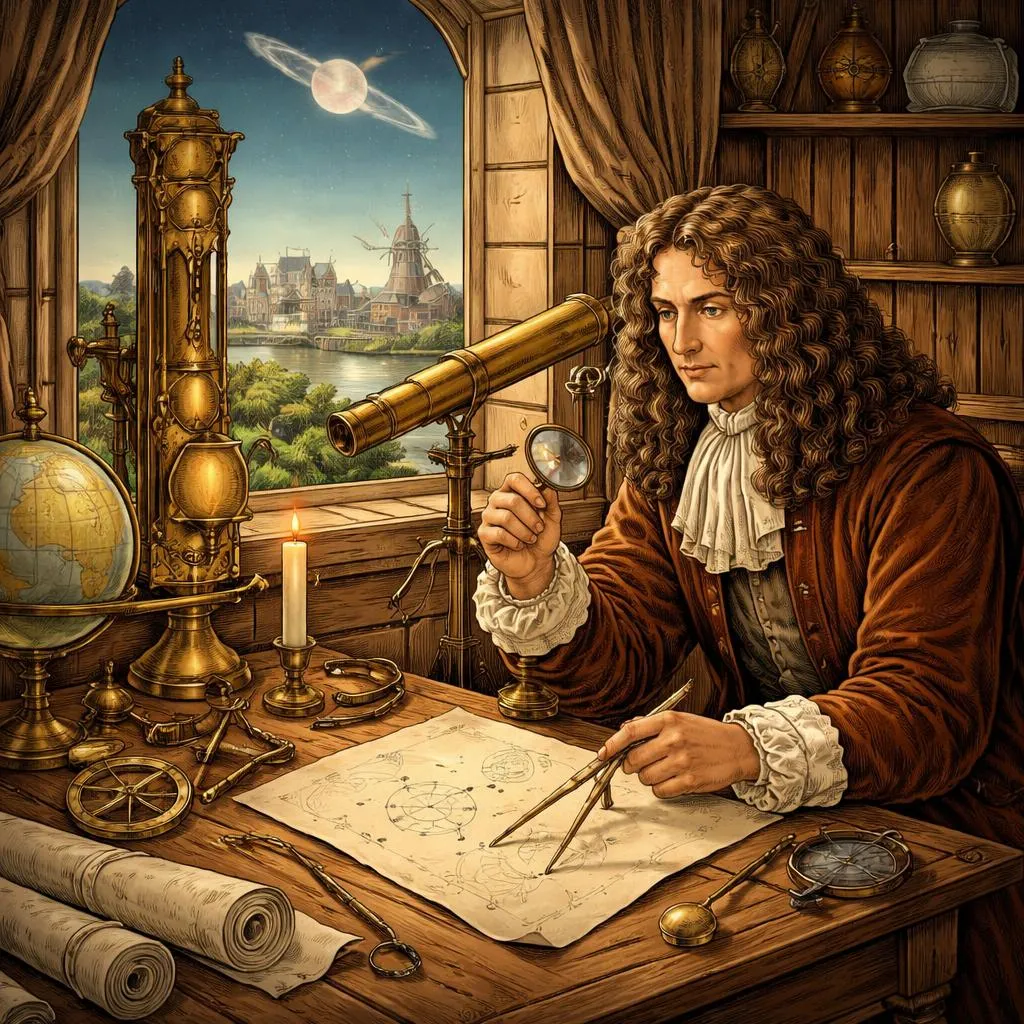

Christian Huygens was born at the Hague on April 14, 1629, and died in the same town on July 8, 1695. He generally wrote his name as Hugens, but I follow the usual custom in spelling it as above: it is also sometimes written as Huyghens. His life was uneventful, and there is little more to record in it than a statement of his various memoirs and researches.
In 1651 he published an essay in which he shewed the fallacy in a system of quadratures proposed by Grégoire de Saint-Vincent, who was well versed in the geometry of the Greeks, but had not grasped the essential points in the more modern methods. This essay was followed by tracts on the quadrature of the conics and the approximate rectification of the circle.
In 1654 his attention was directed to the improvement of the telescope. In conjunction with his brother he devised a new and better way of grinding and polishing lenses. As a result of these improvements he was able during the following two years, 1655 and 1656, to resolve numerous astronomical questions; as, for example, the nature of Saturn's appendage. His astronomical observations required some exact means of measuring time, and he was thus led in 1656 to invent the pendulum clock, as described in his tract Horologium , 1658. The time-pieces previously in use had been balance-clocks.
In the year 1657 Huygens wrote a small work on the calculus of probabilities founded on the correspondence of Pascal and Fermat. He spent a couple of years in England about this time. His reputation was now so great that in 1665 Louis XIV offered him a pension if he would live in Paris, which accordingly then became his place of residence.
In 1668 he sent to the Royal Society of London, in answer to a problem they had proposed, a memoir in which (simultaneously with Wallis and Wren) he proved by experiment that the momentum in a certain direction before the collision of two bodies is equal to the momentum in that direction after the collision. This was one of the points in mechanics on which Descartes had been mistaken.
The most important of Huygens's work was his Horologium Oscillatorium published at Paris in 1673. The first chapter is devoted to pendulum clocks. The second chapter contains a complete account of the descent of heavy bodies under their own weights in a vacuum, either vertically down or on smooth curves. Amongst other propositions he shews that the cycloid is tautochronous. In the third chapter he defines evolutes and involutes, proves some of their more elementary properties, and illustrates his methods by finding the evolutes of the cycloid and the parabola. These are the earliest instances in which the envelope of a moving line was determined. In the fourth chapter he solves the problem of the compound pendulum, and shews that the centres of oscillation and suspension are interchangeable. In the fifth and last chapter he discusses again the theory of clocks, points out that if the bob of the pendulum were, by means of cycloidal clocks, made to oscillate in a cycloid the oscillations would be isochronous; and finishes by shewing that the centrifugal force on a body which moves around a circle of radius r with a uniform velocity v varies directly as v 2 and inversely as r . This work contains the first attempt to apply dynamics to bodies of finite size, and not merely to particles.
In 1675 Huygens proposed to regulate the motion of watches by the use of the balance spring, in the theory of which he had been perhaps anticipated in a somewhat ambiguous and incomplete statement made by Hooke in 1658. Watches or portable clocks had been invented early in the sixteenth century, and by the end of that century were not very uncommon, but they were clumsy and unreliable, being driven by a main spring and regulated by a conical pulley and verge escapement; moreover, until 1687 they had only one hand. The first watch whose motion was regulated by a balance spring was made at Paris under Huygens's directions, and presented by him to Louis XIV.
The increasing intolerance of the Catholics led to his return to Holland in 1681, and after the revocation of the edict of Nantes he refused to hold any further communication with France. He now devoted himself to the construction of lenses of enormous focal length: of these three of focal lengths 123 feet, 180 feet, and 210 feet, were subsequently given by him to the Royal Society of London, in whose possession they still remain. It was about this time that he discovered the achromatic eye-piece (for a telescope) which is known by his name. In 1689 he came from Holland to England in order to make the acquaintance of Newton, whose Principia had been published in 1687. Huygens fully recognized the intellectual merits of the work, but seems to have deemed any theory incomplete which did not explain gravitation by mechanical means.
On his return in 1690 Huygens published his treatise on light in which the undulatory theory was expounded and explained. Most of this had been written as early as 1678. The general idea of the theory had been suggested by Robert Hooke in 1664, but he had not investigated its consequences in any detail. Only three ways have been suggested in which light can be produced mechanically. Either the eye may be supposed to send out something which, so to speak, feels the object (as the Greeks believed); or the object perceived may send out something which hits or affects the eye (as assumed in the emission theory); or there may be some medium between the eye and the object, and the object may cause some change in the form or condition of this intervening medium and thus affect the eye (as Hooke and Huygens supposed in the wave or undulatory theory). According to this last theory space is filled with an extremely rare ether, and light is caused by a series of waves or vibrations in this ether which are set in motion by the pulsations of the luminous body. From this hypothesis Huygens deduced the laws of reflexion and refraction, explained the phenomenon of double refraction, and gave a construction for the extraordinary ray in biaxal crystals; while he found by experiment the chief phenomena of polarization.
The immense reputation and unrivalled powers of Newton led to disbelief in a theory which he rejected, and to the general adoption of Newton's emission theory. Within the present century crucial experiments have been devised which give different results according as one or the other theory is adopted; all these experiments agree with the results of the undulatory theory and differ from the results of the Newtonian theory; the latter is therefore untenable. Until, however, the theory of interference, suggested by Young, was worked out by Fresnel, the hypothesis of Huygens failed to account for all the facts, and even now the properties which, under it, have to be attributed to the intervening medium or ether involve difficulties of which we still seek a solution. Hence the problem as to how the effects of light are really produced cannot be said to be finally solved.
Besides these works Huygens took part in most of the controversies and challenges which then played so large a part in the mathematical world, and wrote several minor tracts. In one of these he investigated the form and properties of the catenary. In another he stated in general terms the rule for finding maxima and minima of which Fermat had made use, and shewed that the subtangent of an algebraical curve f ( x,y ) = 0 was equal to yf y / f x , where f y is the derived function of f ( x,y ) regarded as a function of y . In some posthumous works, issued at Leyden in 1703, he further shewed how from the focal lengths of the component lenses the magnifying power of a telescope could be determined; and explained some of the phenomena connected with haloes and parhelia.
I should add that almost all his demonstrations, like those of Newton, are rigidly geometrical, and he would seem to have made no use of the differential or fluxional calculus, though he admitted the validity of the methods used therein. Thus, even when first written, his works were expressed in an archaic language, and perhaps received less attention than their intrinsic merits deserved.
背景介紹和作者介紹
克里斯蒂安·惠更斯是 17 世紀一位傑出的荷蘭科學家和數學家,當時世界對科學和宇宙的理解正在迅速擴展。惠更斯於 1629 年出生於海牙,生活在科學革命時期,這個時代以突破性的發現和發明為標誌。他的工作涉及許多領域,包括天文學、物理學、數學和計時學(計時的科學)。儘管惠更斯生活在宗教和政治局勢高度緊張的時期,但他一生致力於科學研究和創新。
惠更斯最出名的是發明了擺鐘,大大提高了計時的準確性,以及他的光的波動理論,這為現代光學奠定了基礎。 他對力學的貢獻,尤其是他對物體運動和碰撞的研究,挑戰了早期的觀點,並幫助奠定了經典物理學的基礎。
惠更斯工作的詳細解釋和意義
惠更斯的生活和工作說明了好奇心和細緻觀察的力量。 他對望遠鏡的改進使天文學家能夠更清楚地看到天體,這使人們對土星等行星有了更好的了解。 通過發明擺鐘,他解決了精確計時的一個關鍵問題——這對導航和科學實驗至關重要。
他最重要的著作之一《擺鐘論》是科學寫作的傑作,它結合了理論和實際應用。 在其中,惠更斯解釋了擺的運動方式以及這種運動如何用於調節鐘錶。 他還探索了擺線等曲線的特性,擺線具有等時性的獨特特性——這意味著物體沿其滑動所需的時間相同,無論其起點如何。 這一發現不僅在數學上很美,而且在鐘錶設計中也具有實用價值。
惠更斯的光的波動理論具有革命性意義。 在艾薩克·牛頓的光的粒子理論佔主導地位的時代,惠更斯提出光通過一種稱為以太的介質以波的形式傳播。 這種觀點比牛頓的理論更好地解釋了許多光學現象,例如反射、折射和偏振。 儘管惠更斯的觀點花了幾個世紀才被完全接受,但今天它們構成了現代物理學和光學的基礎。
學生可以從惠更斯的故事中學到什麼
-
好奇心和毅力的重要性
惠更斯的一生告訴學生,科學進步往往來自於提問和仔細驗證想法。 他在鐘錶、光和力學方面的工作表明,好奇心與毅力相結合如何能帶來突破。 -
跨學科學習的價值
惠更斯不僅限於一個領域; 他結合了數學、物理學和工程學。 這種方法鼓勵學生探索多個學科,並了解它們在現實生活中的聯繫。 -
批判性思維和挑戰既定觀念
惠更斯挑戰了他那個時代被接受的理論,例如笛卡爾關於碰撞的觀點和牛頓的光的理論。 這向學生表明了批判性思維和對新證據持開放態度的重要性。 -
精確性和對細節的關注
他改進鏡片研磨和製錶技術,突出了小細節在科學工作中的重要性。 學生可以了解到,細緻的工作和精確性在任何學科中都是必不可少的。
如何在日常生活中應用這些經驗
- 在學習中: 在學習時,學生可以效仿惠更斯的方法,質疑他們所讀的內容,驗證想法,並將不同的學科(如數學和科學)聯繫起來,以加深理解。
- 在解決問題中: 無論是在學校項目還是日常挑戰中,學生都不應害怕以不同的方式思考或驗證新的方法,就像惠更斯在他的發明中所做的那樣。
- 在社交互動中: 惠更斯表現出的耐心和毅力可以激勵學生對自己和他人保持耐心,理解進步往往需要時間和努力。
- 在個人成長中: 擁抱好奇心和對學習的熱愛可以帶來終生的成長和意想不到的發現,就像惠更斯一樣。
從惠更斯的例子中鼓勵積極的特質
- 好奇心: 永遠問“為什麼”,並試圖了解你周圍的世界。
- 毅力: 即使解決方案不清楚,也要繼續解決問題。
- 開放的心態: 願意考慮新想法,即使它們挑戰你已經相信的東西。
- 注重細節: 在你的工作中要小心,並力求準確。
- 跨學科思維: 結合不同領域的知識來解決複雜的問題。
通過學習克里斯蒂安·惠更斯的生活和工作,學生不僅獲得了關於科學和歷史的知識,而且還獲得了如何以深思熟慮、堅持不懈和開放的心態來學習和生活的寶貴經驗。 他的遺產提醒我們,偉大的發現往往來自於想像力、辛勤工作和質疑世界的勇氣的結合。
