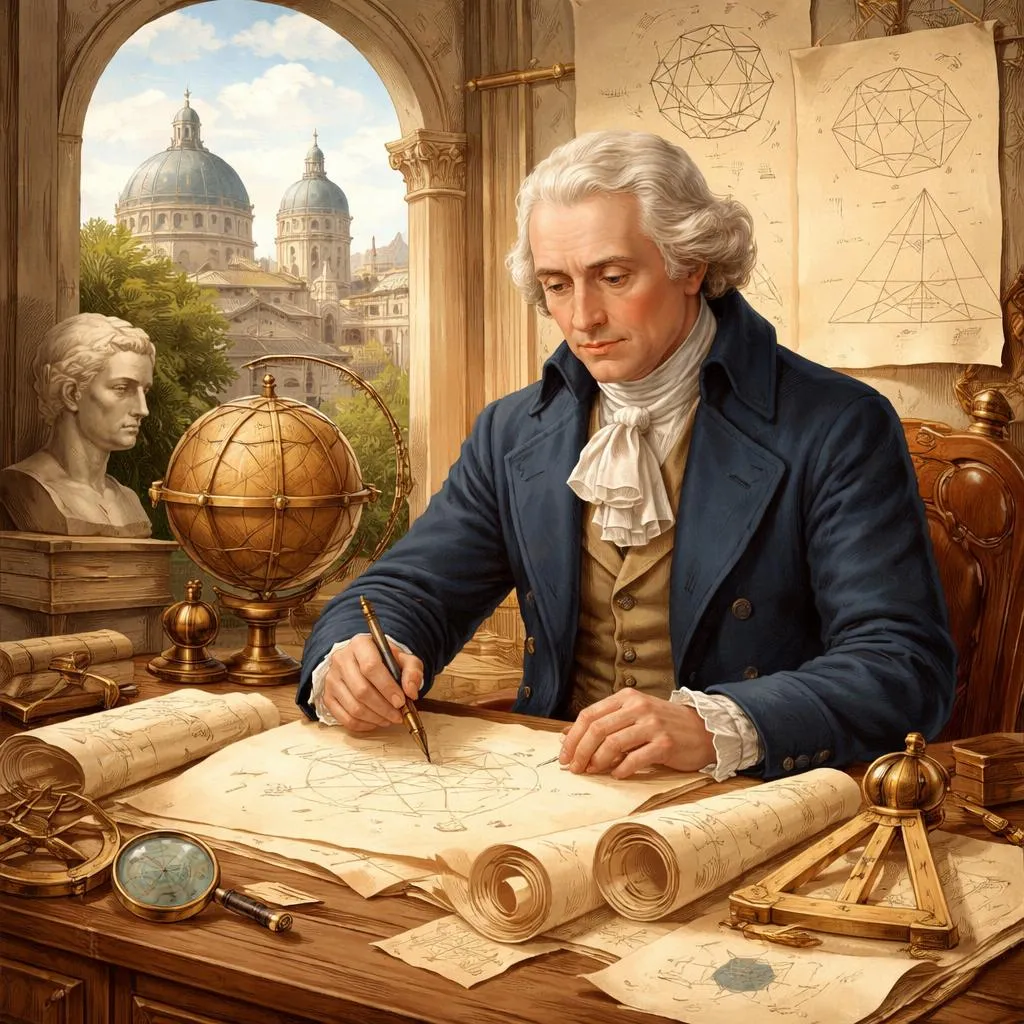

Gaspard Monge was born at Beaune on May 10, 1746, and died at Paris on July 28, 1818. He was the son of a small pedlar, and was educated in the schools of the Oratorians, in one of which he subsequently became an usher. A plan of Beaune which he had made fell into the hands of an officer who recommended the military authorities to admit him to their training school at Mézières. His birth, however, precluded his receiving a commission in the army, but his attendance at an annexe of the school where surveying and drawing were taught was tolerated, though he was told that he was not sufficiently well born to be allowed to attempt problems which required calculation. At last his opportunity came. A plan of a fortress having to be drawn from the data supplied by certain observations, he did it by a geometrical construction. At first the officer in charge refused to receive it, because etiquette required that not less than a certain time should be used in making such drawings, but the superiority of the method over that then taught was so obvious that it was accepted; and in 1768 Monge was made professor, on the understanding that the results of his descriptive geometry were to be a military secret confined to officers above a certain rank.
In 1780 he was appointed to a chair in mathematics in Paris, and this with some provincial appointments which he held gave him a comfortable income. The earliest paper of any special importance which he communicated to the French Academy was one in 1781, in which he discussed the lines of curvature drawn on a surface. These had been first considered by Euler in 1760, and defined as those normal sections whose curvature was a maximum or a minimum. Monge treated them as the locus of those points on the surface at which successive normals intersect, and thus obtained the general differential equation. He applied his results to the central quadrics in 1795. In 1786 he published his well-known work on statics.
Monge eagerly embraced the doctrines of the revolution. In 1792 he became minister of the marine, and assisted the committee of public safety in utilizing science for the defence of the republic. When the Terrorists obtained power he was denounced, and escaped the guillotine only by a hasty flight. On his return in 1794 he was made a professor at the short-lived Normal school, where he gave lectures on descriptive geometry; the notes of these were published under the regulation above alluded to. In 1796 he went to Italy on the roving commission which was sent with orders to compel the various Italian towns to offer pictures, sculpture, or other works of art that they might possess, as a present or in lieu of contributions to the French republic for removal to Paris. In 1798 he accepted a mission to Rome, and after executing it joined Napoleon in Egypt. Thence after the naval and military victories of England he escaped to France.
Monge then settled down at Paris, and was made professor at the Polytechnic school, where he gave lectures on descriptive geometry; these were published in 1800 in the form of a textbook entitled Géométrie descriptive . This work contains propositions on the form and relative position of geometrical figures deduced by the use of transversals. The theory of perspective is considered; this includes the art of representing in two dimensions geometrical objects which are of three dimensions, a problem which Monge usually solved by the aid of two diagrams, one being the plan and the other the elevation. Monge also discussed the question as to whether, if in solving a problem certain subsidiary quantities introduced to facilitate the solution become imaginary, the validity of the solution is thereby impaired, and he shewed that the result would not be affected. On the restoration he was deprived of his offices and honours, a degradation which preyed on his mind and which he did not long survive.
Most of his miscellaneous papers are embodied in his works, Application de l'algèbre à la géométrie , published in 1805, and Application de l'analyse à la géométrie , the fourth edition of which, published in 1819, was revised by him just before his death. It contains among other results his solution of a partial differential equation of the second order.
背景介紹與作者介紹
加斯帕·蒙日是一位傑出的法國數學家和科學家,於 1746 年出生於法國博訥。蒙日出身卑微,是小販的兒子,他的一生充滿了決心和智慧,克服了社會障礙。儘管由於他的出身,他早期遇到了一些障礙,但他以極大的熱情追求教育,並很快在幾何學和數學領域脫穎而出。他的工作奠定了描述幾何學的基礎,描述幾何學是數學的一個分支,它幫助我們在二維空間中表示三維物體——這在工程、建築和藝術中是一項至關重要的技能。
蒙日經歷了法國歷史上動盪的時期,包括法國大革命。他不僅是一位科學家,還是一位公僕,他利用自己的知識來支持革命政府。他的職業生涯包括擔任教授、部長和拿破崙的科學顧問。他對數學和科學的貢獻與他那個時代的社會和政治變革深深地交織在一起。
詳細闡釋與意義
加斯帕·蒙日的故事不是虛構的故事,而是一個關於毅力、創新和教育力量的真實故事。他對描述幾何學的發展是我們如何視覺化和解決空間問題的一個突破。這種方法允許通過二維繪圖來理解複雜的三維形狀,這在今天的許多領域中都是基礎。
蒙日在曲率線、靜力學和微分方程方面的工作也顯著推進了數學的理解。他的方法結合了理論洞察力和實際應用,展示了抽象數學如何解決現實世界的問題。此外,他在法國大革命期間所扮演的角色突出了科學和政治如何相互交織,有時會帶來巨大的個人風險。
給學生的教訓和見解
學生們在閱讀蒙日的故事時,可以學到幾個寶貴的教訓:
-
克服障礙: 蒙日的早期生活告訴我們,背景或社會地位並不能決定一個人的潛力。只要有奉獻精神和努力工作,任何人都可以取得偉大的成就。
-
教育的重要性: 蒙日的成功建立在他深厚的知識和不斷的學習之上。這鼓勵學生重視他們的教育,並努力深入理解學科。
-
創新和創造力: 蒙日在幾何學方面的新方法表明,創造性思維如何能帶來突破。應該鼓勵學生跳出框框思考,並從新的角度解決問題。
-
科學與社會: 蒙日對政治的參與提醒我們,科學並不是與世界隔絕的。知識可以用來服務社會,為重要的事業做出貢獻。
在日常生活中實際應用
-
在學習中: 蒙日的描述幾何學可以激勵學生提高他們的空間推理能力,這在數學、物理和藝術等學科中很有用。
-
在解決問題中: 他的例子鼓勵學生在面對困難問題時保持耐心和毅力,因為他們知道創新的解決方案往往需要時間和努力。
-
在社會互動中: 理解蒙日在政治危險面前的勇氣可以激勵學生捍衛自己的信仰,並為他們的社區做出積極貢獻。
培養積極的品質
為了體現蒙日的精神,學生們可以:
-
培養好奇心和對學習的熱愛,探索課堂之外的學科。
-
通過將失敗視為學習的機會來練習韌性。
-
通過嘗試新的想法和方法來擁抱創造力。
-
認識到為社會做出貢獻的價值,無論是通過科學、藝術還是社會行動。
結論
加斯帕·蒙日的生活和工作為年輕的學習者提供了豐富的靈感來源。他從卑微的背景到成為數學先驅和歷史上的關鍵人物的旅程,展示了教育、創新和勇氣的力量。通過研究他的故事,學生們不僅可以獲得知識,還可以獲得以決心和正直追求自己目標的動力。
