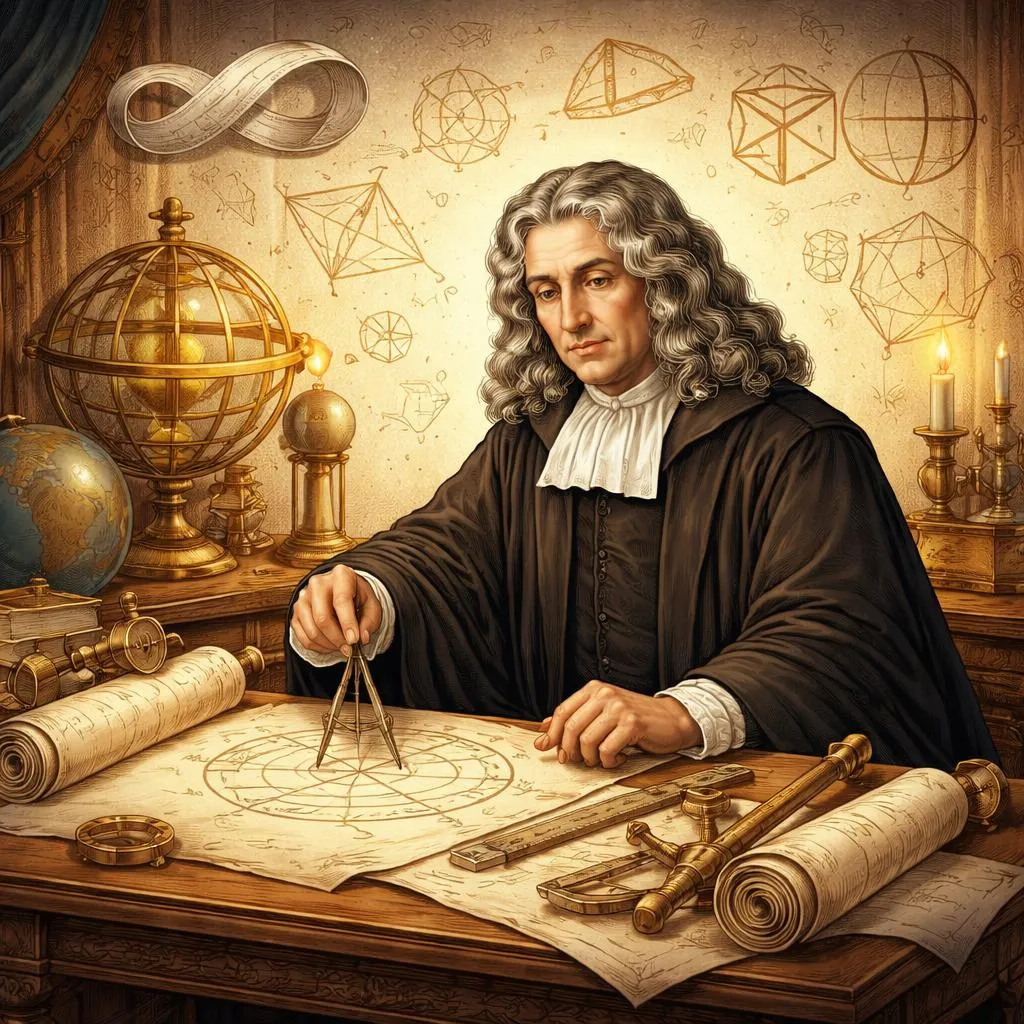

John Wallis was born at Ashford on November 22, 1616, and died at Oxford on October 28, 1703. He was educated at Felstead school, and one day in his holidays, when fifteen years old, he happened to see a book of arithmetic in the hands of his brother; struck with curiosity at the odd signs and symbols in it he borrowed the book, and in a fortnight, with his brother's help, had mastered the subject. As it was intended that he should be a doctor, he was sent to Emmanuel College, Cambridge, while there he kept an "act" on the doctrine of the circulation of the blood; that was said to have been the first occasion in Europe on which this theory was publicly maintained in a disputation. His interests, however, centred on mathematics.
He was elected to a fellowship at Queens' College, Cambridge, and subsequently took orders, but on the whole adhered to the Puritan party, to whom he rendered great assistance in deciphering the royalist despatches. He, however, joined the moderate Presbyterians in signing the remonstrance against the execution of Charles I., by which he incurred the lasting hostility of the Independents. In spite of their opposition he was appointed in 1649 to the Savilian chair of geometry at Oxford, where he lived until his death on October 28, 1703. Besides his mathematical works he wrote on theology, logic, and philosophy, and was the first to devise a system for teaching deaf-mutes. I confine myself to a few notes on his more important mathematical writings. They are notable partly for the introduction of the use of infinite series as an ordinary part of analysis, and partly for the fact that they revealed and explained to all students the principles of the new methods of analysis introduced by his contemporaries and immediate predecessors.
In 1655 Wallis published a treatise on conic sections in which they were defined analytically. I have already mentioned that the Géométrie of Descartes is both difficult and obscure, and to many of his contemporaries, to whom the method was new, it must have been incomprehensible. This work did something to make the method intelligible to all mathematicians: it is the earliest book in which these curves are considered and defined as curves of the second degree.
The most important of Wallis's works was his Arithmetica Infinitorum, which was publishd in 1656. In this treatise the methods of analysis of Descartes and Cavalieri were systematised and greatly extended, but their logical exposition is open to criticism. It at once became the standard book on the subject, and is constantly referred to by subsequent writers. It is prefaced by a short tract on conic sections. He commences by proving the law of indices; shews that x 0 , x -1 , x -2 ... represents 1, 1/ x , 1/ x ²...; that x 1/2 represents the square root of x , that x 2/3 represents the cube root of x 2 , and generally that x -n represents the reciprocal of x n , and that x p/q represents the q th root of x p .
Leaving the numerous algebraical applications of this discovery he next proceeds to find, by the method of indivisibles, the area enclosed between the curve y = x m , the axis of x , and any ordinate x = h ; and he proves that the ratio of this area to that of the parallelogram on the same base and of the same altitude is equal to the ratio 1 : m + 1. He apparently assumed that the same result would be true also for the curve y = a x m , where a is any constant, and m any number positive or negative; but he only discusses the case of the parabola in which m = 2, and that of the hyperbola in which m = -1: in the latter case his interpretation of the result is incorrect. He then shews that similar results might be written down for any curve of the form
and hence that, if the ordinate y of a curve can be expanded in powers of the abscissa, x , its quadrature can be determined: thus he says that if the equation of the curve were y = x 0 + x 1 + x 2 + ⋅⋅⋅ , its area would be x + 1/2 x 2 + 1/3 x 3 + ⋅⋅⋅. He then applies this to the quadrature of the curves y = ( x - x 2 ) 0 , y = ( x - x 2 ) 1 , y = ( x - x 2 ) 2 , y = ( x - x 2 ) 3 , etc. taken between the limits x = 0 and x = 1; and shews that the areas are respectively 1, 1/6, 1/30, 1/140, etc. He next considers curves of the form y = x -m and establishes the theorem that the area bounded by the curve, the axis of x , and the ordinate x = 1, is to the area of the rectangle on the same base and of the same altitude as m : m + 1. This is equivalent to finding the value of x 1/m dx . He illustrates this by the parabola in which m = 2. He states, but does not prove, the corresponding result for a curve of the form y = x p/q .
Wallis shewed considerable ingenuity in reducing the equations of curves to the forms given above, but, as he was unacquainted with the binomial theorem, he could not effect the quadrature of the circle, whose equation is y = ( x - x 2 ) 1/2 , since he was unable to expand this in powers of x . He laid down, however, the principle of interpolation. Thus, as the ordinate of the circle y = ( x - x 2 ) 1/2 is the geometrical mean between the ordinates of the curves y = ( x - x 2 ) 0 and y = ( x - x 2 ) 1 , it might be suppose that, as an approximation, the area of the semicircle ( x - x 2 ) 1/2 dx which is 1/8π might be taken as the geometrical mean between the values of
that is, 1 and 1/6; this is equivalent to taking 4√2/3 or 3.26... as the value of π. But, Wallis argued, we have in fact a series 1, 1/6, 1/30, 1/140, ... and therefore the term interpolated between 1 and 1/6 ought to be chosen so as to obey the law of this series. This, by an elaborate method, which I need not describe in detail, leads to a value for the interpolated term which is equivalent to taking
The mathematicians of the seventeenth century constantly used interpolation to obtain results which we should attempt to obtain by direct analysis.
In this work also the formation and properties of continued fractions are discussed, the subject having been brought into prominence by Brouncker's use of these fractions.
A few years later, in 1659, Wallis published a tract containing the solution of the problems on the cycloid which had been proposed by Pascal. In this he incidentally explained how the principles laid down in his Arithmetica Infinitorum could be used for the rectification of algebraic curves; and gave a solution of the problem to rectify the semi-cubical parabola x ³ = ay ² which had been discovered in 1657 by his pupil William Neil. Since all attempts to rectify the ellipse and hyperbola had been (necessarily) ineffectual, it had been supposed that no curves could be rectified, as indeed Descartes had definitely asserted to be the case. The logarithmic spiral had been rectified by Torricelli, and was the first curved line (other than the circle) whose length was determined by mathematics, but the extension by Neil and Wallis to an algebraical curve was novel. The cycloid was the next curve rectified; this was done by Wren in 1658.
Early in 1658 a similar discovery, independent of that of Neil, was made by van Heuraët, and this was published by van Schooten in his edition of Descartes's Geometria in 1659. Van Heuraët's method is as follows. He supposes the curve to be referred to rectangular axes; if this be so, and if ( x,y ) be the coordinates of any point on it, and n be the length of the normal, and if another point whose co-ordinates are ( x , η ) be taken such that η : h = n : y , where h is a constant; then, if ds be the element of the length of the required curve, we have by similar triangles ds : dx = n : y . Therefore h ds = η dx . Hence, if the area of the locus of the point ( x , η ) can be found, the first curve can be rectified. In this way van Heuraët effected the rectification of the curve y ³ = ax ² but added that the rectification of the parabola y ² = ax is impossible since it requires the quadrature of the hyperbola. The solutions given by Neil and Wallis are somewhat similar to that given by van Heuraët, though no general rule is enunciated, and the analysis is clumsy. A third method was suggested by Fermat in 1660, but it is inelegant and laborious.
The theory of the collision of bodies was propounded by the Royal Society in 1668 for the consideration of mathematicians. Wallis, Wren, and Huygens sent correct and similar solutions, all depending on what is now called the conservation of momentum; but, while Wren and Huygens confined their theory to perfectly elastic bodies, Wallis considered also imperfectly elastic bodies. This was followed in 1669 by a work on statics (centres of gravity), and in 1670 by one on dynamics: these provide a convenient synopsis of what was then known on the subject.
In 1685 Wallis published an Algebra, preceded by a historical account of the development of the subject, which contains a great deal of valuable information. The second edition, issued in 1693 and forming the second volume of his Opera, was considerably enlarged. This algebra is noteworthy as containing the first systematic use of formulae. A given magnitude is here represented by the numerical ratio which it bears to the unit of the same kind of magnitude: thus, when Wallis wants to compare two lengths he regards each as containing so many units of length. This perhaps will be made clearer if I say that the relation between the space described in any time by a particle moving with a uniform velocity would be denoted by Wallis by the formula s = vt , where s is the number representing the ratio of the space described to the unit of length; while the previous writers would have denoted the same relation by stating what is equivalent to the proposition s 1 : s 2 = v 1 t 1 : v 2 t 2 . It is curious to note that Wallis rejected as absurd the now usual idea of a negative number as being less than nothing, but accepted the view that it is something greater than infinity. The latter opinion may be tenable and not inconsistent with the former, but it is hardly a more simple one.
背景介紹與作者導讀
約翰·沃利斯是一位傑出的數學家和學者,於1616年出生於英格蘭的阿什福德。沃利斯最初被期望從事醫學,但他的好奇心引導他走向數學,他在數學領域做出了開創性的貢獻。沃利斯畢業於劍橋大學伊曼紐爾學院,他深深地參與了他那個時代的知識和政治潮流,包括清教徒運動和英格蘭內戰。他的職業生涯在牛津大學蓬勃發展,他在那裡擔任了享有盛譽的薩維爾幾何學教授超過50年。除了數學,沃利斯還為神學、哲學,甚至聾啞教育做出了貢獻,展示了他廣泛的才智。
沃利斯工作的詳細說明
沃利斯最著名的著作《無窮算術》(1656年)徹底改變了數學家處理無窮級數和微積分的方式。在這篇論文中,他擴展了笛卡爾和卡瓦列里等早期數學家的方法,系統地使用無窮級數來解決涉及曲線下面積的問題,這是積分學的先驅。
他引入了使用分數和負指數的概念,解釋了像(x^{1/2})這樣的表達式如何表示平方根,以及(x^{-1})如何表示倒數。這在代數符號和理解方面是一個重要的進步。
沃利斯還解決了尋找曲線下面積(求積)的挑戰。使用不可分量的方法,他計算了像(y = x^m)這樣的曲線下的面積,證明了今天在微積分中是基礎的關係。儘管由於當時缺乏二項式定理,他在某些曲線(如圓)方面遇到了一些困難,但他開發了插值方法來逼近像(\pi)這樣的數值。
他在連分數和曲線(如擺線和半立方拋物線)的求長(測量長度)方面的工作進一步推進了數學分析。沃利斯對物體碰撞的研究引入了早期動量守恆的思想,對物理學產生了深遠的影響。
意義和含義
沃利斯的貢獻為微積分的發展奠定了重要的基礎,微積分是牛頓和萊布尼茨不久後形式化的數學分支。他的方法使數學家能夠嚴格地處理無限過程,以新的方式架起了代數和幾何之間的橋樑。
對於學生來說,沃利斯的故事說明了好奇心和毅力如何帶來突破。儘管資源有限,並且存在一些不正確的假設,但他富有創新精神的思維推動了知識的邊界。他願意參與政治和宗教爭議,也表明了堅持自己的原則,同時為社會做出貢獻的重要性。
給學生的教訓和啟發
-
好奇心引導發現: 沃利斯的旅程始於對算術符號的簡單好奇。學生應該擁抱他們的問題,並深入探索主題。
-
克服挑戰的毅力: 沃利斯面臨知識上的困難和政治上的反對,但他仍然致力於他的工作。這教導了學習和生活中的韌性。
-
跨學科思考: 沃利斯的工作跨越了數學、神學、邏輯和教育。學生可以學習聯繫不同領域以豐富理解的價值。
-
清晰溝通的重要性: 沃利斯幫助其他人理解複雜的想法,表明清晰地分享知識與發現一樣重要。
-
倫理和社會參與: 沃利斯的政治參與提醒學生,學者也可以是活躍的公民,影響他們的社區。
如何在生活中應用這些教訓
- 在學習中: 以好奇心接近新課題,不要害怕提問或尋求幫助,就像沃利斯對待他的兄弟一樣。
- 在解決問題中: 使用創造性的方法,並對近似和逐步改進持開放態度,反映沃利斯的插值技術。
- 在社交場合中: 堅守你的價值觀,同時尊重他人的觀點,從沃利斯平衡的政治立場中學習。
- 在個人成長中: 培養韌性,將挫折視為學習和成長的機會,受到沃利斯毅力的啟發。
培養積極的態度和行為
學生可以通過以下方式培養沃利斯的精神:
- 在學習中練習耐心和奉獻精神。
- 探索跨學科的科目以建立廣泛的知識。
- 在討論和辯論中互相尊重地參與。
- 幫助他人理解困難的概念,促進協作學習環境。
- 將數學和邏輯思維應用於日常問題。
結論
約翰·沃利斯的生活和工作提供了對好奇心的力量、數學思想的演變以及學者在社會中的作用的深刻見解。他的遺產鼓勵學生熱情地追求知識,創造性地思考,並為他們周圍的世界做出有意義的貢獻。
