
Fun Introduction
Last Saturday, Mia helped her mom in the kitchen. She dried dishes with a soft towel. The plates felt warm and damp. Later, Mia wiped the table with a sponge. She scrubbed off sticky juice. Both actions made things clean. But one removed water. The other cleaned a surface. Let’s learn the difference.
Word Breakdown
Core Principle
We reject boring dictionary definitions. We use pictures in your mind. We add functions and memory hooks. This helps you remember forever.
Dry To Do
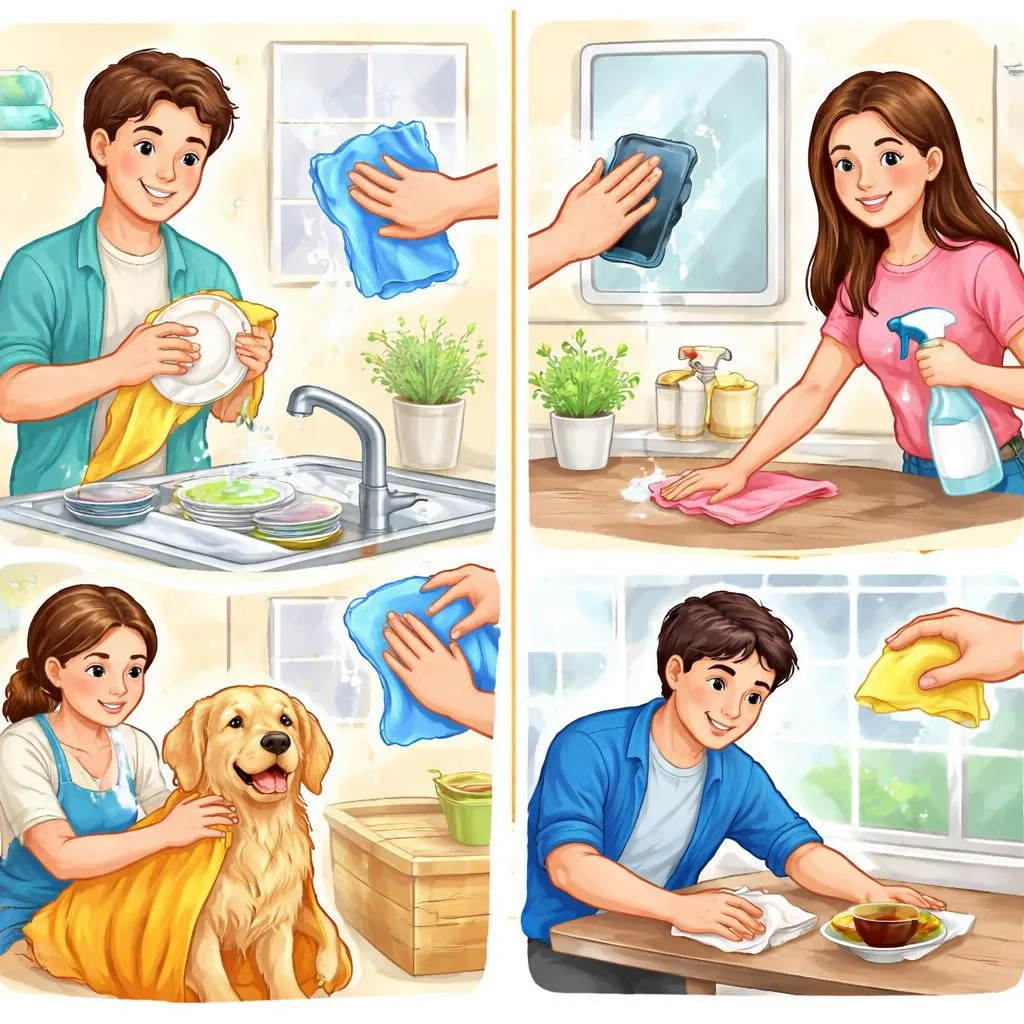
Image: Imagine drying your hair with a fluffy towel. You pat it gently. That is dry to do. It means removing moisture from something.
Function: It is for taking away wetness. Like dry your hands after washing. Or dry the dishes.
Sensory Description: You feel soft fabric. You hear rubbing sounds. Your skin feels warmer.
Memory Anchor: A towel hanging on a rack. See the loops? That is dry to do.
Wipe To Do
Image: Think of wiping a dirty table with a cloth. You rub to clean. That is wipe to do. It means cleaning a surface by rubbing.
Function: It is for removing dirt or marks. Like wipe the counter. Or wipe your nose.
Sensory Description: You feel texture under your hand. You see smudges moving. Your nose might smell cleaner.
Memory Anchor: A cloth with a dark smudge. See the dirt? That is wipe to do.
Advanced Comparison
Dry is about removing moisture. Wipe is about cleaning a surface. Dry uses absorbent materials. Wipe uses friction. Use dry for wet things. Use wipe for dirty surfaces.
Scene Comparison
Scene One happens at home. Leo finishes washing his hands. He grabs a towel. He dries them by patting. His mom nods approval. This is dry to do—removing water.
Scene Two takes place in the kitchen. Emma sees sticky juice on the table. She takes a sponge. She wipes it off with circular motions. The table shines. This is wipe to do—cleaning a surface.
Scene Three occurs after a rainy walk. Ben’s shoes are soaked. He stuffs them with newspaper. He dries them overnight. Later, he notices mud on the sides. He wipes it off with a damp cloth. Notice the shift. Drying removes moisture. Wiping cleans dirt.
Pitfalls Deep Reminder
Mistake One is saying “I wiped my hair.” Why wrong? Hair needs drying. Wiping uses friction. Funny result? Friends imagine you scrubbing your scalp with a rough cloth. Correct phrase is dry my hair. Memory trick: Dry is for wet hair.
Mistake Two is saying “I dried the table.” Why wrong? Tables need wiping. Drying removes moisture only. Funny result? Mom sees water rings left behind. Correct phrase is wipe the table. Memory trick: Wipe is for surfaces.
Mistake Three is saying “I wiped my tears.” Why wrong? Tears are wet. You dry them. Funny result? Sibling thinks you rubbed your cheeks raw. Correct phrase is dry your tears. Memory trick: Dry is for wetness.
Mistake Four is saying “I dried the whiteboard.” Why wrong? Whiteboards need wiping. Drying does nothing. Funny result? Teacher waits for the ink to evaporate. Correct phrase is wipe the whiteboard. Memory trick: Wipe is for marks.
Interactive Exercises
Choose the Right Phrase
Read each sentence. Pick dry or wipe.
I ___ my hands on my jeans. (dry/wipe)
She ___ the spilled milk on the floor. (dry/wipe)
We ___ the sweat off our faces. (dry/wipe)
He ___ the dishes with a tea towel. (dry/wipe)
They ___ the dust off the shelf. (dry/wipe)
Mini Theater
Act with a friend. Use the phrases.
Scene A: After Washing
A: My hands are dripping. I need to ___ them.
B: Use this towel quickly.
Scene B: Cleaning Up
A: Look at this sticky spot. I must ___ it.
B: Here is a damp cloth.
Spot the Mistake
Which sentence sounds odd? Explain why.
Sentence: I wiped my wet swimsuit.
Reason: Swimsuits need drying. Use dry instead.
Sentence: I dried the crayon marks off the wall.
Reason: Marks need wiping. Use wipe instead.
Sentence: We wiped the rain off our jackets.
Reason: Rain is moisture. Use dry instead.
Create Sentences
Use both phrases.
Dry to do: I dry my hair after swimming.
Wipe to do: I wipe my desk before class.
Bonus Challenge
You step in a puddle. Your socks are soaked. Do you dry or wipe them? Answer: Dry. They are wet.
Rhyme Time
Dry the wet, wipe the grime.
One takes moisture, one takes time.
Wet and drippy? Choose dry.
Dirty and sticky? Wipe to comply.
Homework Task
Pick one activity. Complete it this week. Share with family.
Option One: Drawing Journal. Get a small notebook. Draw three pictures. Write a sentence under each.
Picture One: You dry something. Sentence: I dried my wet umbrella.
Picture Two: You wipe something. Sentence: I wiped the jam off the table.
Picture Three: You dry something else. Sentence: I dried my rain boots.
Show your journal to a parent. Explain the differences.
Option Two: Role Play. With a parent, act out moments. Use phrases correctly.
You: Mom, I will dry the dishes tonight.
Parent: Thank you. Use the towel well.
You: Dad, I need to wipe the counter.
Parent: There is a sponge under the sink.
Practice until it feels natural.
Option Three: Sharing Time. Tomorrow at school, tell a friend. Describe one dry and one wipe. Say: Yesterday I dried my jersey after soccer. I wiped my muddy shoes. Ask your friend about theirs.
Life Practice
Week Challenge: Try one task. Complete within seven days. Share your success.
Task One: Observation Log. For three days, note dry and wipe moments. Draw icons.
Day One: Dry a towel. Draw a towel icon.
Day Two: Wipe a window. Draw a window icon.
Day Three: Dry a shirt. Draw a shirt icon.
Show your log to your teacher. Place it on the classroom wall.
Task Two: Action Demo. Use both phrases in real actions.
Step One: Pat a wet surface. Say: I dry this counter.
Step Two: Rub a dirty spot. Say: I wipe this smudge away.
Demonstrate to a sibling. Explain the difference.
Task Three: Social Mission. Use phrases with others.
Dry a friend’s wet sleeve. Say: I dried your cuff for you!
Wipe a classmate’s messy desk. Say: I wiped your desk clean!
Record a short voice message. Send it to your teacher.
Task Four: Creative Story. Write a short tale. Include both phrases.
Title: The Clean-Up Crew.
Story: I dried my wet raincoat. Then I wiped the muddy floor. What a tidy day!
Share your story in class.
Remember, practice makes perfect. Use these phrases often. Soon they will feel easy.