
Opening Introduction
Leo is at the park. He sees kids playing soccer. They kick the ball. They run fast. They jump high. He sees other kids on the playground. They climb the ladder. They slide down. They swing back and forth. So many things are happening! Leo*s dad asks, "Can you tell me what everyone is doing?" Leo thinks. He knows the words 'play' and 'go'. But there are so many more action words. "Let's learn the special words for movement," says Dad. "We are learning action verbs for sports and games. Verbs are action words. They tell us what people do." Leo is ready to learn. Let's jump, run, and play with these exciting words.
Core Knowledge Explanation
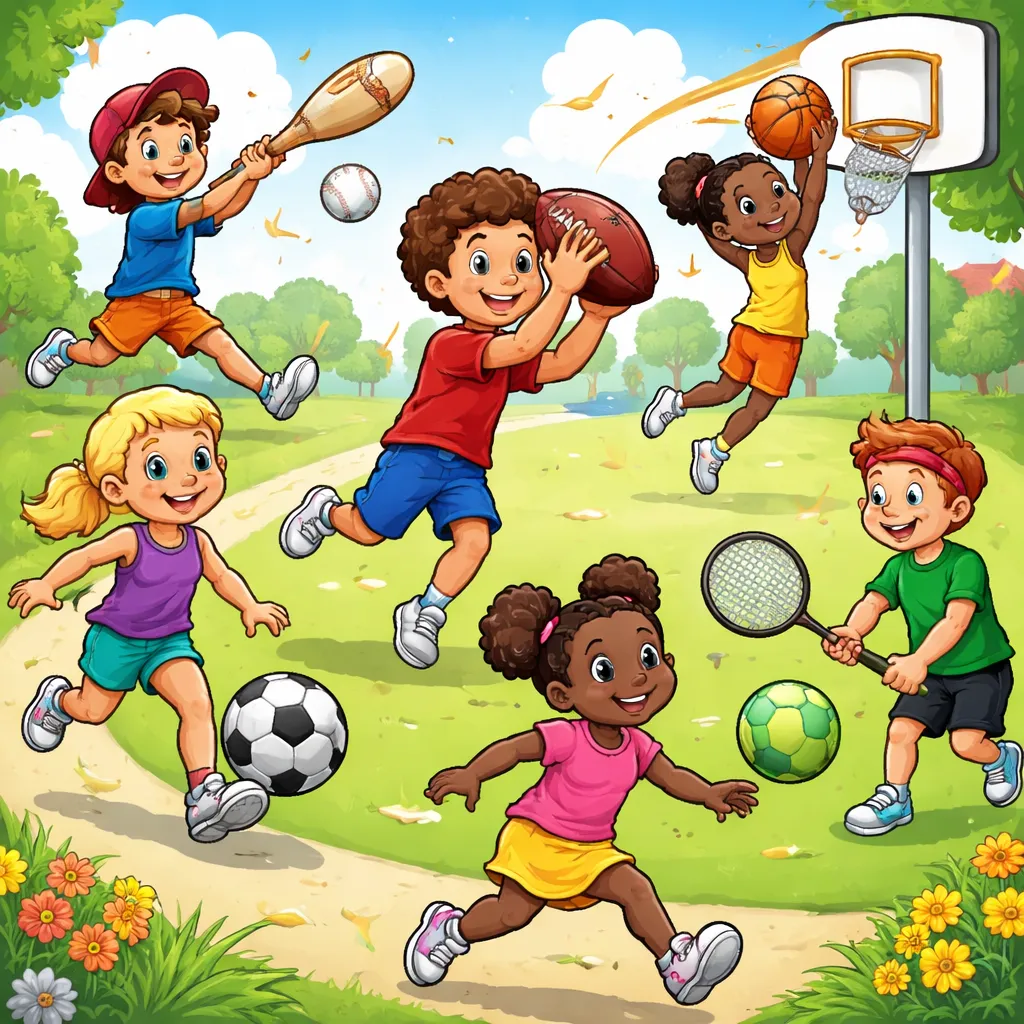
What is a verb? A verb is an action word. It tells us what someone or something does. In sports and games, we use many special verbs. These action verbs for sports and games help us describe the play. They make our stories exciting. Let's look at some common sports. In soccer, players kick the ball. They run across the field. They jump to head the ball. They pass the ball to a friend. They shoot the ball at the goal. The goalkeeper tries to catch or block the ball. See all those verbs? Kick, run, jump, pass, shoot, catch, block.
Now, let's think about basketball. Players bounce or dribble the ball. They throw the ball. They aim and shoot the ball into the hoop. They catch the ball from a teammate. Sometimes, they jump very high. In baseball or cricket, players hit the ball with a bat. They run to a base. They throw the ball. They catch the ball in a glove. The verbs are hit, run, throw, catch.
What about games in the playground? You climb up the ladder. You slide down the slide. You swing on the swing. You skip with a rope. You hop on one foot. You chase your friends. You hide during hide-and-seek. Climb, slide, swing, skip, hop, chase, hide. These are all action verbs for sports and games. They describe how you move your body.
Some verbs are for team play. In many games, you must work together. You pass the ball. You help a teammate. You follow the rules. You win or lose the game. Other verbs are for practice. You practice your throws. You train to run faster. You exercise to get stronger. Learning these action verbs for sports and games gives you the power to talk about all the fun things you do. Your stories will be full of action and life.
Fun Interactive Learning
Let's play a game right now. It is called "Verb Charades." Write different action verbs for sports and games on small pieces of paper. Fold them. Put them in a bowl. Words like: jump, kick, throw, catch, slide, swing, dance. One person picks a paper and acts out the verb without speaking. The others must guess. "Are you jumping? Yes!" This game is fun and gets you moving. It helps you connect the word to the action.
Another activity is "Simon Says with Verbs." One person is Simon. Simon says, "Simon says jump!" Everyone jumps. Simon says, "Simon says spin!" Everyone spins. If Simon just says "Kick!" without saying "Simon says," you do not do it. This game makes you listen carefully to the action verbs for sports and games and react fast. It is a great listening and moving game.
You can also do a "Verb Hunt." Go outside with a notebook. Watch people playing. Write down all the action verbs you see. Do you see a boy run? Write "run." Do you see a girl climb? Write "climb." Try to find ten different verbs. This makes you a great observer. You are collecting action verbs for sports and games from real life. It is like being a word scientist.
Expanded Learning
All over the world, people play sports and games. They use the same action verbs for sports and games, but in their own language. In Spanish, to kick is "patear." To run is "correr." In French, to throw is "lancer." To jump is "sauter." The actions are the same. The fun is the same. Only the words sound different. This shows that action verbs are a global language of play.
Long ago, people played simple games. They would run races. They would throw stones. They would wrestle. The basic verbs are very old. Today, we have new sports with new verbs. In skateboarding, you ollie and grind. In surfing, you ride and carve. But the idea is the same: to move and have fun. Learning these verbs connects you to kids everywhere, in the past and today. Let's make a chant about action verbs. Chants have energy. Say this with a clap and a stomp.
Run, jump, kick, and throw! These are verbs that help us go! Catch, pass, shoot, and score! Let's learn a whole lot more! Climb and slide, swing and play! Using verbs throughout the day! Move your body, use your mind, these great action words you'll find!
What You Will Learn
You are learning about movement and description. You are learning many action verbs for sports and games: kick, run, jump, pass, shoot, catch, block, dribble, throw, hit, climb, slide, swing, skip, hop, chase, hide, bounce, train, win, lose. You are also learning that verbs are action words.
You are learning powerful sentences. You can say, "I can kick the ball far." You can describe, "She climbs the ladder quickly." You can tell a story, "We ran, jumped, and scored a goal!" You are using English to report events and share excitement. This is a key communication skill.
You are building amazing abilities. You are building vocabulary. You learn specific words for specific actions. You are building observation skills. You notice and name different movements. You are building physical intelligence. You connect words to body actions. You are building storytelling skills. You can describe games with detail. You are building confidence. You can talk about your hobbies and play.
You are forming an active habit. The habit of using precise, lively words. You learn that language is not flat. It can leap and run just like you. Mastering these action verbs for sports and games makes you a better player, a better storyteller, and a more expressive person.
Using What You Learned in Life
Use these verbs every time you play. When you are on the soccer field, think, "I will pass the ball to Mia." When you are at the playground, say, "Watch me slide down!" When you watch sports on TV, name the verbs you see. "He threw the ball. She caught it!" When you come home from playing, tell your family about your day. Use the action verbs. "First, I climbed the monkey bars. Then, I chased Leo. We swung on the swings."
At school, during PE class, listen to the teacher's instructions. They are full of action verbs for sports and games. "Everyone, run to the line!" "Now, jump three times." Understanding these verbs helps you follow directions and play the game correctly. You can also teach a friend a new verb. Show them how to dribble a ball and say the word. You are the teacher. The more you use these words, the more they become a part of you.
Closing Encouragement
You are an action hero. You are a word mover. You are a playful and energetic learner. I am so proud of you. Learning all these action verbs shows you are full of life and curiosity.
Keep moving, keep playing, keep using your wonderful new words. Remember, every action you do is a chance to practice your English. Your body and your brain are learning together.
You are strong, you are fast with words, and you are ready for any game. Great work, my amazing action star.