
A Friendly Hello and First Impressions
Zdravo! (ZDRAH-voh). This is a warm "Hello" in the local languages. Hvala! (HVAH-lah). This is a sincere "Thank you". People say it with kindness. Learning reading about Bosnia and Herzegovina starts with these simple, melodic words.
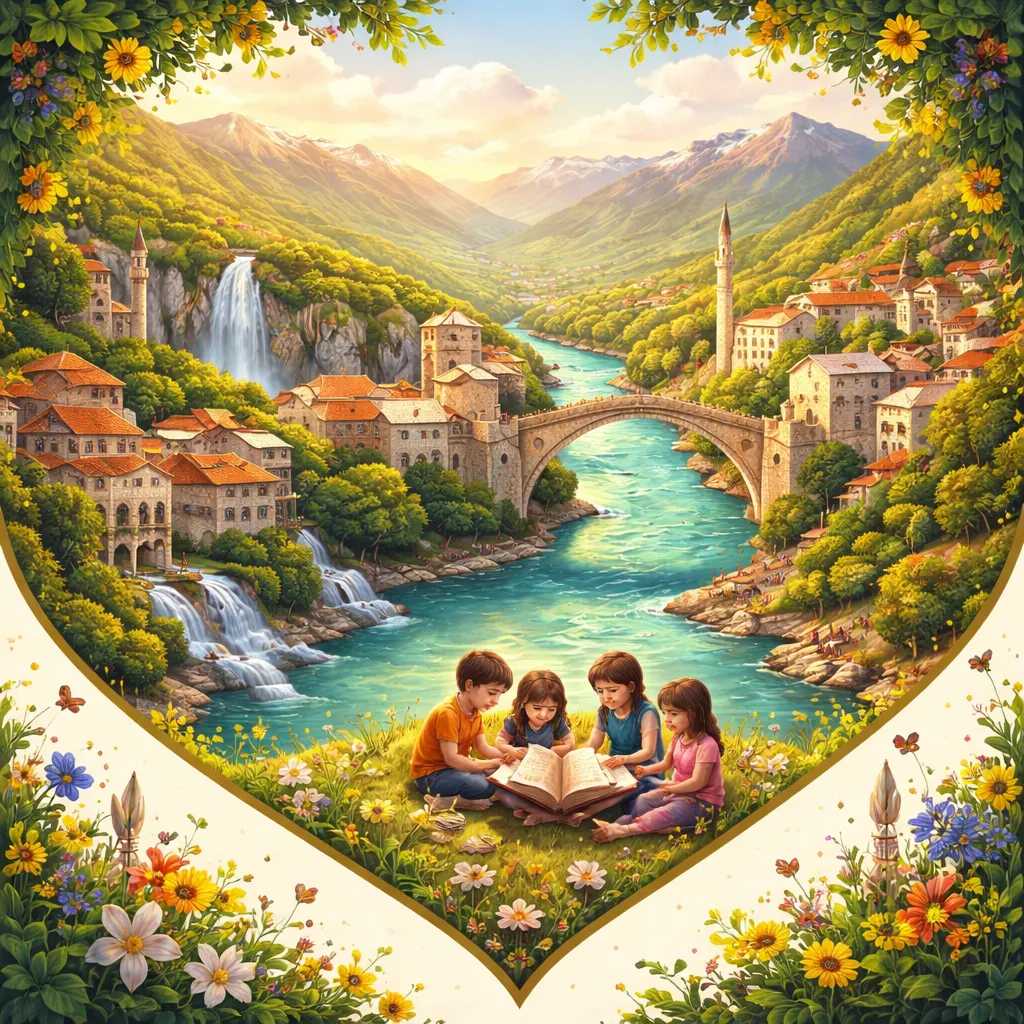
Bosnia and Herzegovina is in Southeast Europe. Its shape looks like a slightly crooked heart. The heart sits in the western Balkan Peninsula. It is a landlocked country. Croatia, Serbia, and Montenegro are its neighbors. A tiny strip of coast touches the Adriatic Sea. The land is full of mountains and valleys.
People call it the "Heart-Shaped Land". Look at a map. The country's outline is like a heart. Another name is the "Land of the Golden Apricot". The town of Mostar is famous for its sweet apricots. The fruit symbolizes the sweetness of life here. What tales are carved into its ancient stones?
Deep Dive into Culture and Stories
Echoes of History
A long and complex history lives here. For centuries, it was part of the Ottoman Empire. Then it became part of Austria-Hungary. In 1914, a world-changing event happened in Sarajevo. A man shot Archduke Franz Ferdinand. This started World War I. The 20th century was very difficult. A brutal war was fought from 1992 to 1995. The country is now at peace. It is slowly healing. This history of survival is key for learning reading about Bosnia and Herzegovina.
A famous historical figure is Tvrtko I. He was a medieval king. He ruled in the 14th century. He expanded the kingdom. He made it strong and independent. He was crowned in the city of Mile. He is seen as a great ruler. His story reminds people of a time of unity and power.
A Unique World Heritage
The country has unique medieval tombstones. They are called "ste?ci". These are large, decorated stones. They are in fields and on hillsides. Artists carved intricate designs on them. The designs are suns, moons, crosses, and figures. They are from the 12th to 16th centuries. Nobody knows exactly who made them. They are a mystery. They are a UNESCO World Heritage site. They are a silent gift from the past.
A Land of Mountains and Rivers
The country is very mountainous. The Dinaric Alps run through it. The mountains are high, green, and rocky. Deep river canyons cut through the land. The Neretva River is the most famous. It is emerald green. There are also rolling hills and fertile plains. The landscape is dramatic and beautiful.
The climate varies. The mountains have cold, snowy winters. The valleys have hot summers. The sea coast has a Mediterranean climate. This affects how people live. In the mountains, houses are made of stone. They have steep, sloping roofs. The roofs shed heavy snow. People grow potatoes, plums, and corn. The rivers are used for hydroelectric power.
A special tree is the Bosnian pine. It is a conifer tree. It grows on rocky slopes. It is very resilient. It can survive in poor soil. It is a symbol of strength. The national animal is not official. But the lynx is a beloved wild cat. It is rare and beautiful. The golden lily is a traditional symbol. It is on the flag of the Bosniak people.
Landmarks of Stone and Meeting
Visit the Stari Most. This means "Old Bridge". It is in the city of Mostar. The Ottomans built it in 1566. It is a single, stone arch bridge. It crosses the bright green Neretva River. It was destroyed in the war in 1993. The world was sad. People rebuilt it stone by stone. It reopened in 2004. It is a symbol of hope and reunion. A tradition is bridge diving. Young men jump from the bridge. The water is 24 meters below. It is a test of courage.
See Ba??ar?ija in Sarajevo. It is the old Ottoman bazaar. The streets are narrow and cobbled. Coppersmiths hammer beautiful pots and trays. The sound is like a musical clock. The Sebilj is a wooden fountain. It is shaped like a small pavilion. People drink water from it. A legend says if you drink from it, you will return to Sarajevo. The bazaar is the heart of the old city.
Another wonder is the Mehmed Pa?a Sokolovi? Bridge. It is in Vi?egrad. The Ottomans built it in 1577. It has 11 stone arches. It crosses the Drina River. The famous writer Ivo Andri? wrote about it. He won the Nobel Prize for Literature. The bridge is a character in his stories. It connects people and histories.
Festivals of Film and Faith
A major festival is the Sarajevo Film Festival. It happens every August. It started during the war in 1995. People watched movies in a basement. It was a act of defiance. Today, it is a huge, international event. Movie stars come. Films are shown in the open air. The city becomes a celebration of art. It shows the power of creativity.
Religious holidays are very important. The population is multi-ethnic and multi-faith. Muslims celebrate Eid. Christians celebrate Christmas and Easter. Jews celebrate Passover. Each community celebrates in its own way. But they also share respect. This coexistence is a daily practice. It is a model for the world.
Food and Flavors
The national dish is ?evapi. They are small, grilled sausages. They are made from minced meat. The meat is a mix of beef and lamb. They are served in a flatbread called "somun". Chopped raw onions are on the side. People eat them with their hands. They are juicy, savory, and delicious. They are the ultimate fast food.
You must try Burek. It is a flaky, layered pastry. It is made with thin dough called "jufka". The filling is usually minced meat, cheese, or spinach. It is shaped like a spiral or a coil. It is baked until golden. People eat it for breakfast or a snack. A hot, fresh burek is crispy and soft. It tastes like a warm, savory hug.
A Culture of Coffee and Coexistence
Drinking coffee is a sacred ritual. It is called "Bosnian coffee" or "Turkish coffee". The coffee is strong and black. It is served in a small copper pot called a "d?ezva". It comes with a sugar cube and a glass of water. You drink it slowly. You talk with friends for hours. The ritual is about time and conversation. This social tradition is a key part of learning reading about Bosnia and Herzegovina.
The country is recovering with creativity. Many young people work in information technology. They start companies. They design software and games. They use the internet to connect with the world. This is the new bridge they are building. It is a bridge made of code and ideas.
Tips for Young Explorers
Cultural Manners Matter
Greetings are formal. Shake hands firmly. Say "Dobar dan" (Good day). Use titles like "Gospodin" (Mr.) or "Gospo?a" (Mrs.) with the last name. This shows respect. Wait for the other person to invite you to use first names.
Hospitality is generous. If invited to a home, bring a small gift. Flowers, chocolates, or coffee are good. Take off your shoes at the door. Your host will give you slippers. Compliment the food. The host will be very happy.
Drinking coffee has rules. The host will pour the coffee. Wait for it to settle. Sip it slowly. Do not drink the grounds at the bottom. Always accept the coffee. Refusing is rude.
A Note on Staying Safe
Bosnia is generally safe. But be aware of your surroundings. Unexploded landmines are a danger in some rural areas. Always stay on marked roads and paths. Do not go into abandoned buildings or fields. Look for warning signs. They are red with a skull.
In cities, be careful in traffic. Drivers can be fast. Use crosswalks. The old towns have cobblestone streets. The stones can be slippery. Watch your step.
A Tasty Stop
Look for "Tufahije" in a bakery. It is a traditional dessert. It is a stewed apple. The apple is filled with walnuts. It is topped with sweet whipped cream. The dessert is soft, sweet, and nutty. Eat it with a spoon. The taste is like a cozy, fruity delight.
Healthy and Happy Travels
Tap water is usually safe in cities. But many people drink bottled water. It is a safe choice. In rural areas, ask if the water is okay. If unsure, drink bottled water.
The weather can change quickly. Dress in layers. Carry a light rain jacket. Good walking shoes are essential. The old towns have uneven stone streets. Comfortable shoes make exploring a joy.
Be respectful at religious sites. Cover your shoulders and knees. Remove your hat. Do not take photos without permission. Be quiet and respectful.
Your Invitation to Explore
Start your journey with a book. Find "The Bridge on the Drina" by Ivo Andri?. It is a novel about the bridge in Vi?egrad. Or, watch a short film from the Sarajevo Film Festival online. See the creativity of the region. This is a wonderful way of learning reading about Bosnia and Herzegovina.
Visit a local market. Look for a Bosnian coffee set. A small pot and cups. Make strong, black coffee at home. Serve it to your family. Sit and talk. Experience the slow, social ritual. Imagine you are in a caf谷 in Ba??ar?ija.
The world is a vast library of human stories. Each country is a chapter written in stone, water, and memory. Bosnia and Herzegovina's chapter is about bridges, both stone and human. Open it with an open heart. Read about its resilience, coffee, and coexistence. Your curiosity is the key.
Bosnian families share a big plate of ?evapi. Friends meet for hours of coffee. Children play in the shadows of ancient bridges. We all know these scenes. We love sharing food. We enjoy long talks with friends. We find joy in simple moments. Learning about Bosnia and Herzegovina shows us this. Our global family is connected by shared hopes for peace. Keep exploring, one page, one country, at a time. Your adventure has just begun.