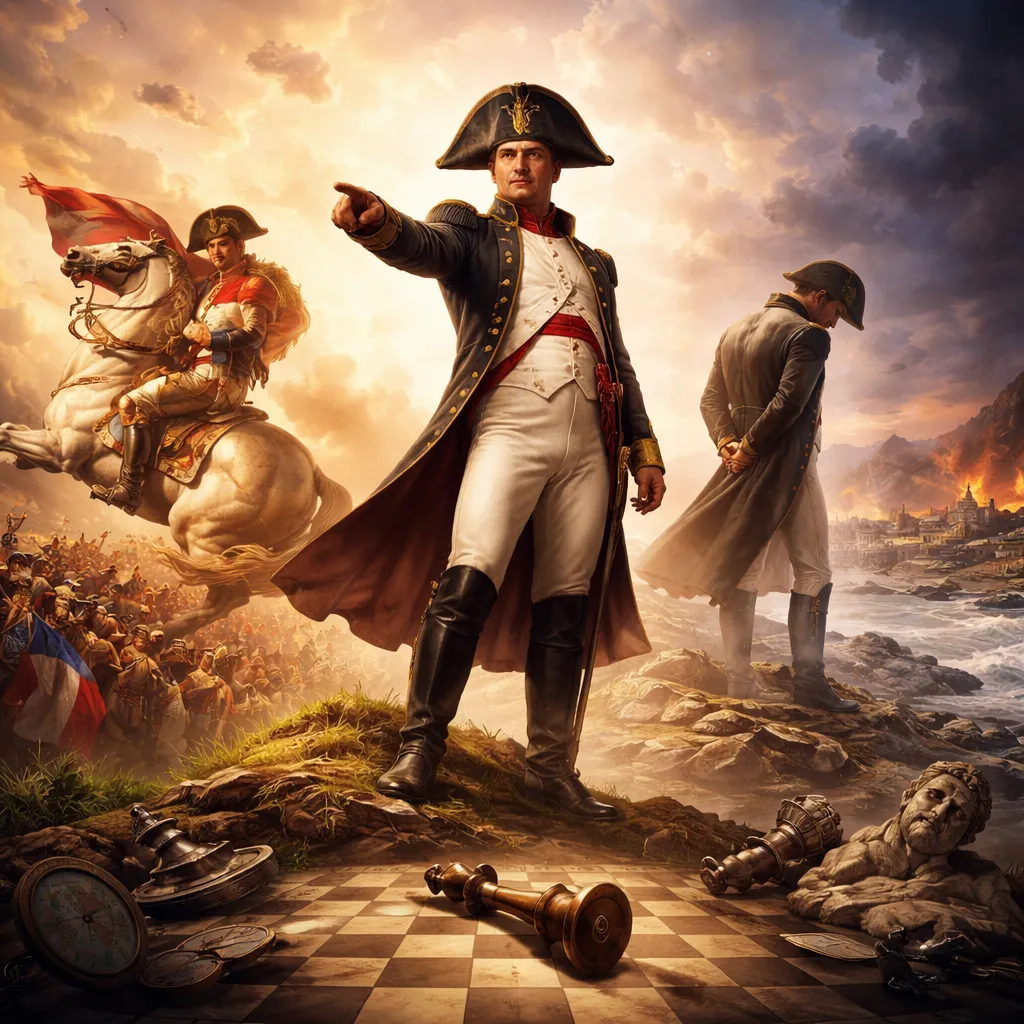

Introduction to Napoleon Bonaparte
Napoleon Bonaparte, born on August 15, 1769, on the island of Corsica, was a French military leader and emperor. He rose from a relatively modest background to become one of the most influential and controversial figures in world history. Napoleon is often remembered for his remarkable rise to power, his strategic brilliance, and his role in shaping European politics during the early 19th century.
Napoleon's story is not just one of military conquests, but also of leadership, resilience, and the pursuit of ambitious goals. His achievements and mistakes offer valuable lessons for both children and parents about determination, the importance of education, and the consequences of unchecked ambition. Studying his life can help young people understand how leadership can shape the course of history and the importance of making wise decisions.
Early Life and Background
Napoleon was born into a relatively poor family in Corsica, a small Mediterranean island that had only recently been transferred to France. His family was of noble Italian descent but did not possess great wealth. Napoleon's early life was marked by challenges, including his family’s financial struggles and his social status as an outsider in mainland France.
At the age of nine, Napoleon was sent to mainland France to attend military school, where he began to show an early interest in military strategy. Although he faced difficulties in adapting to French society due to his Corsican accent and background, he excelled in his studies, especially in mathematics and artillery. These subjects would later become important tools in his military career.
Napoleon’s education also exposed him to the works of great philosophers and political theorists, which influenced his thinking. His early years were formative in shaping his vision of leadership and power. He quickly rose through the ranks of the French military, displaying a natural talent for strategy and a deep understanding of military tactics.
Career Highlights and Achievements
Napoleon’s career is best known for his military genius and his ability to lead France through times of both crisis and success. He first gained recognition during the French Revolution, when he defended the revolutionary government from royalist uprisings. His success in these early battles earned him promotions, and by 1796, he was appointed commander of the French Army in Italy.
One of Napoleon’s greatest achievements was his military campaigns in Italy and Egypt. His victories in Italy established him as a brilliant tactician, and his Egyptian campaign, although ultimately unsuccessful, demonstrated his ability to adapt to different terrains and opponents. It was during this time that Napoleon solidified his reputation as a leader capable of achieving great things.
In 1799, Napoleon staged a coup and took control of the French government, eventually becoming the First Consul. His reforms and the new legal system, known as the Napoleonic Code, helped stabilize France after the chaos of the Revolution. In 1804, he declared himself Emperor of France, and he quickly set his sights on expanding the French Empire across Europe.
Napoleon’s military campaigns, known as the Napoleonic Wars, spanned from 1803 to 1815 and involved almost every European nation. His victories at Austerlitz, Jena, and Wagram cemented his reputation as one of history's greatest military leaders. Under his rule, France controlled much of Europe, and he instituted numerous reforms that reshaped European society.
Despite his military successes, Napoleon’s empire eventually began to crumble due to overextension, poor strategic decisions, and the rise of powerful coalitions against him. His defeat in Russia in 1812 marked the beginning of his decline, and after a series of defeats in 1814, he was exiled to the island of Elba. However, he escaped from Elba in 1815 and returned to power for a brief period known as the Hundred Days, before being defeated at the Battle of Waterloo and exiled to Saint Helena, where he died in 1821.
Famous Works or Performances
While Napoleon is most famous for his military campaigns, his legacy also includes significant reforms that shaped modern Europe. One of his most enduring legacies is the Napoleonic Code, a legal framework that influenced legal systems around the world. The Napoleonic Code emphasized equality before the law, property rights, and the protection of individual freedoms, and it continues to influence legal systems in many countries today.
Napoleon also reformed education, established the Bank of France, and centralized the French government. His administrative and legal reforms helped bring stability to France after the upheaval of the Revolution. These changes laid the groundwork for modern France and influenced other countries throughout Europe.
In addition to his military and administrative accomplishments, Napoleon was a patron of the arts and sciences. He supported numerous artists, scientists, and engineers during his reign, and his campaigns helped spread ideas about the Enlightenment and the importance of progress and knowledge.
Personal Life and Fun Facts
Napoleon’s personal life was as complex as his career. He married Josephine de Beauharnais in 1796, but their marriage ended in divorce in 1810 when it became clear that Josephine could not provide him with an heir. He then married Marie Louise of Austria, with whom he had a son, Napoleon II.
One interesting aspect of Napoleon’s life was his love for books and learning. Despite his military focus, he was an avid reader and surrounded himself with a library that contained thousands of books on various subjects. Napoleon believed that a leader should never stop learning and that education was the key to success.
Another fun fact is Napoleon’s height. For years, there was speculation that Napoleon was shorter than average, but it turns out that he was actually of average height for his time. The myth of his short stature was largely fueled by British propaganda and misinterpretations of French measurements.
Napoleon also had a deep interest in geography, military strategy, and history. His understanding of the world around him helped him make informed decisions during his campaigns and contributed to his success as a leader.
Legacy and Influence
Napoleon Bonaparte’s legacy is multifaceted and continues to influence the world in many ways. His military strategies are studied in military academies around the world, and his political and legal reforms have shaped modern European nations. The Napoleonic Code is still in use today, and many of his administrative practices continue to be influential.
Napoleon’s influence also extended beyond Europe. His conquests spread the ideas of the French Revolution, including the notions of liberty, equality, and fraternity, to other parts of the world. His leadership style and ability to inspire loyalty in his soldiers have made him a symbol of strength and determination.
Despite his fall from power, Napoleon’s impact on history cannot be denied. His rise and fall serve as a powerful reminder of the importance of strategic thinking, the consequences of ambition, and the need for resilience in the face of challenges.
Quotes or Famous Sayings
Napoleon Bonaparte is known for many famous quotes that reflect his leadership philosophy and strategic mindset. Some of his most notable quotes include:
“Impossible is a word to be found only in the dictionary of fools.” “The battlefield is a scene of constant chaos. The winner will be the one who controls that chaos, both his own and the enemy’s.” “Courage isn’t having the strength to go on—it is going on when you don’t have strength.”
These quotes capture Napoleon’s belief in perseverance, strategic thinking, and the importance of leadership. They serve as timeless reminders of the value of determination and resilience in achieving one’s goals.
How to Learn from Napoleon Bonaparte
Napoleon’s life offers many lessons that can be applied to both leadership and personal development. For children, his story teaches the importance of education, self-discipline, and persistence in the face of adversity. Napoleon’s rise to power was not based on luck but on his relentless pursuit of knowledge and his ability to adapt to changing circumstances.
One key lesson from Napoleon’s life is the importance of strategic thinking. Whether in military campaigns or in everyday life, thinking ahead and planning carefully can make the difference between success and failure. Napoleon’s ability to read situations and make calculated decisions helped him win many battles and maintain control of his empire for a significant period.
Another important lesson is the need for resilience. Despite facing many setbacks and defeats, Napoleon never gave up. His ability to return from exile and briefly reclaim power during the Hundred Days demonstrates his determination and refusal to accept failure.
Lastly, Napoleon’s story teaches us about the consequences of unchecked ambition. While his drive and leadership skills helped him achieve great things, his ambition ultimately led to his downfall. This serves as a reminder that while ambition is important, it must be balanced with wisdom and humility.
By studying Napoleon Bonaparte’s life, children can learn valuable lessons about leadership, resilience, and the importance of making thoughtful decisions in pursuit of their goals.