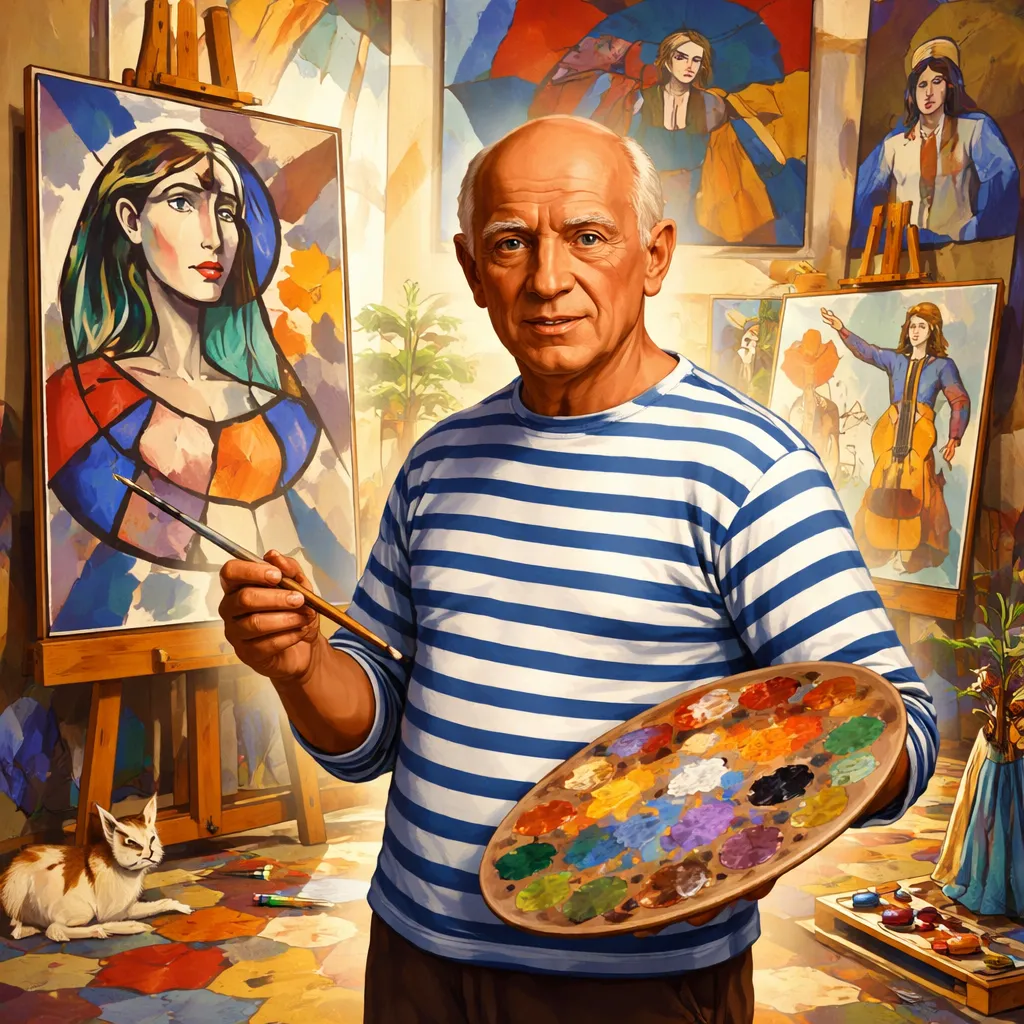

Introduction to Pablo Picasso
Pablo Picasso was a Spanish painter, sculptor, and one of the most influential artists of the 20th century. Born on October 25, 1881, in Málaga, Spain, Picasso revolutionized the world of art with his innovative approach and groundbreaking techniques. His work spans many periods, from his early Blue and Rose periods to his later involvement in Cubism, a style he co-founded. Picasso's creativity and artistic evolution make him an exciting figure to study, especially for young learners interested in art and creativity.
Why is Pablo Picasso worth knowing? His ability to reinvent art and push the boundaries of what was possible in painting and sculpture makes him a key figure in the world of visual art. Picasso’s adventurous spirit, dedication to his craft, and ability to create revolutionary works make him a figure who continues to inspire artists and art enthusiasts around the world.
Early Life and Background
Picasso’s early life was heavily influenced by his father, who was an art teacher and a painter. His father recognized his son’s talent at an early age, and by the age of seven, Picasso was already creating impressive drawings. Picasso’s family moved frequently due to his father’s job, which exposed him to various cultural influences and art styles.
Picasso’s formal education in art began when he was just 14 years old, as he attended the Royal Academy of San Fernando in Madrid. However, he quickly grew frustrated with traditional art education and preferred to explore his own artistic ideas. His early years were marked by both struggle and discovery, as he sought to express his unique vision of the world. During his time in Barcelona and later in Paris, Picasso met other young artists and was influenced by modern art movements.
Despite his youth, Picasso showed immense promise. His early works, while somewhat traditional, already hinted at the artistic innovation that would define his career. By his late teens, Picasso was gaining attention, and his career began to take off as he explored different styles and techniques.
Career Highlights and Achievements
Pablo Picasso’s career was a true journey of artistic evolution. Over his 75 years of painting, sculpture, printmaking, and ceramics, Picasso created an estimated 50,000 artworks. His career can be divided into various phases, each marked by distinct styles and themes.
One of Picasso’s most notable milestones was the co-founding of the Cubist movement. Cubism, along with his partner Georges Braque, changed the course of art history. The style sought to depict objects from multiple viewpoints, breaking traditional perspectives and creating abstract forms. Picasso’s work Les Demoiselles d'Avignon (1907) is considered one of the first Cubist paintings and is still celebrated as a revolutionary piece of art.
Picasso’s work was not limited to just Cubism. He was also known for his Blue Period (1901-1904), which reflected themes of sadness, loneliness, and poverty. During this time, Picasso painted subjects like beggars and the disabled, often using shades of blue to convey a sense of melancholy. His Rose Period (1904-1906) followed, featuring more light-hearted subjects like circus performers, with a warmer color palette.
Another key achievement in Picasso’s career was his ability to master many forms of art. From ceramics to sculptures and even printmaking, Picasso’s artistic versatility set him apart from many of his contemporaries. He was constantly exploring new techniques and ideas, which kept his work fresh and exciting throughout his life.
Famous Works or Performances
Picasso created numerous works that have become iconic in the art world. Some of his most famous works include:
Les Demoiselles d'Avignon (1907): This painting marks the birth of Cubism. It depicts five female nudes in an abstract and fragmented manner, with distorted forms and multiple perspectives. The work was revolutionary, breaking away from traditional Western representations of the human form. Guernica (1937): One of Picasso’s most famous and powerful works, Guernica was painted as a response to the bombing of the Spanish town of Guernica during the Spanish Civil War. The large mural depicts the chaos, violence, and suffering caused by war. Guernica remains a symbol of anti-war sentiment and a testament to Picasso’s emotional and political engagement through his art. The Weeping Woman (1937): This series of paintings portrays a woman in distress, reflecting the emotional toll of war. It is seen as an extension of Guernica and remains one of Picasso’s most iconic and emotionally charged works. Girl before a Mirror (1932): This painting is one of Picasso’s best-known works from his later years, showcasing his exploration of the female form and his use of bold colors and shapes. The painting’s abstract nature invites viewers to reflect on identity, youth, and self-perception.
These works, among many others, are central to understanding Picasso’s ability to capture emotion, political statements, and innovative artistic techniques through his distinctive style.
Personal Life and Fun Facts
Picasso’s personal life was just as colorful and complex as his art. He was married twice and had several relationships with prominent women, many of whom influenced his work. His first wife, Olga Khokhlova, a Russian ballerina, inspired a series of works in which Picasso explored his personal emotions through abstract and surreal representations. His second wife, Jacqueline Roque, was the subject of many of his later works.
Picasso was also known for his larger-than-life personality and his love for the bohemian lifestyle. He was deeply involved in the artistic and intellectual circles of Paris and often associated with writers, musicians, and other artists. His works were a reflection of his constant search for new ideas and the way he viewed the world around him.
One fun fact about Picasso is that he was a perfectionist when it came to his work. He would often destroy pieces he didn’t feel were up to his standards, sometimes even cutting up completed works to start anew. This constant desire to improve and experiment with his art was one of the driving forces behind his success.
Legacy and Influence
Pablo Picasso’s influence on art and culture cannot be overstated. As one of the most important figures of the 20th century, his work changed the course of modern art. His involvement in Cubism and his constant experimentation with new styles and mediums revolutionized the way artists approached representation and abstraction.
Beyond his artistic achievements, Picasso’s work has influenced countless artists, including those in the Abstract Expressionist and Pop Art movements. Artists like Andy Warhol, Roy Lichtenstein, and Jackson Pollock were deeply inspired by Picasso’s boldness and willingness to break from tradition.
Picasso’s impact extended far beyond his own time. His work continues to inspire artists and art lovers today, with his paintings displayed in major museums and galleries around the world. His contributions to the world of art are seen as a cornerstone of modern creativity.
How to Learn from Pablo Picasso
There are many lessons we can learn from Pablo Picasso, both as artists and as individuals. One of the most important lessons from Picasso’s life is the value of experimentation. He was never afraid to break boundaries and challenge traditional notions of art. His willingness to take risks and try new techniques is something that young artists and learners can greatly benefit from.
Another lesson from Picasso’s life is the power of self-expression. His art was deeply personal, and he used it as a way to explore his emotions, political views, and relationships. Picasso’s work teaches us that art is not just about technique, but about expressing our inner thoughts and feelings in a meaningful way.
Finally, Picasso’s commitment to his craft reminds us that dedication and hard work are key to success. Despite his many personal struggles and the initial lack of recognition, he never stopped creating. His relentless drive to improve and push the limits of what art could be serves as an inspiration to everyone who strives to achieve greatness in their own field.
Pablo Picasso’s life and work continue to inspire people of all ages around the world. His revolutionary approach to art, combined with his fearless experimentation and boundless creativity, makes him a true icon in the history of art. Through his work, Picasso teaches us that art is not just about creating beautiful images, but about expressing the complexities of life and pushing the boundaries of what is possible.