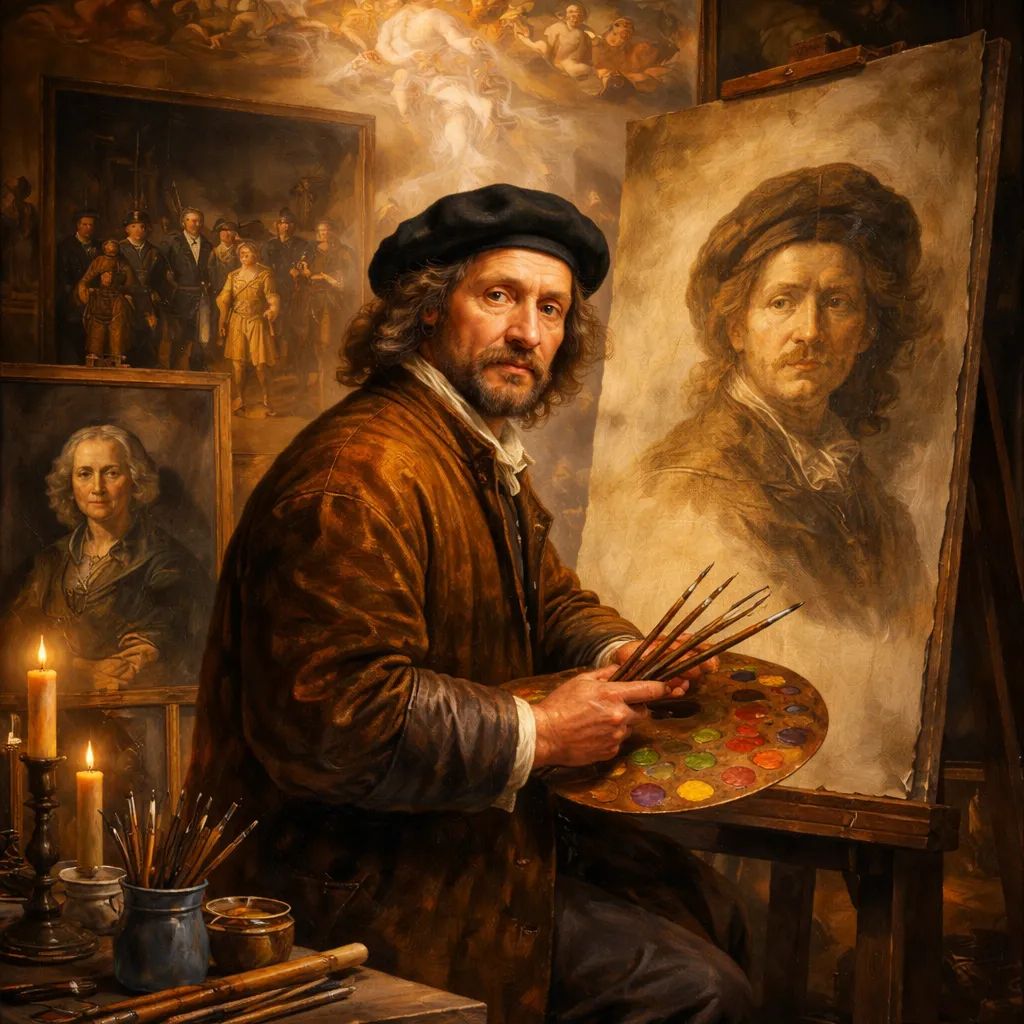

Introduction to Rembrandt
Rembrandt Harmenszoon van Rijn, born on July 15, 1606, in Leiden, Netherlands, is widely regarded as one of the greatest painters and printmakers in history. He is best known for his brilliant use of light and shadow, which earned him recognition as a master of chiaroscuro. Rembrandt’s innovative techniques and emotionally charged works have had an enduring impact on the world of art.
Rembrandt’s story is one of both incredible achievement and personal tragedy. Throughout his life, he faced significant challenges, including financial difficulties and personal loss. Despite this, his art continues to captivate viewers for its raw emotion and technical brilliance. His exploration of human emotions and his ability to capture the soul of his subjects make his work relevant even today.
Why is Rembrandt so important? His mastery of light, his remarkable portraits, and his powerful storytelling through paint have cemented his place as one of the most influential artists in the world. His legacy has inspired generations of artists, and his work is still studied and admired worldwide.
Early Life and Background
Rembrandt was born in Leiden, a city in the Netherlands, to a family of modest means. His father, Harmen Gerritszoon van Rijn, was a miller, and his mother, Neeltje van Zuytbrouck, came from a family of craftsmen. Rembrandt was the youngest of ten children, and his family’s humble background played a significant role in shaping his early life and career.
At the age of 14, Rembrandt enrolled at the University of Leiden to study art, although he quickly left formal education to pursue an apprenticeship with a local painter named Pieter Lastman in Amsterdam. Under Lastman’s guidance, Rembrandt was introduced to the techniques of historical painting and the use of dramatic lighting, both of which would later become hallmark features of his style.
During his early years, Rembrandt was particularly fascinated by religious themes and biblical stories. These themes would become a constant source of inspiration throughout his career, appearing in many of his most famous works. Rembrandt’s talent was evident from the start, and by the time he was in his twenties, he had already begun painting portraits, a genre in which he would later become renowned.
Career Highlights and Achievements
Rembrandt’s career spanned more than 40 years, during which he produced an astonishing body of work. He became famous for his portraits, self-portraits, historical scenes, and landscapes. One of the key milestones in Rembrandt’s career was his ability to master the technique of chiaroscuro, or the use of light and shadow to create depth and drama. This technique set his work apart and allowed him to convey complex emotions in his paintings.
Rembrandt’s early career saw great success, particularly in Amsterdam, where he became a sought-after portraitist. His ability to capture the personality and essence of his subjects made him immensely popular among the wealthy and powerful citizens of Amsterdam. However, his financial stability was short-lived. Despite his artistic success, Rembrandt struggled with poor financial decisions and overspending, which led to his bankruptcy in 1656. He was forced to sell much of his art collection and even his home, but this did not stop him from creating powerful works.
In the 1650s and 1660s, Rembrandt shifted his focus to more intimate subjects, including self-portraits, biblical scenes, and studies of human emotions. His work became more introspective, and he developed a more somber, reflective style. One of the key highlights of Rembrandt’s career was his ability to convey deep psychological insight into his subjects. His self-portraits, in particular, are considered a window into his soul, showing both the vulnerability and strength of the artist.
Despite his financial troubles, Rembrandt was celebrated for his technical mastery. His use of light and shadow, as well as his innovative approach to brushwork, made him one of the most admired painters of his time. His influence on later artists, including his pupil and friend, Peter Paul Rubens, was profound.
Famous Works or Performances
Rembrandt’s body of work is vast and varied, but several masterpieces stand out for their emotional depth and technical brilliance. Below are some of his most famous and influential works:
The Night Watch (1642): Perhaps Rembrandt’s most famous painting, The Night Watch depicts a group of civic guardsmen preparing for a mission. The painting is renowned for its dramatic use of light and shadow, which gives the figures a sense of movement and vitality. The composition breaks away from traditional group portraits by depicting the guards in action, rather than in a static pose. The Night Watch is a striking example of Rembrandt’s ability to bring life and energy to his subjects. The Anatomy Lesson of Dr. Nicolaes Tulp (1632): This painting is one of Rembrandt’s early masterpieces and showcases his skill at capturing both the human form and the dramatic use of light. The painting depicts Dr. Tulp, a prominent physician, demonstrating a dissection to a group of his colleagues. Rembrandt’s use of light to focus attention on the subject of the dissection creates a powerful, almost theatrical effect. Self-Portrait with Two Circles (1665–1669): One of Rembrandt’s later self-portraits, this painting shows the artist in a moment of deep introspection. The use of light to highlight Rembrandt’s face and the dramatic, almost mystical background with two circles creates a sense of mystery. This self-portrait is often seen as a reflection of Rembrandt’s personal and artistic struggles during his later years. The Jewish Bride (1665): This painting, which depicts a couple in a tender embrace, is one of Rembrandt’s most beautiful and emotionally rich works. The use of light and texture in the painting creates a sense of intimacy, while the deep expressions of love and devotion on the couple’s faces make it a poignant representation of human emotion. The Return of the Prodigal Son (1668–1669): This powerful painting depicts the biblical story of the Prodigal Son, focusing on the moment when the son returns home to be embraced by his father. The painting is celebrated for its emotional depth, capturing the themes of forgiveness, redemption, and unconditional love. Rembrandt’s use of light and his ability to depict complex human emotions make this work one of his greatest achievements. Personal Life and Fun Facts
Rembrandt’s personal life was marked by both joy and hardship. He married Saskia van Uylenburgh in 1634, and the couple had several children, though most of them died young. Saskia’s death in 1642 left Rembrandt devastated, and he never fully recovered from the loss. He later had a relationship with Hendrickje Stoffels, who became his companion until his death. Despite their personal struggles, Hendrickje was an important figure in his life and supported him through his later years.
Rembrandt was also known for his love of collecting objects, including antiques and curiosities. His personal collection reflected his fascination with history and the human experience, which were themes that frequently appeared in his art. It is said that he would often use objects from his collection as props in his paintings, adding a layer of personal meaning to his works.
Fun fact: Rembrandt was also an accomplished printmaker, producing over 300 etchings throughout his career. His innovative techniques in printmaking were as groundbreaking as his paintings and contributed to his reputation as a master of multiple mediums.
Legacy and Influence
Rembrandt’s legacy extends far beyond his own time. His innovative use of light and shadow, his ability to capture the emotional depth of his subjects, and his mastery of both painting and printmaking have left a lasting impact on the art world. Rembrandt’s influence can be seen in the work of countless artists who followed him, from the Baroque painters of the 17th century to the modern artists of the 20th century.
Rembrandt’s style evolved throughout his life, from the dramatic compositions of his early works to the more introspective and emotional paintings of his later years. His ability to convey deep psychological insight into his subjects, as well as his technical innovation, has made him one of the most studied and admired artists in history.
Rembrandt’s paintings are housed in museums around the world, and his work continues to inspire artists, art historians, and art lovers alike. His legacy reminds us of the power of art to capture the human experience, to evoke emotion, and to challenge traditional boundaries.
How to Learn from Rembrandt
Rembrandt’s life and work offer valuable lessons for young people and aspiring artists. One of the key lessons from Rembrandt is the importance of perseverance. Despite facing personal hardships, including financial struggles and the loss of loved ones, Rembrandt continued to create art that resonated with people for centuries.
Another important lesson is the value of observation. Rembrandt had a remarkable ability to capture the human experience in all its complexity, whether it was the drama of a historical scene or the quiet introspection of a self-portrait. Aspiring artists can learn from his keen observation of the world around him, as well as his deep empathy for his subjects.
Finally, Rembrandt’s work teaches us the importance of innovation. Throughout his career, he pushed the boundaries of art, experimenting with light, shadow, and texture to create powerful, emotionally charged works. His ability to evolve as an artist and to constantly challenge himself is a lesson in creativity and growth that all young artists can take to heart.
Rembrandt’s art continues to captivate audiences with its emotional depth and technical brilliance. His work has left an indelible mark on the world of art, and his influence continues to inspire new generations of artists. Through his paintings and prints, Rembrandt has shown us the power of art to express the deepest aspects of the human experience.