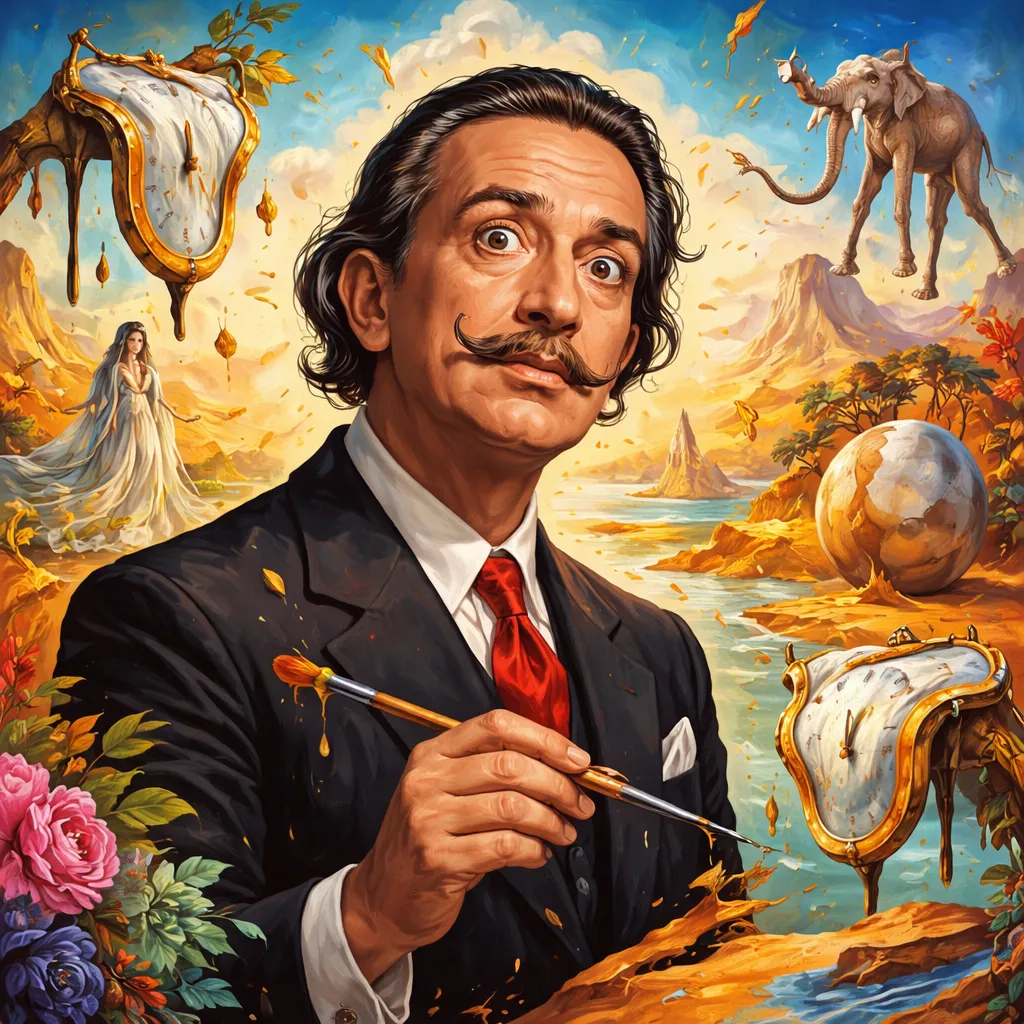

Introduction to Salvador Dalí
Salvador Dalí, born on May 11, 1904, in Catalonia, Spain, was one of the most famous surrealist artists in history. Known for his eccentric personality and brilliant imagination, Dalí’s work transcended traditional art, exploring the dream world, the unconscious mind, and the bizarre aspects of human experience. His bold use of strange, distorted imagery and meticulous technique made his paintings both captivating and thought-provoking.
Why is Salvador Dalí worth knowing about? His artistic vision was unlike any other, and his ability to combine detailed realism with surreal, imaginative elements changed the way people viewed art. Dalí’s contributions to the Surrealist movement have left a lasting legacy, influencing generations of artists, filmmakers, and thinkers. His unique blend of creativity and intellect makes him a fascinating figure to explore, especially for young learners interested in art and creative thinking.
Early Life and Background
Salvador Dalí was born into a family of modest means. His father, Salvador Dalí i Cusi, was a lawyer, and his mother, Felipa Domènech, was a devout and supportive woman. Dalí’s early life was marked by tragedy, as his older brother, also named Salvador, died when Dalí was just a baby. This loss deeply affected him, and he often claimed that his older brother’s death influenced much of his art and the way he viewed life.
Dalí showed a talent for drawing from a young age, and by the time he was 17, he had already begun attending the Royal Academy of Fine Arts of San Fernando in Madrid. It was here that Dalí’s unconventional approach to art started to emerge. He quickly became known for his eccentricity and non-traditional methods, even causing controversy among his professors for his unwillingness to conform to conventional artistic norms.
Dalí’s time in Madrid was pivotal in his development as an artist. He was influenced by a variety of artistic movements, including Impressionism and Cubism, but it was the works of Freudian psychology and the teachings of Sigmund Freud that sparked Dalí’s interest in the Surrealist movement. His desire to explore the unconscious mind and dream imagery would soon become central to his artistic style.
Career Highlights and Achievements
Dalí’s career spanned over six decades, and during this time, he produced thousands of works across various mediums, including painting, sculpture, and filmmaking. One of the key milestones in Dalí’s career was his involvement with the Surrealist movement in the 1920s and 1930s. Surrealism, led by André Breton, was a movement that sought to express the unconscious mind and dreams, breaking free from traditional artistic rules and logic.
In 1929, Dalí became closely associated with the Surrealists, and his works began to gain attention for their bizarre, dreamlike quality. It was during this time that Dalí produced some of his most iconic paintings, including The Persistence of Memory (1931), a piece that featured melting clocks draped over tree branches and a distorted landscape. This painting became one of the most famous examples of Surrealism and remains a symbol of Dalí’s unique artistic vision.
Dalí’s career also included significant recognition and awards. He exhibited his work in major galleries worldwide, and his fame grew exponentially. He worked alongside other influential artists, including Pablo Picasso, and collaborated with filmmakers such as Alfred Hitchcock and Luis Bu?uel. Dalí’s ability to blend his art with pop culture, literature, and film made him one of the most innovative and adaptable artists of his time.
Dalí’s influence extended beyond traditional art. He also ventured into the realms of sculpture, fashion, and design. His interest in all things fantastical and imaginative led him to create surreal furniture designs and even jewelry. In his later years, Dalí explored religious themes, producing works that incorporated both his religious beliefs and his signature surrealist style.
Famous Works or Performances
Salvador Dalí’s body of work is vast and varied, but several pieces stand out as quintessential representations of his surrealist vision. Here are some of his most famous works:
The Persistence of Memory (1931): Arguably Dalí’s most famous painting, The Persistence of Memory depicts a desolate landscape with soft, melting clocks draped over tree branches and other objects. The painting plays with the concept of time, suggesting that it is fluid and malleable. The dreamlike quality of the piece and its unusual composition make it an iconic example of Surrealism. The Elephants (1948): This painting features towering elephants with long, spindly legs, carrying obelisks on their backs. The surreal, exaggerated proportions and dreamlike composition are signature elements of Dalí’s work, and the painting explores themes of strength, fragility, and the passage of time. The Sacrament of the Last Supper (1955): In this later work, Dalí reimagines the biblical scene of the Last Supper with surreal, geometric elements. The painting reflects Dalí’s complex relationship with religion and his desire to blend traditional iconography with his unique style. The piece features a large, translucent figure of Christ hovering above the scene, and the figures around the table are distorted, creating an otherworldly atmosphere. The Great Masturbator (1929): One of Dalí’s most personal and psychological works, The Great Masturbator delves into the unconscious mind, reflecting Dalí’s exploration of Freudian theories. The painting features a distorted face with an unsettling combination of symbols, suggesting themes of desire, anxiety, and repression.
These works represent just a fraction of Dalí’s extensive portfolio, but they encapsulate the core of his surrealist approach—blending meticulous realism with dreamlike, irrational imagery.
Personal Life and Fun Facts
Dalí’s personal life was as eccentric and colorful as his artwork. He was known for his flamboyant personality, extravagant mustache, and dramatic flair. His relationship with his wife, Gala Dalí, was one of the most significant aspects of his personal life. Gala, a former Russian model, was not only Dalí’s muse but also his business manager and a central figure in his work. The two had a deeply passionate, yet complicated relationship that lasted until Gala’s death in 1982.
Dalí also had a penchant for the bizarre, often blending his personal life with his artistic persona. He once appeared at an exhibition wearing a diving suit and helmet, symbolizing his immersion into the depths of his subconscious. He enjoyed shocking people with his outrageous behavior, which only added to his fame.
One of the most fun and curious aspects of Dalí’s life was his fascination with optical illusions and the concept of "paranoiac-critical" method— a technique he developed to tap into his unconscious mind by focusing on ambiguous images and creating surreal interpretations of them. His ability to find inspiration in everyday objects and transform them into extraordinary visions is one of the reasons his work continues to captivate audiences.
Legacy and Influence
Salvador Dalí’s influence on the art world is profound and enduring. As a central figure in the Surrealist movement, Dalí helped redefine the role of the artist in the 20th century. His exploration of the unconscious mind, dreams, and irrational imagery opened new pathways for artistic expression and intellectual exploration.
Dalí’s work paved the way for many later movements, including Abstract Expressionism and Pop Art. His ability to blend fine art with commercial culture has also made him a key figure in the intersection of art and mass media. Dalí’s surreal, imaginative works continue to inspire contemporary artists, filmmakers, and designers.
Beyond the world of art, Dalí’s influence can be seen in literature, psychology, and popular culture. His work, particularly The Persistence of Memory, has been referenced in films, advertisements, and even cartoons. Dalí’s ability to merge intellectual concepts with fantastical imagery makes his legacy one that resonates far beyond the art world.
How to Learn from Salvador Dalí
Salvador Dalí’s life and work provide valuable lessons for young learners and aspiring artists. One of the key lessons from Dalí is the importance of imagination. He encouraged everyone to explore their dreams, subconscious thoughts, and emotions through their art. Dalí’s work shows that creativity is not confined by rules or reality—it is something that can be boundless and free.
Another lesson from Dalí’s life is the value of embracing individuality. Dalí was never afraid to stand out, whether through his bold art or his flamboyant personal style. His willingness to be himself and embrace his eccentricities teaches us that being unique is something to be celebrated.
Finally, Dalí’s relentless pursuit of his artistic vision, despite criticism or challenges, serves as a powerful reminder to never give up on one’s creative dreams. His perseverance, passion, and exploration of the unknown make him a lasting example of how dedication to one’s craft can lead to extraordinary achievements.
Salvador Dalí’s contribution to the world of art is immeasurable. His surrealist masterpieces, his willingness to push boundaries, and his unforgettable personality have left a lasting legacy that continues to inspire artists and thinkers alike. Through his work, Dalí showed us that art is not just about creating beautiful images; it is about exploring the mysteries of the mind, the universe, and the human experience.