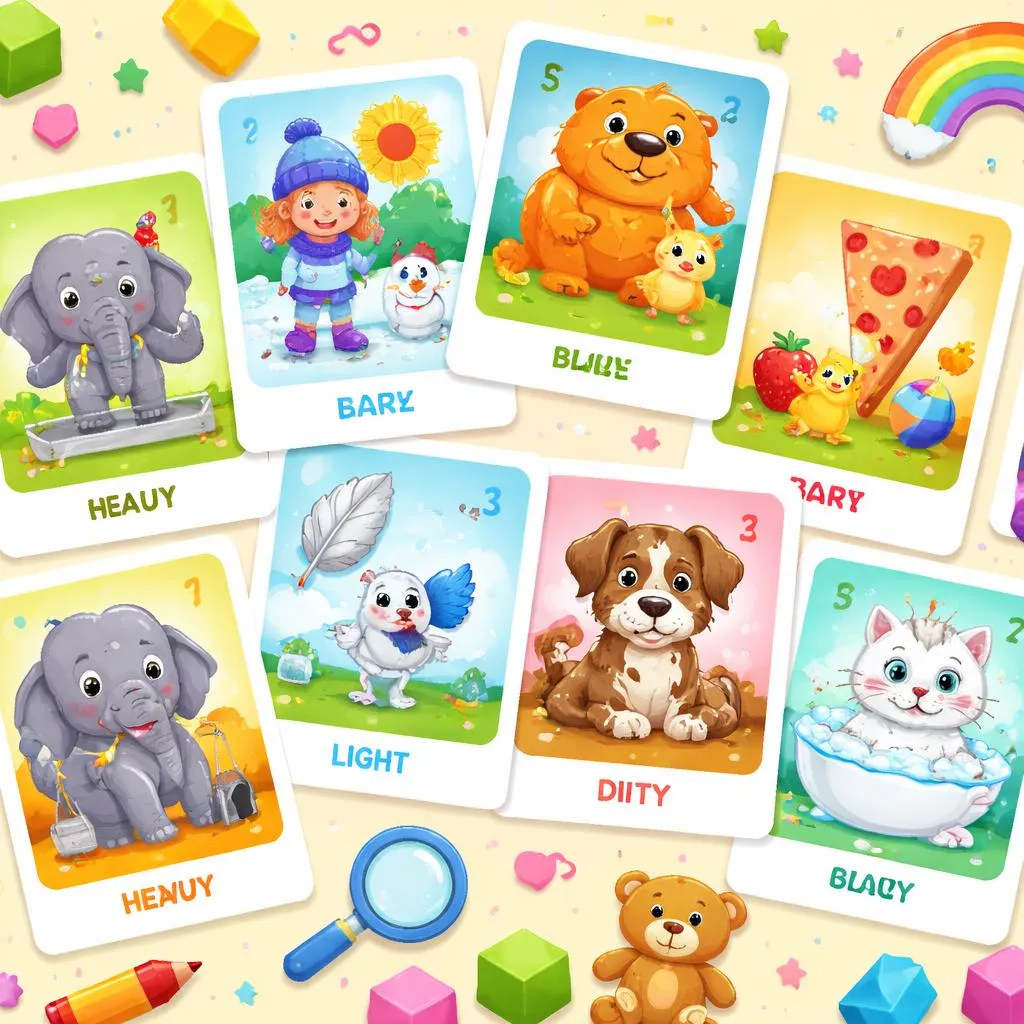

Each card shows one picture, however, the vocabulary words in the set are paired with their opposite. For example, there is one card for ‘high’ and one for ‘low’, ‘easy’ and ‘difficult’, etc. Most of the items being described are simple vocabulary that beginner level students will already be familiar with (pencil, desk, boy, girl, hair, pig). A few of the words might be new: city (or building), ladder, math, glass.
Word list: clean, cool, difficult, dirty, dull, easy, empty, full, geeky, heavy, high, light, long, loud, low, messy, new, old, poor, quiet, rich, sharp, short, thick, thin, tidy
Click here to download the full Adjectives Set C PDF — free
By practicing with flashcards, children can:
Flashcards featuring opposite adjectives help children build essential vocabulary by pairing words like "high" and "low," "easy" and "difficult," or "clean" and "dirty." These cards use simple, relatable images and words that beginner learners recognize, making it easier to grasp new concepts. Children develop their understanding of descriptive language, improve memory through repetition, and enhance their ability to express comparisons and contrasts. This foundational skill supports reading comprehension, speaking confidence, and overall language development.
How to Teach Opposite Adjectives Flashcards with Flashcards
Parents and educators can use these flashcards by showing one card at a time and encouraging children to say the word aloud. Then, present the opposite card and ask children to describe how the two words differ. For example, show the card for "clean" and then "dirty," prompting children to talk about things that are clean or dirty in their environment. Repetition and discussion help reinforce meaning. Using real-life examples alongside the cards makes learning more concrete and engaging.
(1) Fun Opposite Adjectives Flashcard Games
Playing games like "Memory Match," where children find pairs of opposite words, or "Charades," where kids act out the adjectives, makes learning enjoyable. Another game is "Opposite Hunt," where children look around the room to find objects that match the adjectives on the cards. These activities encourage active participation, improve retention, and make vocabulary learning dynamic and social.
(2) Example Sentences with Opposite Adjectives
Children can practice sentences such as "The pencil is sharp, but the eraser is dull," or "The box is full, but the bag is empty." Using these sentences helps children understand how adjectives describe objects and situations, and how opposites provide contrast. This practice builds sentence structure skills and encourages expressive language use.
Free Opposite Adjectives Flashcards PDF Download
To support learning at home or in the classroom, free printable PDFs of the opposite adjectives flashcards are available for download. These resources can be printed on card stock for durability and used repeatedly. Having physical flashcards allows for hands-on interaction, which is especially helpful for young learners who benefit from tactile experiences.
FAQ about Opposite Adjectives Flashcards
Q: At what age are these flashcards suitable?
A: They are ideal for beginner learners, typically preschool to early elementary age.
Q: How often should children practice with the flashcards?
A: Short daily sessions of 5-10 minutes are effective for steady vocabulary growth.
Q: Can these flashcards be used for group activities?
A: Yes, they work well for both individual and group learning settings.
Q: Are there exercises to reinforce learning beyond flashcards?
A: Yes, simple writing prompts, drawing activities, and storytelling using the adjectives can further deepen understanding.
These flashcards provide a fun, interactive way to build essential descriptive vocabulary through opposites, supporting early language development and communication skills.