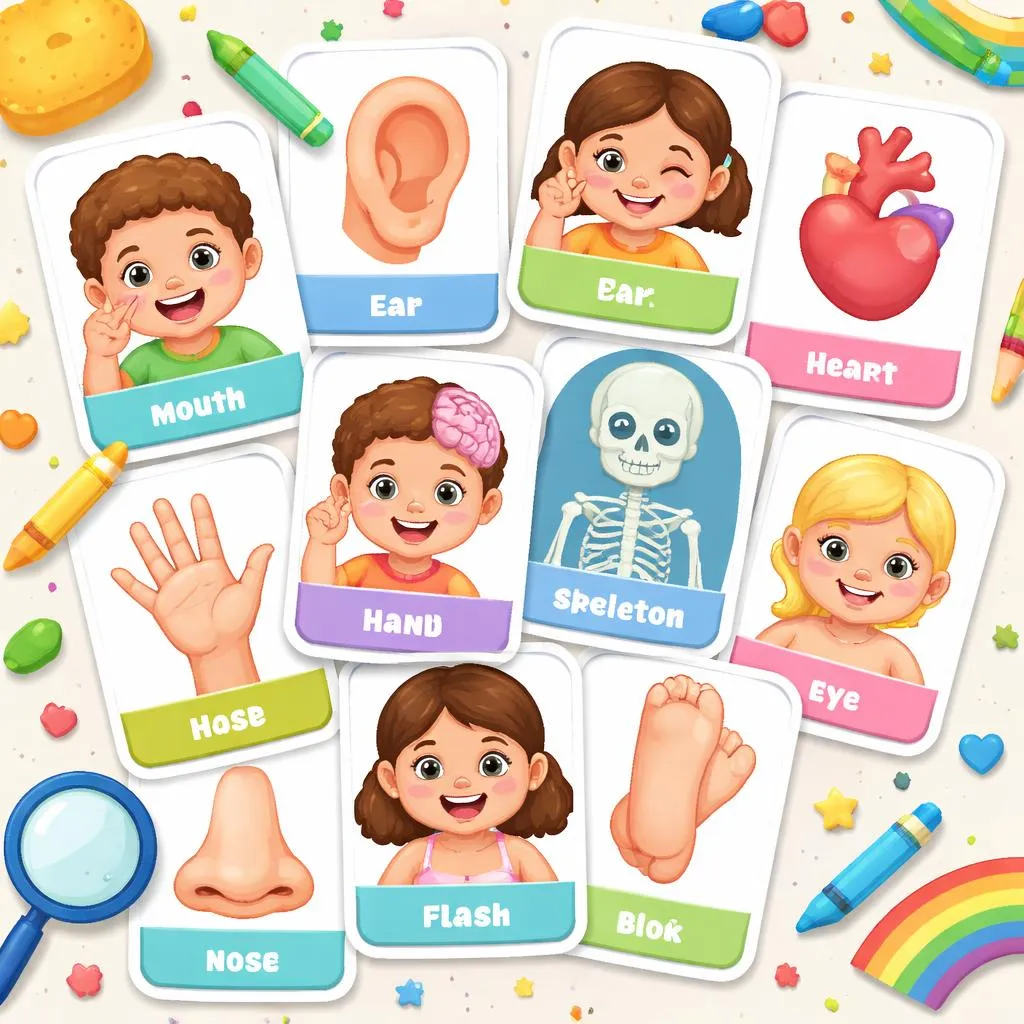

These picture cards have the same cartoon style and Body – Set 1 . However, this set of body vocabulary includes more specific words for parts of the face and head. There are also useful words for describing facial hair, mustache and beard . If you have a mixed level class (or quick-learning beginners) add these less-commonly taught body parts cards to your lesson for added challenge.
Word list: beard, brain, cheek, chin, eyebrow, eyelash, hair, lips, moustache, neck, teeth, tongue
Click here to download the full Body – Set 2 PDF — free
By practicing with flashcards, children can:
Flashcards are a fun and interactive way for children to learn new vocabulary related to parts of the face and head. Using these flashcards, kids can improve their memory, pronunciation, and recognition skills while becoming familiar with specific words like beard, brain, cheek, chin, eyebrow, eyelash, hair, lips, moustache, neck, teeth, and tongue. These cards also help children develop their descriptive language abilities by introducing terms related to facial hair and other detailed features. Practicing with flashcards encourages active participation and makes learning engaging, especially for mixed-level classrooms or quick learners seeking an extra challenge.
How to Teach Body Vocabulary with Flashcards
Parents and educators can use these flashcards by first introducing each word with a clear picture and pronunciation. Encourage children to repeat the words aloud and point to the corresponding parts on their own faces or on pictures. Using the flashcards in short, frequent sessions helps reinforce learning without overwhelming young learners. Incorporate storytelling or simple questions like “Where is your chin?” or “Can you show me your eyebrows?” to make the lessons interactive. For home use, parents can make learning a daily routine by reviewing a few flashcards each day and praising children for their progress.
(1) Fun Body Vocabulary Flashcard Games
(2) Example Sentences with Body Vocabulary
To strengthen vocabulary retention, play games such as “Flashcard Memory,” where children match pairs of cards, or “Simon Says” using body parts, e.g., “Simon says touch your lips.” Another engaging game is “Guess the Body Part,” where one child describes a part without naming it, and others guess. Example sentences help children understand how to use new words in context: “My moustache is curly,” “She has long eyelashes,” or “The brain helps us think.” These activities make learning lively and encourage children to use the vocabulary in everyday conversation.
Free Body Vocabulary Flashcards PDF Download
Families and teachers can easily access and print the full set of Body Vocabulary flashcards for free. The downloadable PDF includes colorful, cartoon-style images that appeal to children and are perfect for classroom or home use. Simply click the provided link to get the complete set and start teaching right away. Having physical flashcards on hand makes it easy to integrate vocabulary practice into daily routines and supports consistent learning.
FAQ about Body Vocabulary Flashcards
Q: What age group are these flashcards suitable for?
A: These flashcards are ideal for young children aged 3-8 years, including beginners and early learners.
Q: How often should children practice with the flashcards?
A: Short daily sessions of 5-10 minutes are most effective for retention and engagement.
Q: Can these flashcards be used for mixed-level groups?
A: Yes, the cards include both common and less commonly taught words, making them suitable for mixed-ability classes.
Q: Are there any additional activities to support learning?
A: Yes, parents and teachers can create drawing or labeling exercises, role-playing scenarios, and matching games to reinforce vocabulary comprehension and usage.