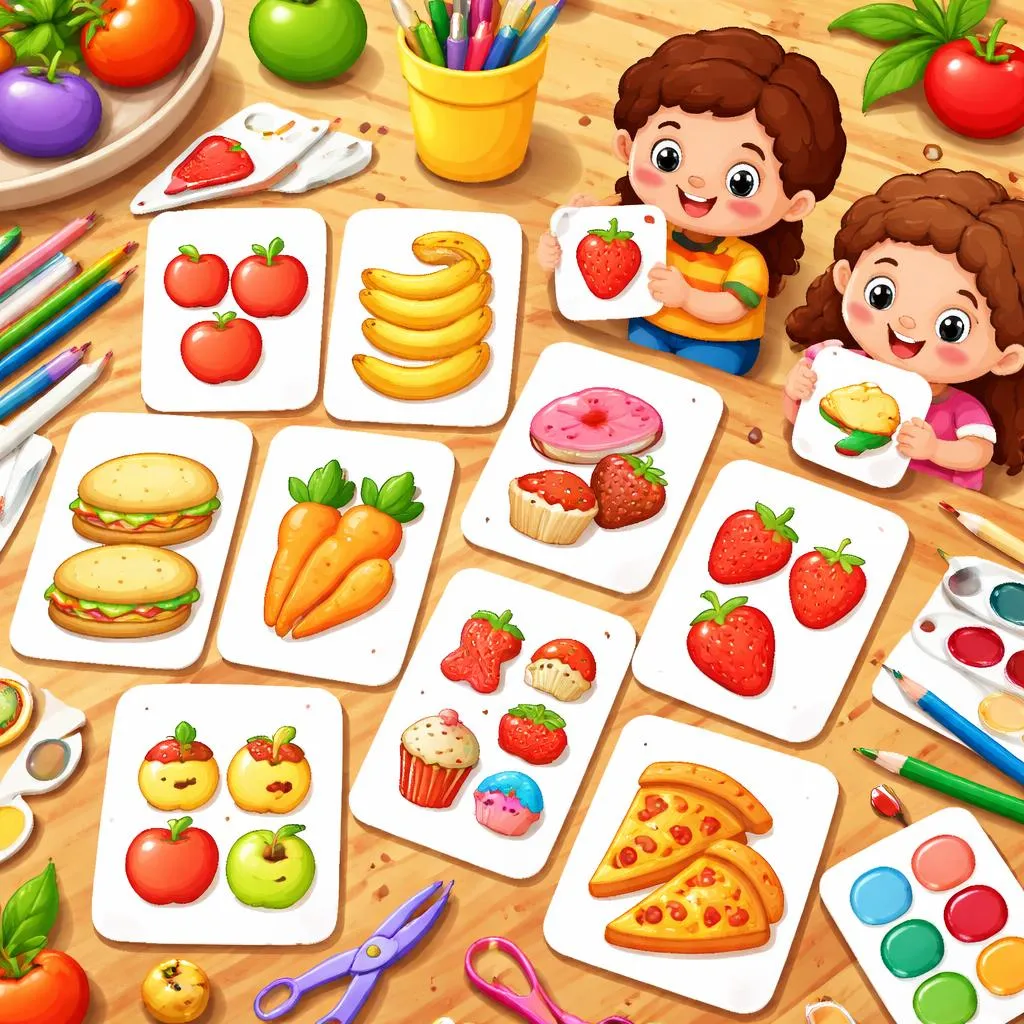

All the pictures in this set show plural food items that you can count. (Those pies are still uncut so they are countable, too!) Use these cards for teaching food vocabulary and for practicing Do you like… ? / I like … / I don’t like… + food, and keep working on that final -s sound.
Word list: apples, bananas, carrots, cookies, cucumbers, donuts, eggs, hamburgers, hotdogs, onions, oranges, peppers, pies, pineapples, pretzels, sandwiches, strawberries, tomatoes
Click here to download the full Countable Food PDF — free
By practicing with flashcards, children can:
Flashcards are a fantastic tool for young learners to build vocabulary, improve pronunciation, and develop sentence structure skills. Using these plural food flashcards, children can practice naming common foods they see every day, helping them become more confident in speaking English. They also learn to form simple sentences like "Do you like apples?" or "I don’t like onions," which encourages conversational skills. Additionally, focusing on the final -s sound in plural nouns helps children improve their pronunciation and listening abilities. These flashcards make learning interactive and fun, keeping children engaged while reinforcing essential language skills.
How to Teach Countable Food Flashcards with Flashcards
Parents and teachers can start by introducing each flashcard one by one, showing the picture and saying the word clearly. Encourage children to repeat after you, paying attention to the plural -s sound. Use questions like "Do you like bananas?" and prompt children to answer with "Yes, I do" or "No, I don’t." You can group flashcards by color or type (fruits, vegetables, snacks) to help children categorize vocabulary. Repetition is key, so review the cards daily in short sessions to build familiarity and confidence. Using real food items alongside flashcards can make the learning more tangible and relatable for children.
(1) Fun Countable Food Flashcard Games
Games make learning exciting and memorable. Try "Flashcard Bingo," where children mark off foods as you call them out, or "Memory Match," where they find pairs of the same food cards. Another game is "I Spy," where you describe a food item and children guess the card. These activities reinforce vocabulary and help children practice listening and speaking in a playful way. You can also play "Food Sorting," where children group flashcards into categories like fruits or vegetables, encouraging critical thinking and vocabulary expansion.
(2) Example Sentences with Countable Food Vocabulary
Using the flashcards, children can practice sentences such as "I like strawberries," "Do you like cookies?" or "I don’t like onions." Adding emotions to these sentences, like "I love apples!" or "I don’t like tomatoes because they are sour," helps children express preferences and feelings, making language learning more meaningful. Encourage children to create their own sentences using the flashcards to boost creativity and confidence.
Free Countable Food Flashcards PDF Download
You can easily download and print a free PDF of these countable food flashcards from the provided link. This makes it simple to have a ready set of colorful, engaging cards at home or in the classroom. Printing multiple copies allows for group activities and games, enhancing the learning experience. The PDF is designed to be clear and kid-friendly, perfect for early learners.
FAQ about Countable Food Flashcards
Q: How often should children practice with these flashcards?
A: Short daily sessions of 10-15 minutes are most effective to keep children engaged without overwhelming them.
Q: Can these flashcards be used for children who are beginners in English?
A: Yes, these flashcards are ideal for beginners as they focus on simple, common vocabulary and basic sentence structures.
Q: What if a child struggles with pronunciation?
A: Encourage slow, repeated practice and model the words clearly. Using songs or videos with the same vocabulary can also help.
Q: Are these flashcards suitable for group learning?
A: Absolutely! Group games and activities with these flashcards promote social interaction and language practice among peers.
Q: How can parents support learning outside of flashcard use?
A: Parents can incorporate the vocabulary into daily routines, like naming foods during meals or grocery shopping, to reinforce learning naturally.