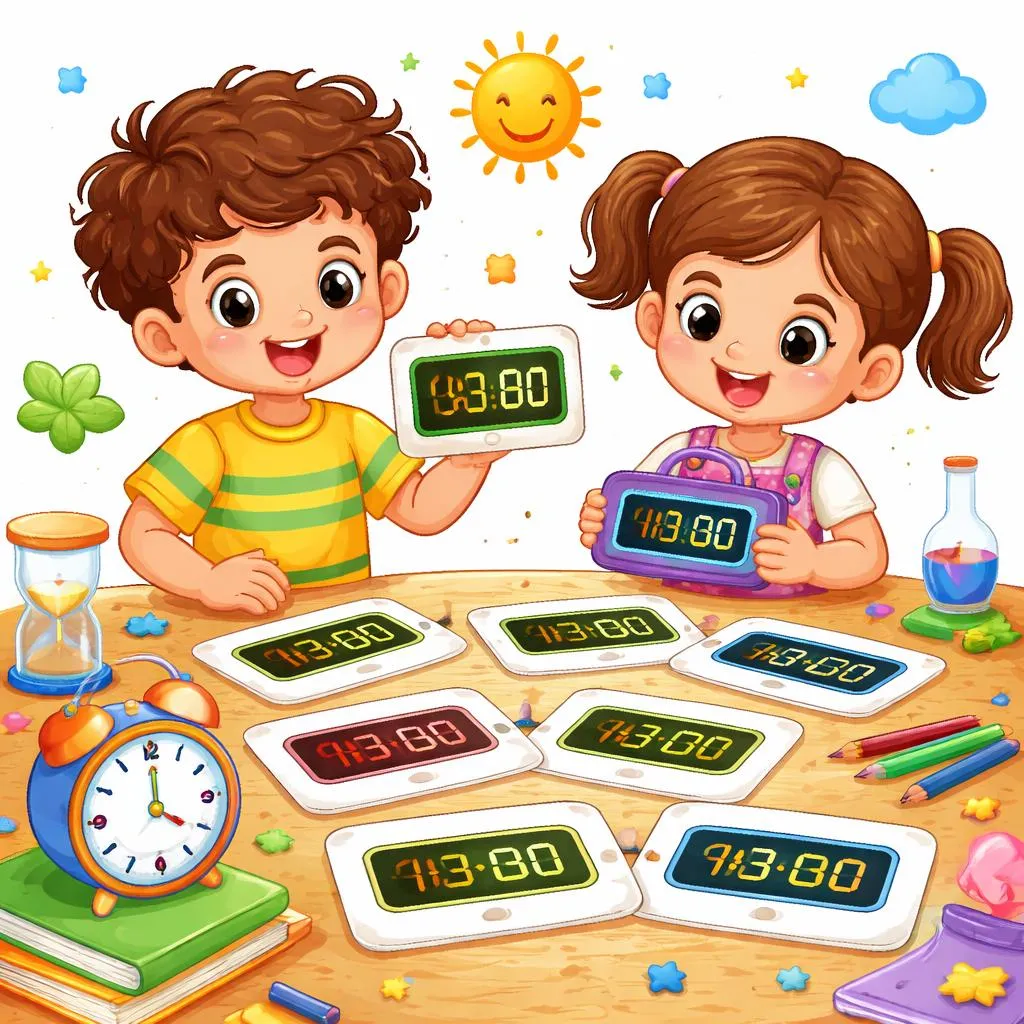

Teach how to tell time in English with our Digital Clocks flashcards! This set perfectly matches up with the analog clocks in the Time Flashcards Set. Here we have 48 time flashcards using a digital clock font. These time cards follow 15-minutes increments throughout a 12-hour cycle. It’s possible to combine the two sets for memory games or other activities.
The differences between the two sets are: the digital clocks have a horizontal, landscape layout <–>, whereas the analog clock cards are vertical the digital clocks’ “word only” cards are actually full sentences, ex. It’s twelve thirty. the card border colours are different This digital font isn’t actually my favourite– it leans like an italic and the 1s and 7s are very similar. Still, it’s the font I had on hand. Please let me know in the comments whether these cards work for you ??
Word list: 1:00, 1:15, 1:30, 1:45, 10:00, 10:15, 10:30, 10:45, 11:00, 11:15, 11:30, 11:45, 12:00, 12:15, 12:30, 12:45, 2:00, 2:15, 2:30, 2:45, 3:00, 3:15, 3:30, 3:45, 4:00, 4:15, 4:30, 4:45, 5:00, 5:15, 5:30, 5:45, 6:00, 6:15, 6:30, 6:45, 7:00, 7:15, 7:30, 7:45, 8:00, 8:15, 8:30, 8:45, 9:00, 9:15, 9:30, 9:45
Click here to download the full Digital Clocks Flashcards PDF — free
By practicing with Digital Clocks Flashcards, children can:
- Learn to tell time in English using clear, easy-to-read digital clock formats.
- Understand time increments in 15-minute intervals, building a strong foundation in time concepts.
- Improve their reading and speaking skills by practicing full sentence time expressions, such as "It’s twelve thirty."
- Develop memory and cognitive skills through interactive games combining digital and analog clock flashcards.
- Gain confidence in expressing time verbally, enhancing everyday communication.
How to Teach Digital Clocks Flashcards with Flashcards
Parents and educators can start by introducing the digital clock flashcards one at a time, pronouncing each time clearly and encouraging children to repeat after them. Use the full sentence cards to help children form complete time expressions, reinforcing both vocabulary and sentence structure. Combine the flashcards with real-life activities, such as asking children to read the time on clocks around the house or classroom. Consistent daily practice with these flashcards helps children become familiar with telling time in a fun and engaging way.
(1) Fun Digital Clocks Flashcard Games
To make learning enjoyable, try memory matching games by pairing digital clock cards with their analog counterparts. Another game involves showing a flashcard and asking children to act out or draw what they might be doing at that time of day. You can also play "What time is it?" where children pick a flashcard and say the time aloud, earning points for accuracy. These games reinforce time vocabulary and help children internalize time concepts through play.
(2) Example Sentences with Time Vocabulary
Using the flashcards, children can practice sentences like "It’s three fifteen," "It’s six forty-five," or "It’s nine o’clock." Encourage them to add emotions or daily activities, for example, "It’s seven thirty, time to wake up!" or "It’s twelve fifteen, I am hungry." This approach helps children connect time expressions with real-life contexts and emotions, making learning more meaningful.
Free Digital Clocks Flashcards PDF Download
Our Digital Clocks Flashcards are available for free download in PDF format, making it easy for parents and teachers to print and use them at home or in the classroom. The set includes 48 cards covering all 15-minute increments in a 12-hour cycle, designed with a clear digital font and colorful borders to capture children’s attention. Downloading and printing these flashcards provides a convenient, cost-effective way to support children’s time-telling skills.
FAQ about Digital Clocks Flashcards
Q: Are these flashcards suitable for beginners?
A: Yes, they are designed for children just starting to learn how to tell time, using simple digital clock displays and full sentence examples.
Q: Can these flashcards be used with analog clock flashcards?
A: Absolutely! Combining both types helps children understand the relationship between digital and analog time formats.
Q: How often should children practice with these flashcards?
A: Daily short sessions of 5-10 minutes are ideal to build familiarity and confidence without overwhelming the child.
Q: Are there any suggested activities to reinforce learning?
A: Yes, besides games, parents can encourage children to read clocks in their environment and describe daily routines using the time phrases learned.
These flashcards offer a comprehensive, interactive way to help children master telling time in English while having fun.