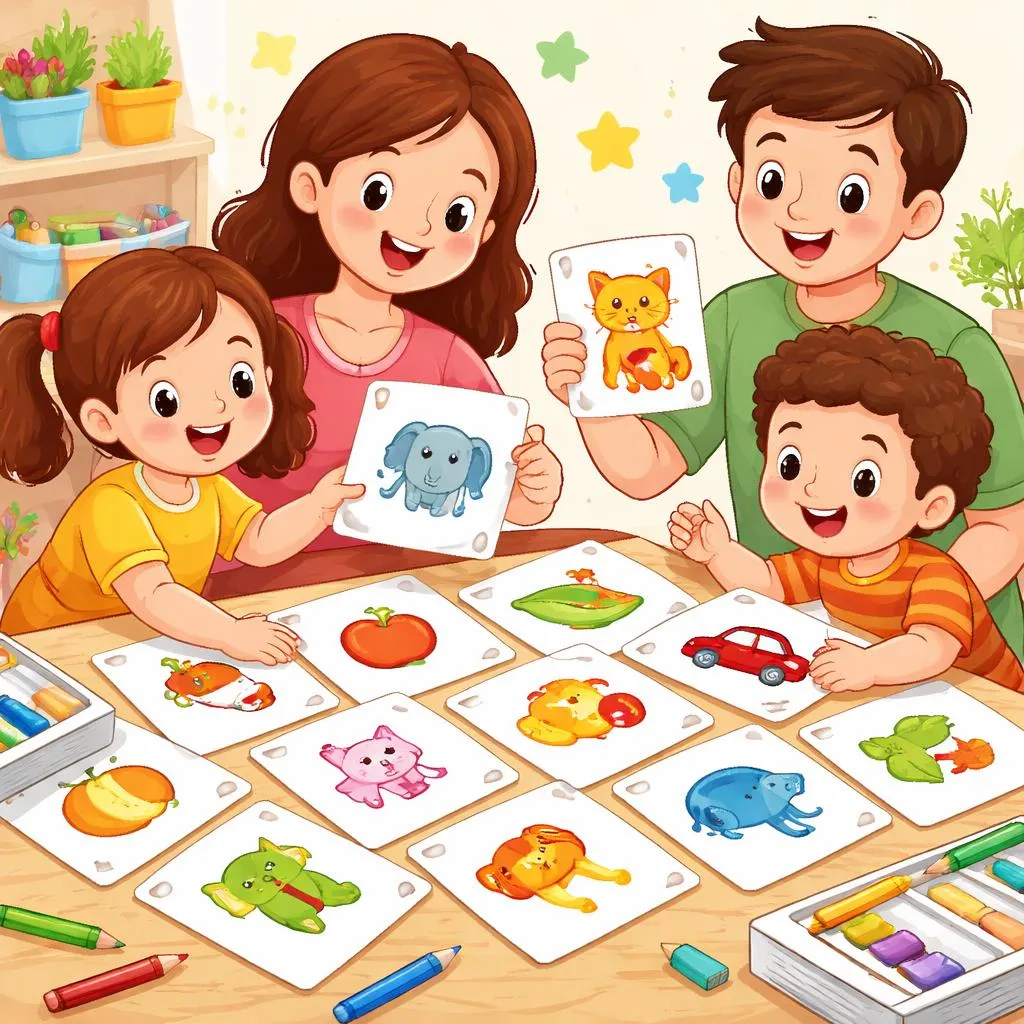

The Family Flashcards set has 15 cards for teaching the words for people in a family. These cards are suitable for teaching young learners as well as beginner adults. When teaching young children, you may want to omit the cards for children, daughter and son ?? Three of the cards depict the word “family”, showing examples of families of different sizes: 3 people, 4 people + dog, and a 9-person extended family with grandparents. Other Uses for Family Flashcards Pair up the people flashcards with another set of vocabulary cards when you need subjects for sentence building activities. For example, pulling one card each from the family set and an action flashcard set: Card 1 = brother Card 2 = draw Possible Sentences = My brother likes to draw. My baby brother can’t draw. Does your brother draw?
Word list: brother, children, daughter, family, father, grandfather, grandmother, grandparents, mother, parents, pets, sister, son
Click here to download the full Family Flashcards PDF — free
By practicing with Family Flashcards, children can:
- Learn the names of family members and related vocabulary in an engaging and visual way.
- Improve their memory and recognition skills by associating words with pictures.
- Develop sentence-building abilities by combining family words with action verbs.
- Enhance their speaking confidence through interactive games and practice.
- Understand family relationships and social concepts in a fun context.
How to Teach Family Flashcards with Flashcards
Parents and educators can use Family Flashcards to introduce children to basic family vocabulary. Start by showing each card clearly and saying the word aloud, encouraging children to repeat after you. Use real-life examples by relating the cards to the child's own family members. For younger children, focus on simpler words like mother, father, sister, and brother, gradually adding more complex terms such as grandparents and pets. Incorporate storytelling by describing the family scenes on the cards to make learning more meaningful and memorable.
(1) Fun Family Flashcard Games
After children become familiar with the cards, engage them in fun games to reinforce their learning. For example, play a matching game where children pair family member cards with action cards (e.g., "father" + "draw"). Another popular game is "Who is it?" where children describe a family member using clues, and others guess who it is. These interactive activities boost vocabulary retention and encourage social interaction.
(2) Example Sentences with Family Vocabulary
Using the flashcards, children can practice making simple sentences such as "My sister likes to play," or "Grandfather is reading a book." Encourage them to express emotions and preferences, for example, "I love my mother," or "The baby brother is happy." This helps children connect vocabulary with everyday communication and emotional expression.
Free Family Flashcards PDF Download
You can download and print the full set of Family Flashcards for free from the provided link. The printable PDF includes 15 colorful cards featuring various family members and scenes, suitable for both classroom and home use. Having physical cards allows for hands-on learning and easy sharing during group activities or one-on-one teaching sessions.
FAQ about Family Flashcards
Q: What age group are these flashcards best for? A: They are ideal for young learners and beginner adults, especially children aged 3-8.
Q: Can these flashcards be used for sentence building? A: Yes, pairing family flashcards with action flashcards helps children create simple sentences.
Q: How can parents support learning at home? A: Parents can use the cards daily, involve children in naming family members, and play interactive games.
Q: Are there suggestions for adapting the cards for different learning levels? A: For younger children, focus on basic family members; for older children, include extended family and sentence practice.
Q: What other activities complement these flashcards? A: Storytelling, role-playing family scenarios, and drawing family portraits can enhance understanding and engagement.