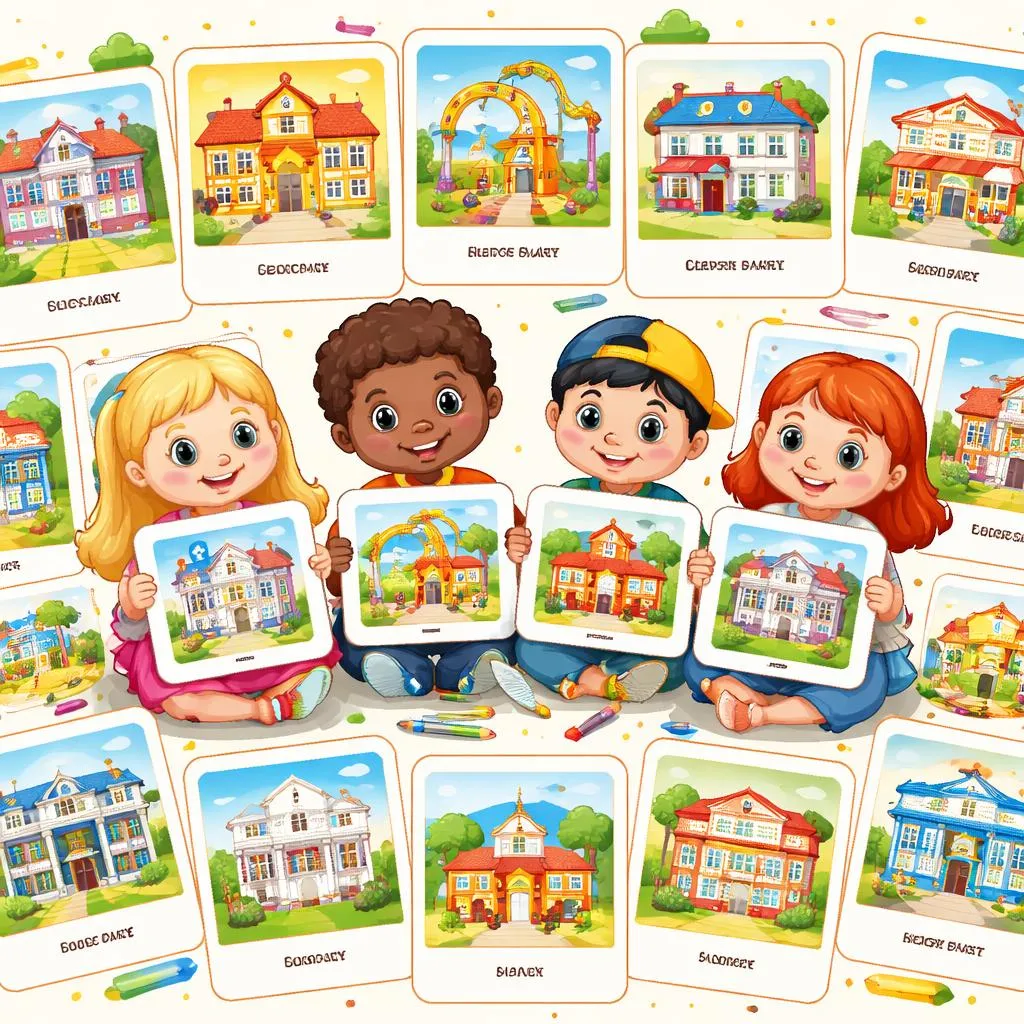

This set of Places Flashcards depict buildings you see around town or in the city, along with one key item as a hint. The extra picture in the corner makes the context clear without using words.
For example, instead of a B-A-N-K sign, the flashcard uses a picture of money. Encourage students to use these extra vocabulary words when playing guessing games. American English / British English apartment building / block of flats gas station / petrol station ice cream shop / ice-cream parlour jewelry store / jewellery store movie theater / movie theatre / cinema –> see note NOTE : The American English set includes a duplicate card with two variations: the spelling “ movie theatre ” is preferred in Canada and “ movie theater ” is used in the US. Since I’m not sure which term Australians and New Zealanders prefer, I added both cinema and movie theatre to the British English set.
Word list: apartment building / block of flats, bakery, bank, barber shop, bus stop, church, coffee shop, concert hall, fire station, furniture store, gas / petrol station, gym, hospital, hotel, ice cream shop / parlour, jewelry / jewellery store, movie theatre / theater, night club, pet shop, pharmacy, police station, post office, restaurant, temple
Click here to download the full Places in a City PDF — free
By practicing with Places Flashcards, children can:
- Recognize and name common buildings and places found in towns and cities.
- Expand their vocabulary with both American and British English terms.
- Improve their memory and association skills by linking images with words.
- Develop conversational skills by using new words in sentences and games.
- Enhance cultural awareness by learning different spellings and terms used in various English-speaking countries.
How to Teach Places Flashcards with Flashcards
Parents and educators can use Places Flashcards to introduce children to everyday locations in a fun and interactive way. Start by showing each card and saying the word clearly, encouraging the child to repeat it. Use the extra picture hints to explain the function of each place, making the learning contextual and engaging. Incorporate storytelling by asking children to imagine visiting these places or describe what they might do there. This method helps children connect vocabulary to real-life experiences, making the words more memorable.
(1) Fun Places Flashcard Games
After children become familiar with the flashcards, you can play guessing games where one person describes a place without naming it, and others guess which card it is. Another game is matching the flashcards with real photos or drawings of the places. You can also create a simple board game where children move pieces to different places on a map, saying the place names as they land on them. These activities reinforce vocabulary through repetition and context, making learning enjoyable.
(2) Example Sentences with Places Vocabulary
Using the flashcards, children can practice sentences like: “I go to the bakery to buy bread,” or “The fire station is where firefighters work.” Encourage them to express feelings or preferences, such as “I like the ice cream shop because it has chocolate flavor.” This helps children use the vocabulary in meaningful ways and improves their sentence-building skills.
Free Places Flashcards PDF Download
You can download a free PDF of the full Places Flashcards set, which includes all the vocabulary with clear images and hints. This resource is perfect for printing at home or in classrooms, allowing easy access to high-quality learning materials. The PDF supports both American and British English terms, making it versatile for different learners. Simply visit the provided link to get your free copy and start practicing today.
FAQ about Places Flashcards
Q: Can these flashcards be used for different age groups? A: Yes, they are designed for young learners but can be adapted for older children by adding more complex sentences or discussions.
Q: How often should children practice with the flashcards? A: Short, frequent sessions (10-15 minutes daily) work best to maintain interest and retention.
Q: Are there digital versions available? A: Yes, some platforms offer interactive digital flashcards that complement the printable versions.
Q: What if a child struggles with pronunciation? A: Encourage slow, repeated practice and use audio resources if available to model correct pronunciation.
Q: Can these flashcards be used to teach other languages? A: While designed for English, the images can support vocabulary learning in other languages by pairing them with translated words.