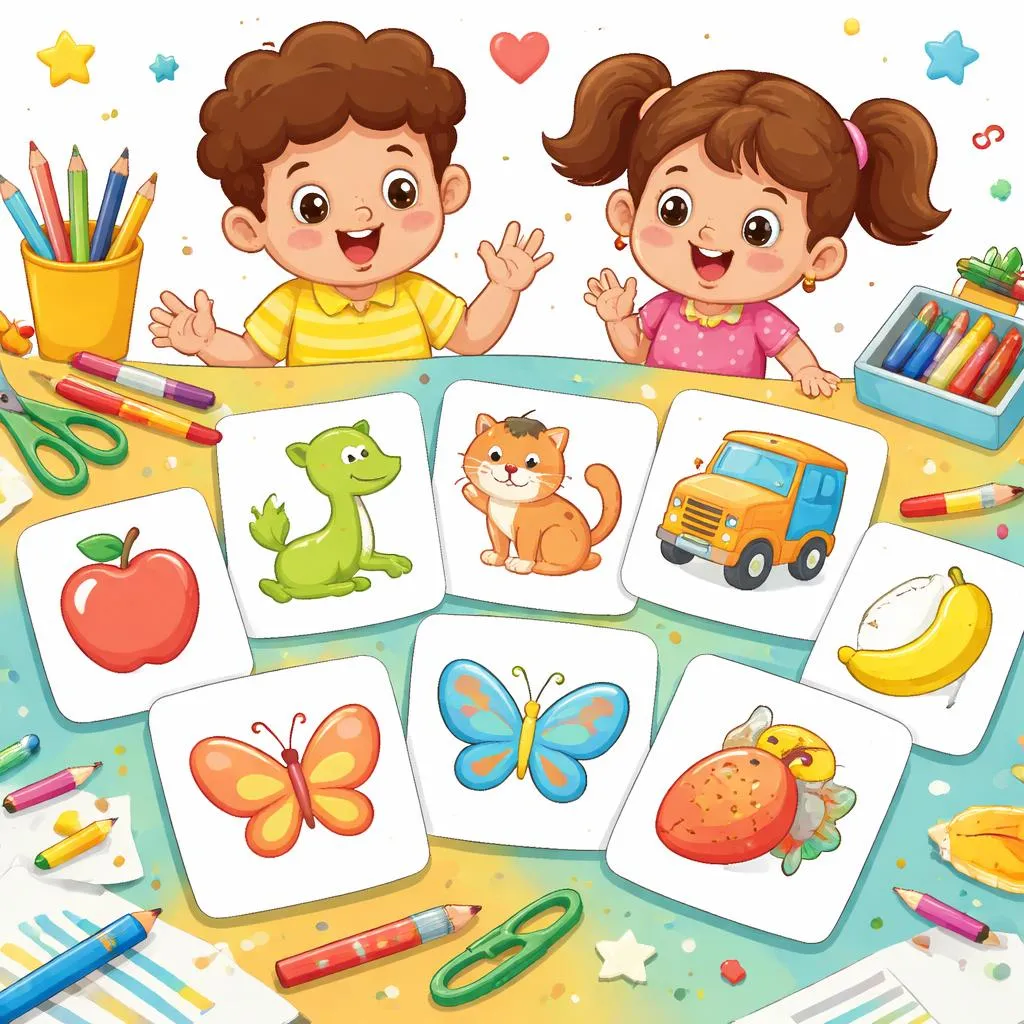

This set of Prices Flashcards gives you a chance to practice numbers up to 100 in the context of shopping. The picture cards show images of school supplies with prices printed below. Using the school supply flashcards without prices, you can try a “prices dictation” (the teacher’s checklist makes this easy).
Or allow the students to set their own prices and dictate to each other. You can also print prices-only flashcards and combined them with a different set of nouns, such as food flashcards . Most of the pictures are recycled from the bigger “ Classroom Objects ” flashcard set. Most of the objects are singular nouns, except three ( scissors , coloured pencils , and stickers ). So be ready to practice both How much is the ~ ? and How much are the ~ ? The prices are realistic– I found these numbers on a cheaply-priced online retailer of actual classroom supplies. Prices are all in dollars, with the $ symbol. Have fun shopping!
Word list: $1.07, $1.79, $13.98, $14.27, $14.99, $15.33, $2.79, $22.79, $25.95, $3.98, $33.15, $4.99, $42.48, $65.52, $79.97, $8.95, $9.97, $99.99
Click here to download the full Prices under $100 PDF — free
By practicing with Prices Flashcards, children can:
- Develop number recognition and counting skills up to 100 in a fun, practical context.
- Learn to associate numbers with real-life objects and prices, enhancing their understanding of money and value.
- Practice asking and answering questions about prices using common phrases like "How much is the ~?" and "How much are the ~?"
- Improve vocabulary related to school supplies and shopping scenarios.
- Build confidence in using English for everyday conversations involving numbers and money.
How to Teach Prices Flashcards with Flashcards
Parents and educators can use Prices Flashcards by first introducing the school supply items without prices to familiarize children with the vocabulary. Then, show the flashcards with prices to help children associate the numbers with the objects. Encourage children to repeat the prices aloud and practice asking and answering questions about the cost of each item. For example, a parent might say, "How much is the pencil?" and the child responds, "$1.07." This method helps children connect numbers with real-world shopping situations, making learning both meaningful and engaging.
(1) Fun Prices Flashcard Games
To reinforce learning, try interactive games such as "Price Dictation," where one child or the teacher calls out a price and the other finds the correct flashcard. Another game is "Shopping Role-Play," where children take turns being the shopkeeper and customer, practicing dialogues like "How much are the scissors?" and "They are $14.99." These activities make learning dynamic and encourage children to use English naturally while having fun.
(2) Example Sentences with Prices Vocabulary
- "How much is the notebook?"
- "It is $3.98."
- "How much are the coloured pencils?"
- "They are $14.27."
- "Can I buy the stickers for $1.79?"
- "Yes, you can!"
Using these sentences helps children practice common question and answer structures related to prices, improving their conversational skills.
Free Prices Flashcards PDF Download
You can easily download and print the full set of Prices Flashcards for free from the provided link. This resource includes all school supply images with realistic prices, perfect for classroom or home use. Having printed flashcards allows children to physically handle the cards, which can improve memory retention and make learning more interactive.
FAQ about Prices Flashcards
Q: What age group are these flashcards suitable for?
A: They are ideal for children aged 5 to 10 who are beginning to learn numbers and basic English vocabulary related to shopping.
Q: Can these flashcards be used for group activities?
A: Yes, they are perfect for group games like price matching and role-playing shopping scenarios.
Q: How can I help my child if they struggle with the prices?
A: Start with smaller numbers and gradually introduce higher prices. Use repetition and encourage your child to say the prices aloud.
Q: Are the prices realistic?
A: Yes, the prices are based on actual classroom supply costs from an online retailer, making the learning experience authentic.
Q: Can these flashcards be combined with other vocabulary sets?
A: Absolutely! You can mix prices with other flashcards like food or classroom objects to expand vocabulary and practice different contexts.