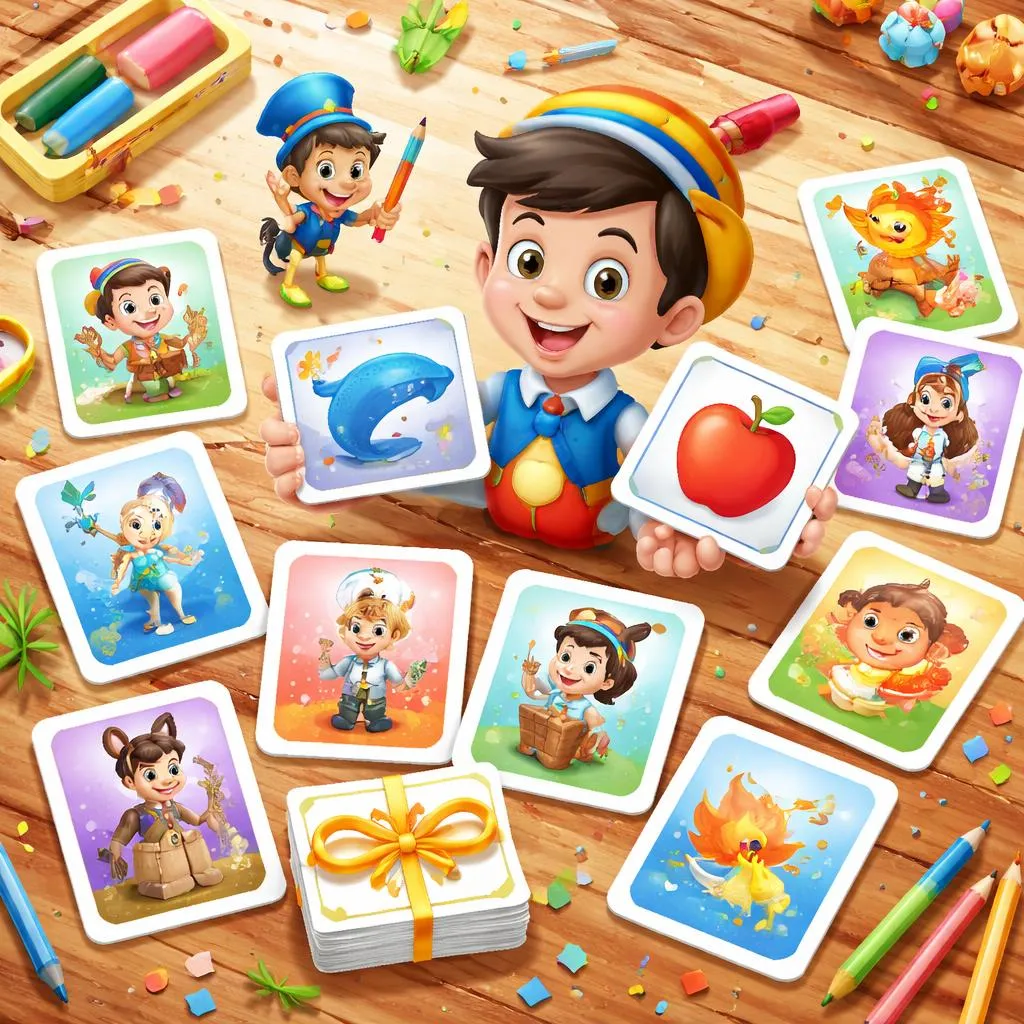

The concept of left and right is often difficult for young learners to understand. Use these flashcards to teach left/right and parts of the body vocabulary. They’re also a great tool to use to teach the vocabulary in our super popular song, “ The Pinocchio .”
Contains 7 Cards : right arm, left arm, right leg, left leg, chin, turn around, sit down
Download For best results, we recommend printing with Adobe Acrobat Reader . Related Songs The Pinocchio
Click here to download the full The Pinocchio Flashcards PDF — free
By practicing with flashcards, children can:
Flashcards are an engaging and effective tool for young learners to grasp the concepts of left and right, as well as parts of the body vocabulary. Through repeated exposure and interactive play, children develop spatial awareness and language skills simultaneously. Using these flashcards, kids can better understand directional terms like "left arm" and "right leg," and identify body parts such as "chin." This foundational knowledge supports their comprehension of related songs and activities, making learning both fun and memorable.
How to Teach Left and Right Body Parts Flashcards with Flashcards
Parents and educators can use these flashcards by first introducing each card individually, clearly pronouncing the term and pointing to the corresponding body part on the child. Encourage children to mimic the actions, such as touching their left arm or right leg, to reinforce understanding. Incorporate the flashcards into daily routines or songs like “The Pinocchio” to create a multisensory learning experience. Repetition and positive reinforcement help children internalize the vocabulary and directional concepts.
(1) Fun Left and Right Body Parts Flashcard Games
Playing games such as “Simon Says” using the flashcards can make learning dynamic and interactive. For example, instruct children to “touch your left arm” or “lift your right leg,” prompting them to respond physically. Another game is “Flashcard Memory,” where children match pairs of left and right body parts. These activities not only enhance vocabulary retention but also improve listening skills and body coordination.
(2) Example Sentences with Body Parts Vocabulary
Using simple sentences helps children apply new words in context. Examples include: “Raise your right arm,” “Touch your chin,” or “Turn around and sit down.” Adding emotions or expressions, like saying “Can you smile and touch your left arm?” makes the practice more engaging and expressive, encouraging children to connect language with actions and feelings.
Free Left and Right Body Parts Flashcards PDF Download
To support learning at home or in the classroom, free printable flashcards are available for download. These high-quality cards can be printed using Adobe Acrobat Reader for best results. Having physical copies allows children to interact with the cards anytime, making it easy to review and practice regularly. Download the full set of Left and Right Body Parts Flashcards here: The Pinocchio Flashcards PDF.
FAQ about Left and Right Body Parts Flashcards
Q: At what age are these flashcards most effective?
A: These flashcards are ideal for preschoolers and early elementary children, typically ages 3 to 7, who are beginning to learn spatial concepts and body vocabulary.
Q: How often should children practice with the flashcards?
A: Short, frequent sessions (5-10 minutes daily) are most effective for retention and engagement.
Q: Can these flashcards be used for children who speak different languages?
A: Yes, the visual nature of the cards makes them versatile. Parents and teachers can label the cards in multiple languages to support bilingual learning.
Q: Are there any recommended follow-up activities?
A: Yes, incorporating songs like “The Pinocchio,” movement games, and drawing activities related to body parts can deepen understanding and make learning enjoyable.