
Fun Introduction
Last Saturday, Mia joined her friends to play soccer. They formed two teams. Mia scored a goal. Later, Mia united with her brother to build a fort. They used blankets and chairs. Both actions involved working together. But one was joining an existing group. The other was creating a new bond. Let’s explore the difference.
Word Breakdown
Join To Do
Imagine jumping into a hopscotch game. Your friends are already playing. You ask to join. That is join to do. It means becoming part of an existing activity or group.
It feels inclusive and fun. Like join to sing in the choir. Or join to work on a group project. Your body moves into the group. Your heart feels happy. The memory anchor is a plus sign connecting circles. See them link? That is join to do.
Unite To Do
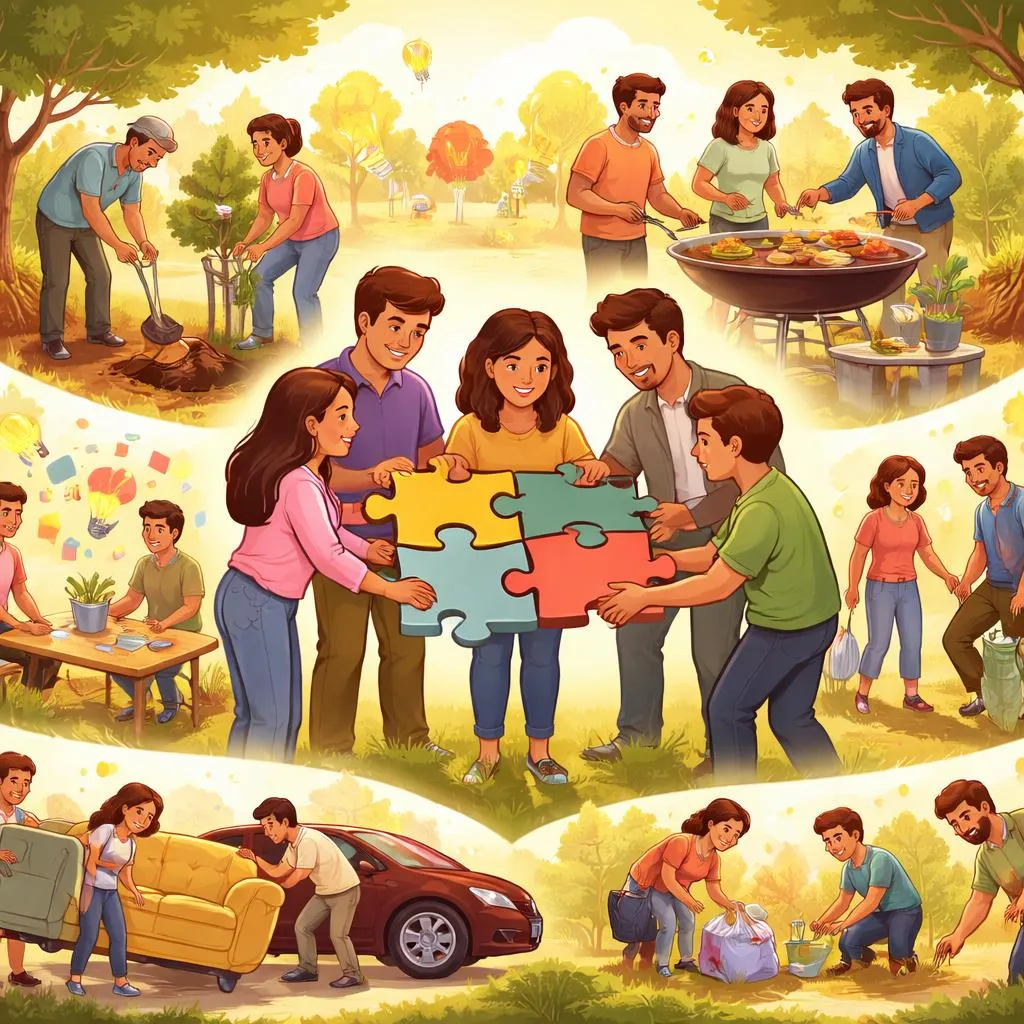
Think of two puzzle pieces clicking together. They were separate. Now they form one piece. That is unite to do. It means coming together to create something new or stronger.
It feels powerful and meaningful. Like unite to clean the park. Or unite to support a friend. Your body stands together. Your purpose aligns. The memory anchor is two hands shaking firmly. Feel the grip? That is unite to do.
Advanced Comparison
Join is entering an existing activity. Unite is forming a new connection. Join is about fitting in. Unite is about bonding together. Use join for groups already doing something. Use unite for creating shared purpose.
Scene Comparison
Scene One happens at recess. Leo sees his classmates playing tag. He runs over and joins to chase the runner. Everyone laughs and runs. This is join to do—entering an ongoing game.
Scene Two takes place during a school project. Emma and her partner unite to design a poster. They share ideas and draw together. Their work becomes one big creation. This is unite to do—combining efforts for a common goal.
Scene Three occurs at home. Ben joins his family to watch a movie. They are already on the couch. Ben sits with them. Later, Ben unites with his sister to surprise Mom with breakfast. They cook pancakes together. Notice the shift. Joining is entering an existing activity. Uniting is creating a joint effort.
Pitfalls Deep Reminder
Mistake One is saying “I united to play soccer with my friends.” Why wrong? Soccer is already happening. You join an existing game. Funny result? Friends think you started a new league. Correct phrase is join to play soccer. Memory trick: Join is for ongoing activities.
Mistake Two is saying “I joined to help clean the beach.” Why wrong? Beach cleanup needs collective effort. You unite for a cause. Funny result? Organizers think you just watched. Correct phrase is unite to clean the beach. Memory trick: Unite for shared missions.
Mistake Three is saying “I united to sing in the school choir.” Why wrong? Choir is an established group. You join it. Funny result? Conductor asks if you formed a new choir. Correct phrase is join to sing in the choir. Memory trick: Join existing groups.
Hidden Trap: Some kids think unite sounds more important than join. But importance is not the point. Existing versus new is key. Join fits into something. Unite builds something together.
Interactive Exercises
First Level: Choose the Right Phrase. Read each sentence. Pick join or unite.
I ___ my friends to play basketball. (join/unite)
She ___ her classmates to plant trees. (join/unite)
We ___ the art club to paint murals. (join/unite)
He ___ with his neighbor to fix a fence. (join/unite)
They ___ the team to win the match. (join/unite)
Answers: join, unite, join, unite, join.
Second Level: Mini Theater. Act with a friend. Use the phrases.
Scene A: Joining a Game
A: Can I ___ to play tag with you?
B: Sure! Tag, you’re it!
Scene B: Uniting for a Cause
A: Let’s ___ to collect food for the shelter.
B: Great idea! I will bring cans.
Third Level: Spot the Mistake. Which sentence sounds odd? Explain why.
Sentence: I joined to raise money for the animal hospital.
Reason: Fundraising is a shared mission. Use unite instead.
Sentence: I united to play in the school band.
Reason: Band is an existing group. Use join instead.
Sentence: We joined forces to stop bullying.
Reason: Stopping bullying needs unity. Use unite instead.
Fourth Level: Create Sentences. Use both phrases.
Join to do: I join to dance in the recital.
Unite to do: I unite to help my community.
Bonus Challenge: You see classmates picking up litter. Do you join or unite with them? Answer: Join. They are already doing it.
Rhyme Time
Join the game, jump right in.
Unite to build, let’s begin.
Fit in? Choose join.
Build as one? Unite to win.
Homework Task
Pick one activity. Complete it this week. Share with family.
Option One: Drawing Journal. Get a small notebook. Draw three pictures. Write a sentence under each.
Picture One: You join a game. Sentence: I joined my friends to play hopscotch.
Picture Two: You unite for a cause. Sentence: I united with my sister to clean the garage.
Picture Three: You join a club. Sentence: I joined the book club to read stories.
Show your journal to a parent. Explain the differences.
Option Two: Role Play. With a parent, act out moments. Use phrases correctly.
You: Mom, I will join the soccer team to practice.
Parent: Have fun and work hard.
You: Dad, I will unite with my classmates to volunteer.
Parent: That is a wonderful way to help.
Practice until it feels natural.
Option Three: Sharing Time. Tomorrow at school, tell a friend. Describe one join and one unite. Say: Yesterday I joined the kickball game. I united with friends to plant flowers. Ask your friend about theirs.
Life Practice
Week Challenge: Try one task. Complete within seven days. Share your success.
Task One: Observation Log. For three days, note join and unite moments. Draw icons.
Day One: Join a line. Draw a line icon.
Day Two: Unite with siblings. Draw a heart icon.
Day Three: Join a class. Draw a book icon.
Show your log to your teacher. Place it on the classroom wall.
Task Two: Action Demo. Use both phrases in real actions.
Step One: Walk to a group playing. Say: I join to play catch with you.
Step Two: Stand with a friend holding supplies. Say: We unite to make a card for Grandma.
Demonstrate to a sibling. Explain the difference.
Task Three: Social Mission. Use phrases with others.
Join a friend’s game. Say: I joined you to play frisbee!
Unite with neighbors. Say: We united to organize a street fair!
Record a short voice message. Send it to your teacher.
Task Four: Creative Story. Write a short tale. Include both phrases.
Title: The Teamwork Day.
Story: I joined my friends to play soccer. Then we united to fix the broken goalpost. What teamwork!
Share your story in class.
Remember, practice makes perfect. Use these phrases often. Soon they will feel easy.