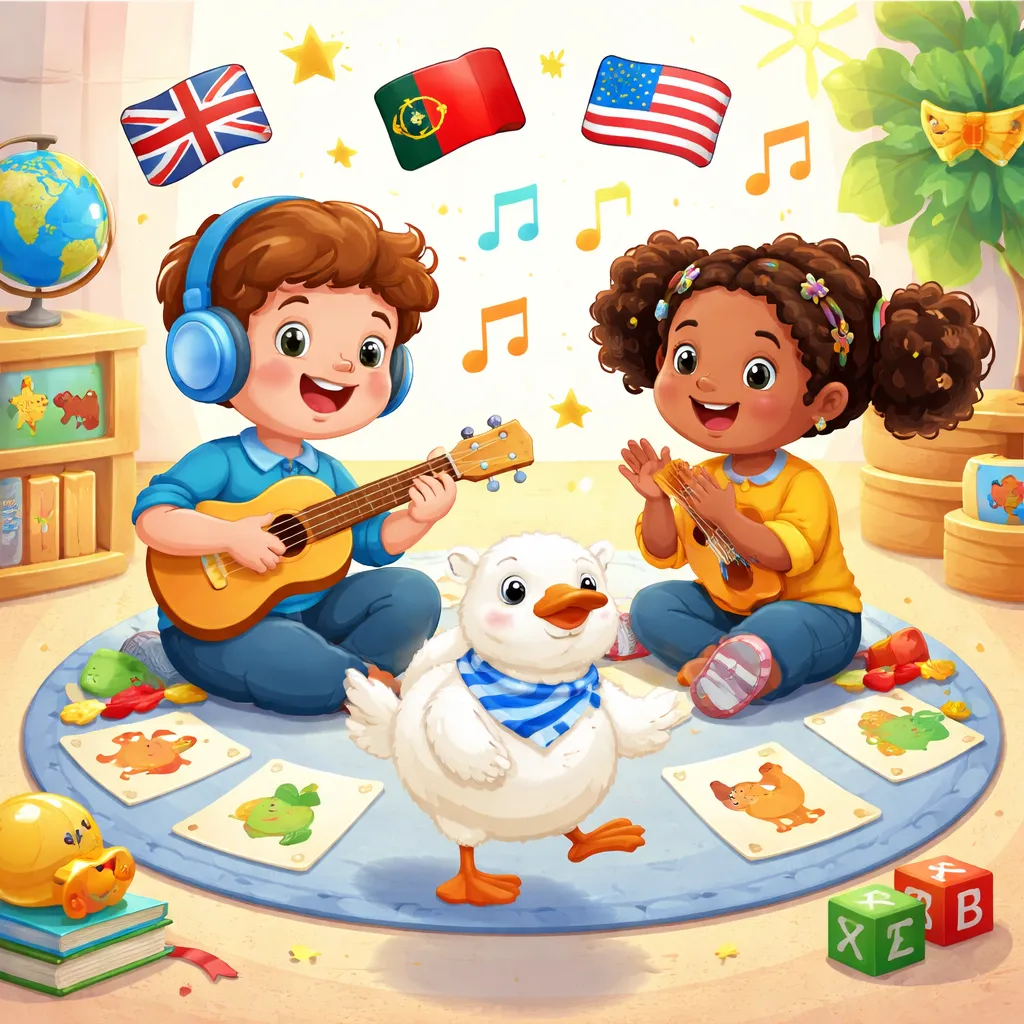

A goose moves through the world with quiet purpose. A children’s song can move through a young learner’s mind with that same gentle purpose. Today, we explore a traditional Portuguese rhyme called “O Gansinho,” which means “The Little Goose.” This peaceful song follows a small goose as he walks and explores his world. We will use this melody as a gentle bridge into English. Together, we will learn new words, discover important sounds, and see how a simple song can make language learning feel like a calm walk in the countryside. The little goose takes one step at a time. Your child can learn one word at a time, at their own comfortable pace.
What is the rhyme? “O Gansinho” is a beloved nursery rhyme in Portuguese-speaking families. It tells the story of a little goose who walks along a path, sometimes alone and sometimes with friends. The song has a steady, walking rhythm. Children often use hand movements. They make a beak with their fingers. They waddle from side to side. They make soft honking sounds. The song creates a calm, focused atmosphere. It speaks to a child’s natural interest in animals and simple journeys. When we bring this song to English learning, we keep its steady spirit. We use the familiar melody to introduce English words in a way that feels like walking along a familiar path.
The lyrics of nursery rhymes To understand this song, we first look at the original Portuguese words. Then we see how they translate into English. This shows children that the same quiet story can be told in different languages. You do not need to know Portuguese to enjoy the steady, walking rhythm of the words.
Original Version (Portuguese)
O gansinho, o gansinho Vai andar, vai andar Sozinho, sozinho Vai passear, vai passear
English Version
The little goose, the little goose Will walk, will walk Alone, alone Will stroll, will stroll
A second verse often continues the story, showing the goose finding a friend.
Original Version (Portuguese)
Encontrou, encontrou Um amigo, um amigo Os dois juntos, os dois juntos Vão brincar, vão brincar
English Version
He found, he found A friend, a friend The two together, the two together Will play, will play
As you read these words, notice the steady repetition. The rhythm moves like footsteps. The story is simple and warm. A little goose walks alone. Then he finds a friend. Together they play. This narrative is easy for a child to follow and understand.
Vocabulary learning This song offers a lovely set of words that connect to movement, friendship, and simple actions. We can explore these words through conversation, pictures, and gentle play.
Start with the main character: the goose. In Portuguese, it is gansinho. In English, we say “little goose.” The word “goose” refers to a water bird with a long neck. You can look at pictures of geese together. Notice how they walk in a line. Practice the sound a goose makes. In English, we often say “honk honk.”
Here are the key words to focus on from the song:
Goose: A bird that walks and swims. Explain that geese often travel together.
Walk: Moving step by step. This is a familiar word. Walk together around the room like geese.
Alone: By oneself. This is an important concept. Talk about times when you are alone and times when you are with others.
Stroll: A slow, relaxed walk. This word is similar to walk but has a peaceful feeling. Stroll together slowly.
Found: Discovered or met. This is a past tense word. Talk about things you found today.
Friend: Someone you like to be with. This is a special word. Talk about your child’s friends.
Together: Being with someone. Hold hands and say “we are together.”
Play: What friends do. This joyful word appears in many children’s songs.
Use these words in natural moments. When you go for a walk, say “let us stroll like the little goose.” When your child plays with a friend, say “you are together, just like the geese.” These connections make the vocabulary meaningful.
Phonics points Phonics helps children understand the sounds that build English words. This song gives us several clear sounds to explore in a relaxed, steady way.
First, focus on the ‘g’ sound at the beginning of “goose.” This is a voiced sound made with the back of the tongue. Say “g g g” like a gentle growl. Then say “goose.” Practice with “go,” “garden,” and “goose.” This sound appears in many common words.
Next, notice the long ‘oo’ sound in “goose” and “stroll.” Actually, “stroll” has the long ‘o’ sound. Let us focus on the long ‘oo’ first. Purse your lips and say “oo oo.” Practice with “moon,” “spoon,” and “goose.” For “stroll,” the long ‘o’ sound is different. Say “oh” like in “go.” Practice with “roll,” “pole,” and “stroll.”
The word “walk” contains the ‘lk’ blend. The ‘l’ is silent. Say “wawk.” Practice with “talk” and “chalk.” This is a common pattern in English. It helps children learn that not all letters are sounded.
Finally, look at the ‘fr’ blend in “friend.” This is two consonants together. Say “f” and then quickly add “r.” Then add “end.” Practice with “frog,” “free,” and “friend.” This blend builds confidence with consonant combinations. The song also has “alone,” which contains the long ‘o’ sound again. Say “oh” and then “lone.” Notice how the mouth stays open.
Grammar patterns Even a simple song contains grammar that we can introduce gently. We do not need to use technical terms. Instead, we show how words work together through examples and play.
The song uses the future tense with the word “will.” “Will walk” means the goose plans to walk. You can explain this simply. “Will” is a helper word that tells us something is going to happen. Practice by talking about your day. “You will play.” “We will go for a walk.” This gives children a tool to talk about future events.
The second verse introduces the past tense. “He found” describes something that already happened. You can point this out without using the term “past tense.” Say “this is what happened. The goose found a friend.” Practice by talking about your day. “You found your toy.” “We ate breakfast.” This introduces the concept of talking about things that already happened.
Notice the word “alone” and the phrase “together.” These describe states of being. “Alone” means one. “Together” means more than one. You can practice by using your hands. One finger alone. Two fingers together. This teaches these concepts in a concrete way.
Also, look at the adjective “little” in “little goose.” This word shows size and affection. You can use it throughout the day. “Little spoon.” “Little book.” “Little you.”
Learning activities Activities bring the song into the body and the imagination. They transform listening into active participation. These ideas are simple and require little preparation.
The Goose Walk Play the song and pretend to be the goose. Walk slowly around the room. When the song says “alone,” walk by yourself. When it says “found a friend,” find your child and hold hands. When it says “together,” walk side by side. When it says “will play,” stop and play together. This activity builds listening skills and understanding of relationships.
Friend Walk Go for a walk outside. Take a toy goose or a stuffed animal. Walk together. Talk about the song. “The little goose walked alone. Now he has a friend. We have a friend too.” This connects the song to real life.
Alone and Together Use toys to act out the song. One toy walks alone. Then another toy joins. Talk about what is happening. “He is alone. Now they are together.” This teaches the vocabulary in a visual, hands-on way.
Printable materials Printable resources offer a quiet way to reinforce the song’s vocabulary. They are perfect for moments when children want to create or focus calmly.
Flashcards Create a set of flashcards. One card shows the goose. One shows a walking footstep. One shows a single figure for “alone.” One shows two figures holding hands for “together.” One shows a happy face for “friend.” One shows two toys playing. Use these cards for a matching game. Sing a line from the song and ask your child to find the matching card. This builds word recognition.
Coloring Page Draw a simple scene from the song. Show the little goose walking alone on a path. On another page, show the goose with a friend. Children can color both pages. As they color, talk about the scenes. “Is the goose alone or together?” “Who is his friend?” This keeps the language flowing naturally.
Friendship Bracelet Create a simple paper bracelet. Draw a goose on one side. Draw a heart on the other. While making the bracelet, talk about friendship. “The little goose found a friend. You have friends too.” This connects the song to social-emotional learning.
Educational games Games encourage repetition without boredom. They invite children to use the language in new and creative ways.
Goose Says Play a game similar to “Simon Says.” Give commands using the song’s vocabulary. “The goose says walk alone.” “The goose says find a friend.” “The goose says play together.” If you give a command without saying “the goose says,” the child does not move. This game builds listening skills.
Friend Hunt Hide a toy goose or a picture of a goose around the room. Sing the song while searching. When the goose is found, say “I found a friend!” Then hide it again. This builds anticipation and makes the vocabulary part of an active experience.
Walking Parade Line up and walk together like geese. Walk alone first. Then join together. Walk in a line. Sing the song as you walk. When you reach the end, say “we are together!” This combines movement with the song’s rhythm and concepts.
As you share “O Gansinho” with your child, remember that you are building more than English skills. You are building understanding of friendship, togetherness, and gentle progress. The little goose walks alone at first. Then he finds a friend. Learning a new language can feel like walking alone sometimes. But with a song, a game, and your presence, your child never walks alone. Let the steady rhythm of the little goose guide your journey together. Sing it when you walk. Hum it when you play. Let the quiet purpose of the goose remind you both that language learning unfolds one gentle step at a time.