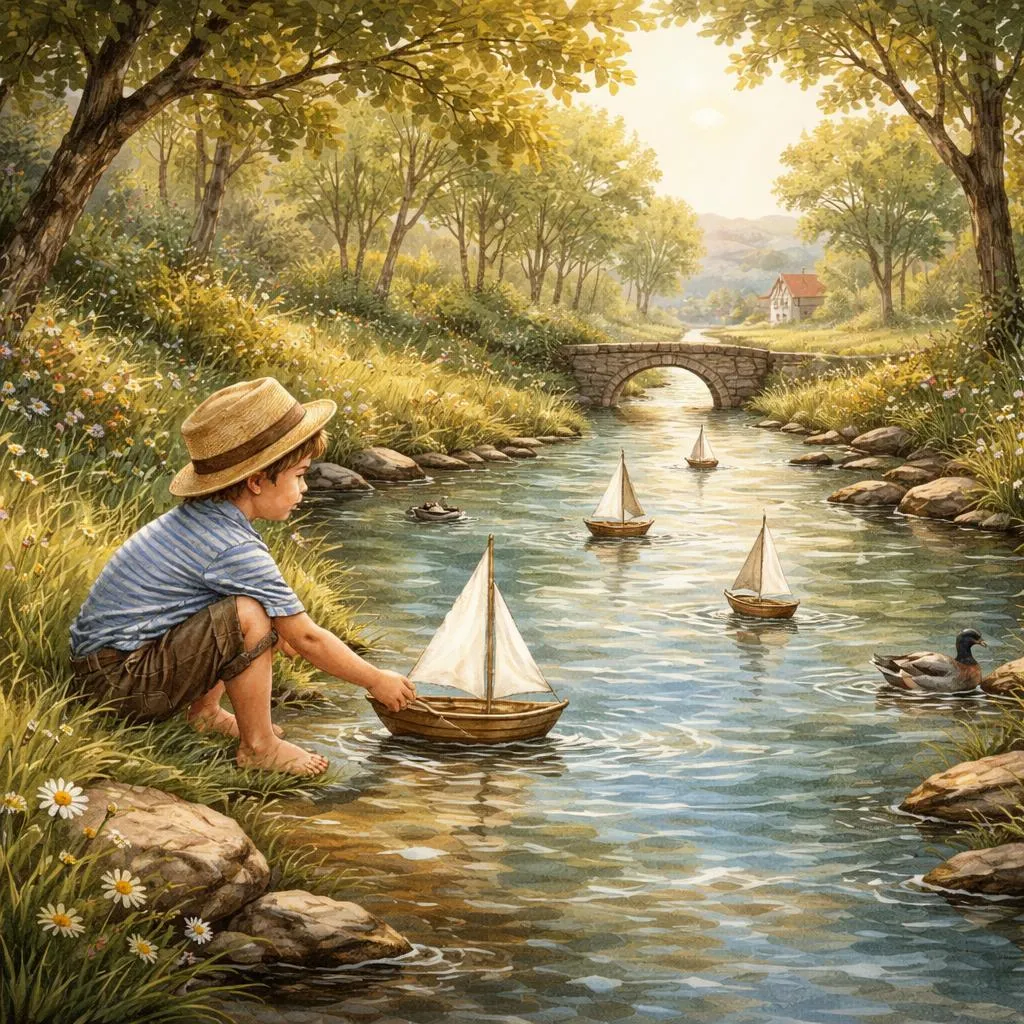

O it’s I that am the captain of a tidy little ship, Of a ship that goes a sailing on the pond; And my ship it keeps a-turning all around and all about; But when I’m a little older, I shall find the secret out How to send my vessel sailing on beyond. For I mean to grow as little as the dolly at the helm, And the dolly I intend to come alive; And with him beside to help me, it’s a-sailing I shall go, It’s a-sailing on the water, when the jolly breezes blow And the vessel goes a divie-divie-dive. O it’s then you’ll see me sailing through the rushes and the reeds, And you’ll hear the water singing at the prow; For beside the dolly sailor, I’m to voyage and explore, To land upon the island where no dolly was before, And to fire the penny cannon in the bow.
Story Background and Author Introduction
This charming poem captures the imaginative world of a child who envisions themselves as the captain of a small ship sailing on a pond. The playful rhythm and vivid imagery invite readers to join in the adventure of exploration and discovery. While the author of this particular poem is not widely known, it reflects a classic tradition of children’s literature where the power of imagination transforms everyday objects into vessels of adventure. Such stories often come from the late 19th or early 20th century, a time when children’s poetry and tales frequently celebrated the innocence and creativity of childhood.
Detailed Story Interpretation and Meaning
At its heart, this poem is about imagination, growth, and the excitement of discovery. The narrator, a child, takes command of a “tidy little ship” that sails on a pond, symbolizing the small but significant adventures that children embark on in their everyday lives. The “dolly at the helm” represents a cherished toy or companion, which the child hopes will come alive to join them on their journey. This blending of reality and fantasy is a hallmark of childhood storytelling, where toys and playthings become friends and co-adventurers.
The poem’s repeated references to sailing “all around and all about” and the desire to “find the secret out” suggest a yearning for knowledge and understanding that grows with age. The child’s dream of exploring “the island where no dolly was before” symbolizes the human desire to explore the unknown, to be brave and curious, and to make new discoveries.
Lessons and Insights for Children and Students
-
Imagination and Creativity
This poem encourages children to use their imagination freely. It shows how a simple toy or a small pond can become the setting for grand adventures. Imagination is a vital skill that helps children develop problem-solving abilities and emotional intelligence. -
Curiosity and Exploration
The child’s wish to “find the secret out” and explore new places mirrors the natural curiosity that drives learning. Encouraging children to ask questions and seek new experiences fosters a lifelong love of learning. -
Growth and Patience
The narrator mentions growing “as little as the dolly,” which hints at the understanding that growth and learning take time. This teaches children patience and the importance of gradual progress. -
Friendship and Companionship
The idea of the dolly coming alive to help on the voyage highlights the value of friendship and teamwork. It reminds children that having support from friends makes challenges easier and more enjoyable.
Applying These Lessons in Daily Life
-
In Learning: Children can be encouraged to approach new subjects with curiosity, imagining themselves as explorers discovering new knowledge. Teachers and parents can create playful learning environments where imagination is nurtured alongside facts.
-
In Social Interactions: The poem’s emphasis on companionship can inspire children to value friendships and cooperation. They can learn to support and encourage their peers, just as the dolly supports the captain.
-
In Personal Growth: Children can be taught to appreciate their own growth and development, understanding that learning takes time and that every small step is important.
Cultivating Positive Spirit and Behavior
To nurture the positive qualities illustrated in the poem, educators and parents can:
- Encourage imaginative play and storytelling, allowing children to express their thoughts and feelings creatively.
- Foster a safe environment where curiosity is welcomed and questions are encouraged.
- Model patience and perseverance, reinforcing that growth is a journey.
- Promote kindness and teamwork, helping children understand the importance of supporting one another.
By embracing these values, children can develop confidence, creativity, and social skills that will serve them well throughout their lives. This poem, with its gentle reminder of the magic in everyday moments, offers a timeless lesson: that with imagination and a spirit of adventure, even the smallest ship can sail to wonderful places.