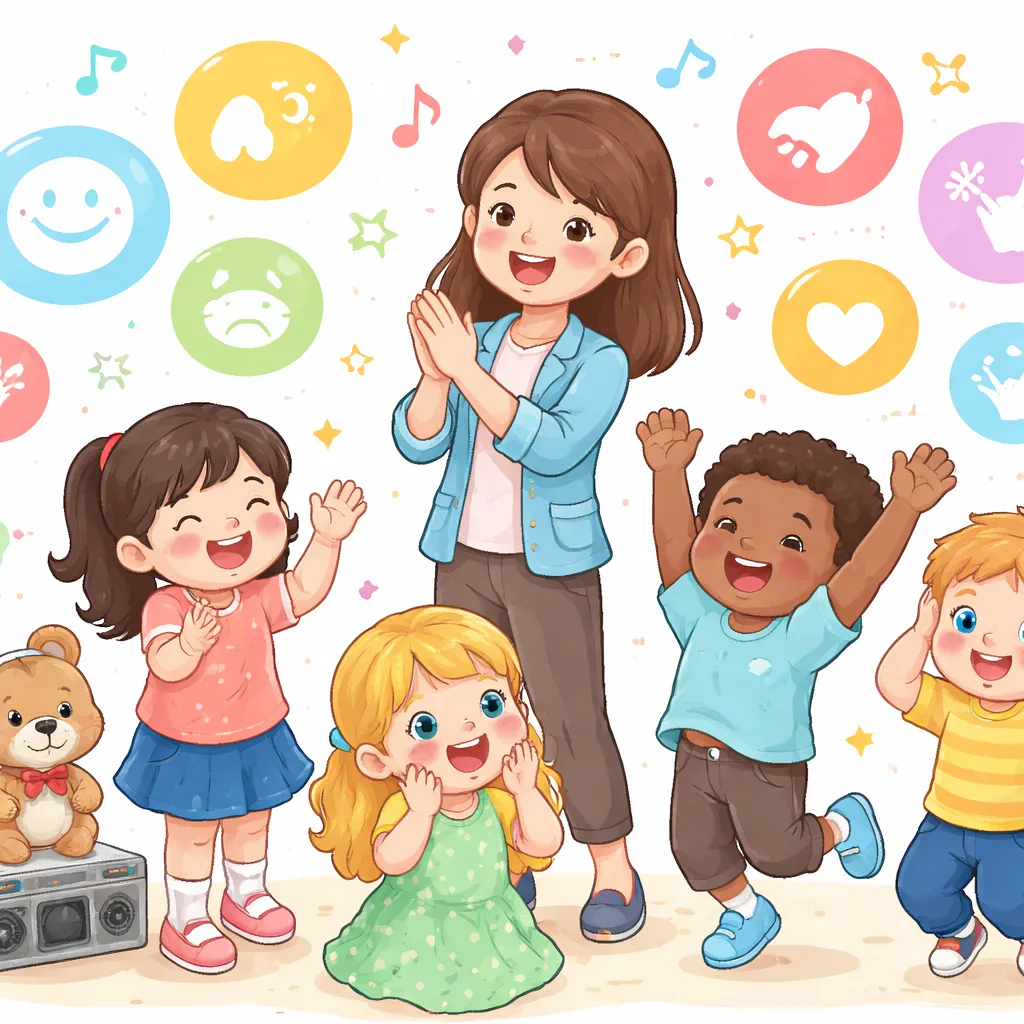

Happiness shows itself in a clap. In a stomp. In a cheerful “hurray!” A children’s song can give children the words to express those feelings. Today, we explore a Japanese version of the beloved nursery rhyme “If You’re Happy and You Know It,” known as “幸せなら手をたたこう” (Shiawase nara te o tatakō). This joyful song invites children to clap, stomp, and shout along. We will use this melody as a happy, expressive path into English. Together, we will learn new words, explore important sounds, and discover how a simple song can make language learning feel like celebrating happiness in your whole body. The song asks, are you happy? Then show it! Your child can learn to show their feelings in English with that same joyful expression.
What is the rhyme? “If You’re Happy and You Know It” is one of the most beloved children’s action songs in the English-speaking world. The Japanese version, “幸せなら手をたたこう,” follows the same pattern. The song asks if you are happy and tells you to show it with actions. Each verse adds a new action. The song has a lively, participatory rhythm. Children love the hand movements. They clap their hands. They stomp their feet. They shout “hurray!” The song creates a joyful, expressive atmosphere. It invites children to connect feelings with actions. When we bring this song to English learning, we keep its joyful, expressive spirit. We use the familiar melody to introduce English words in a way that feels like playing a happiness game.
The lyrics of nursery rhymes To appreciate this song, we first look at the original Japanese words. Then we see how they translate into English. This shows children that the same joyful song about feelings exists in different languages. You do not need to know Japanese to enjoy the lively, participatory rhythm of the words.
Original Version (Japanese)
幸せなら手をたたこう 幸せなら手をたたこう 幸せなら 体で あらわそう 幸せなら手をたたこう
English Version
If you’re happy, clap your hands If you’re happy, clap your hands If you’re happy, show it with your body If you’re happy, clap your hands
Additional Verses:
幸せなら足を踏み鳴らそう (stomp your feet) 幸せなら声を合わせよう (shout “hurray!”) 幸せなら みんなで 踊ろう (everyone dance)
English Version
If you’re happy, stomp your feet If you’re happy, join your voices (shout “hurray!”) If you’re happy, let us all dance
As you read these words, notice the joyful repetition. The rhythm moves like a happy dance. The song is simple and participatory. If you are happy, show it. Clap. Stomp. Shout. Dance. This narrative invites children to connect feelings with actions and words.
Vocabulary learning This song offers a wonderful set of words that connect to feelings, actions, and expression. We can explore these words through conversation, movement, and joyful play.
Start with the main idea: happiness. In Japanese, it is 幸せ (shiawase). In English, we say “happy.” Happiness is a feeling we can show with our faces and bodies.
Here are the key words to focus on from the song:
Happy: Feeling joy. Make a happy face. Ask your child when they feel happy.
Know it: Understand or realize. You know you are happy.
Clap: Hit your hands together. Clap your hands together.
Hands: The parts at the end of your arms. Show your hands.
Body: Your whole self. Show it with your body.
Stomp: Hit your foot on the ground. Stomp your feet.
Feet: The parts at the end of your legs. Show your feet.
Shout: Say something loudly. Shout “hurray!”
Hurray: A word of joy and celebration. Shout “hurray!” together.
Dance: Move to music. Dance together.
Use these words in natural moments. When your child is happy, say “you are happy! Let us clap!” When you celebrate something, shout “hurray!” These connections make the vocabulary meaningful.
Phonics points Phonics helps children understand the sounds that build English words. This song gives us several clear sounds to explore in a joyful, expressive way.
First, focus on the ‘h’ sound at the beginning of “happy” and “hurray.” This is a soft, breathy sound. Say “h h h” like a gentle sigh. Practice with “hello,” “home,” and “happy.” This sound is light and joyful.
Next, notice the short ‘a’ sound in “happy” and “clap.” Say “a” like in “apple.” Practice with “cat,” “hat,” and “clap.” This sound is bright and crisp.
The word “stomp” contains the ‘st’ blend and the short ‘o’ sound. Say “s,” then quickly add “t.” Then add “omp.” Practice with “stop,” “star,” and “stomp.” The short ‘o’ is like “hot.”
Finally, look at the ‘sh’ sound in “show” and “shout.” This is a quiet, airy sound. Put your finger to your lips and say “shhh.” Then say “show.” Practice with “ship,” “fish,” and “shout.” The song also has “dance,” which contains the ‘an’ sound. Say “an” like in “man.”
Grammar patterns Even a simple song contains grammar that we can introduce gently. We do not need to use technical terms. Instead, we show how words work together through examples and play.
The song uses the conditional “if” to set up the action. “If you are happy, then clap.” This shows a condition. You can practice with other “if” phrases. “If you are tired, then rest.” “If you are hungry, then eat.” This builds understanding of cause and effect.
Notice the imperative mood in “clap,” “stomp,” and “shout.” These are commands. You can practice giving commands in a playful way. “Clap your hands.” “Stomp your feet.” This builds understanding of instructions.
The phrase “and you know it” adds a second condition. You must know you are happy. You can practice with other “know it” phrases. “If you are ready and you know it.” “If you are done and you know it.” This builds awareness of self-knowledge.
Also, look at the phrase “show it with your body.” This connects feelings to physical expression. You can practice with other “show it” phrases. “Show it with your face.” “Show it with your hands.” This builds expressive language.
Learning activities Activities bring the song into the body and the imagination. They transform listening into active participation. These ideas are simple and require little preparation.
Happy Actions Game Play the song and do the actions. Clap your hands. Stomp your feet. Shout “hurray!” Dance together. This activity builds listening skills and joyful movement.
Feelings Faces Make different faces. Happy face. Sad face. Surprised face. Ask your child to guess the feeling. Then practice the happy face and clap. This builds emotional vocabulary and recognition.
Celebration Time When something good happens, sing the song. A good meal. A fun game. A visit from a friend. Use the song to celebrate. This connects the song to real moments of happiness.
Printable materials Printable resources offer a quiet way to reinforce the song’s vocabulary. They are perfect for moments when children want to create or focus calmly.
Flashcards Create a set of flashcards. One card shows a happy face for “happy.” One shows two hands clapping for “clap.” One shows feet stomping for “stomp.” One shows a mouth shouting for “shout.” One shows a dancer for “dance.” One shows the word “hurray.” Use these cards for a matching game. Sing a line from the song and ask your child to find the matching card. This builds word recognition.
Coloring Page Draw a simple scene with children doing the actions. One child clapping. One stomping. One shouting “hurray.” One dancing. Children can color the scene. As they color, talk about the actions. “What is this child doing?” “How do they feel?” This keeps the language flowing naturally.
Feelings Chart Create a simple chart with different feelings. Happy. Sad. Excited. Tired. Draw a happy face next to “happy.” Your child can draw faces for the other feelings. This builds emotional vocabulary.
Educational games Games encourage repetition without boredom. They invite children to use the language in new and creative ways.
Happy Says Play a game similar to “Simon Says.” Give commands using the song’s vocabulary. “Happy says clap your hands.” “Happy says stomp your feet.” “Happy says shout hurray.” “Happy says dance.” If you give a command without saying “happy says,” the child does not move. This game builds listening skills.
Action Guessing Do one of the actions silently. Clap. Stomp. Dance. Ask your child to guess the action. Then switch roles. This builds observation and vocabulary.
Feelings Freeze Play music. When the music stops, make a face. Happy. Sad. Surprised. Ask your child to name the feeling. Then do the happy actions. This builds emotional recognition and vocabulary.
As you share “幸せなら手をたたこう” with your child, remember that you are celebrating the joy of expression. If you are happy, clap. If you are happy, stomp. If you are happy, shout “hurray!” Feelings are meant to be shown. Language is meant to be expressed. Learning English is not just about words. It is about using those words to share who you are and how you feel. Let the happy song be your guide. Sing it when you feel joy. Use it to celebrate small moments. Let the joyful spirit of the song remind you both that every word you learn is another way to show the world how you feel, and every time you speak, you have a reason to clap.