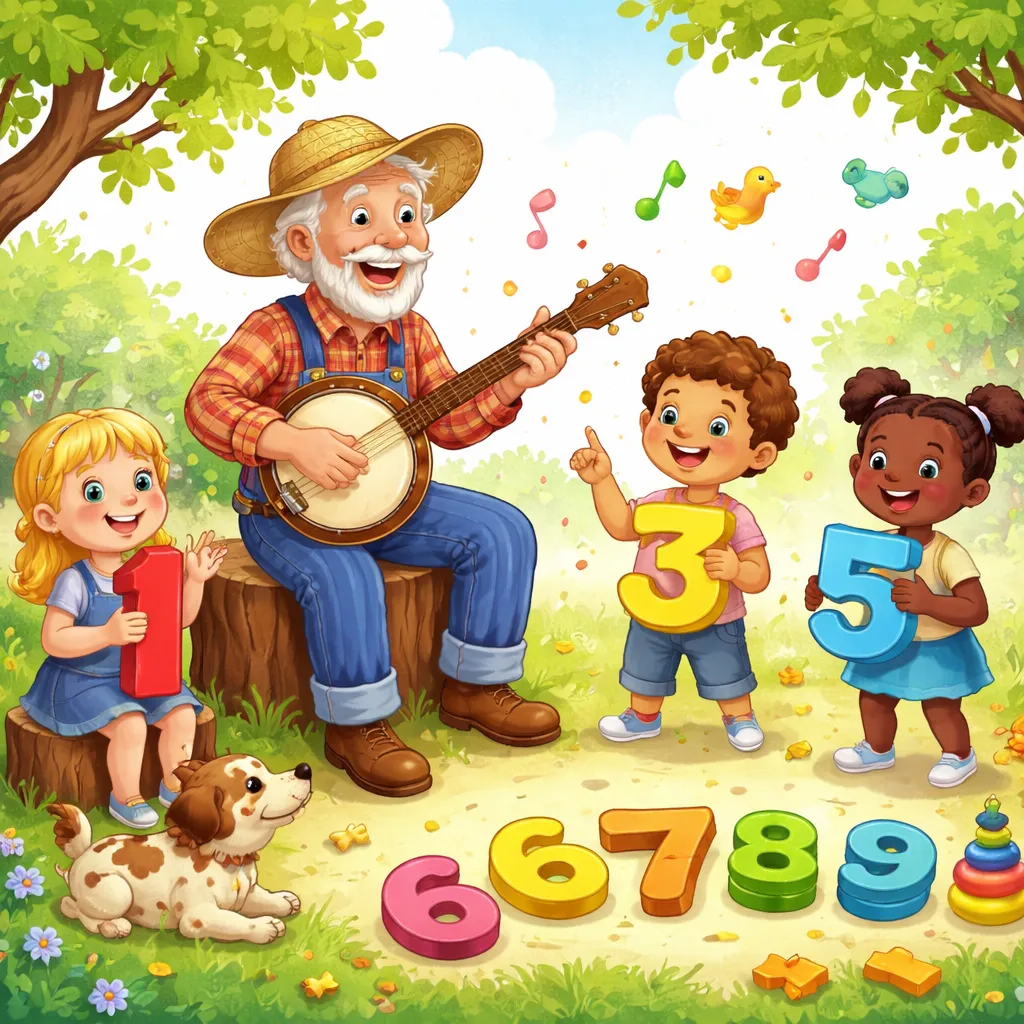

What is the Rhyme "This Old Man"? "This Old Man" is a playful and beloved English nursery rhyme that helps children practice counting from one to ten. The song tells the story of an old man who plays knick-knack on different things. He plays on his thumb, on his shoe, on his knee, and many more places. Each verse introduces a new number and a new rhyming word. The English song: This Old Man has been sung by generations of children learning their numbers. The repetitive structure makes it easy to remember. The silly actions make children laugh. The rhyming words help predict what comes next. This combination of counting, rhyming, and playful language creates a powerful learning experience that feels like pure fun.
The Complete Lyrics of the Nursery Rhyme Let us look at the words together. The song has ten verses, one for each number from one to ten.
This old man, he played one, He played knick-knack on my thumb. With a knick-knack paddywhack, Give the dog a bone, This old man came rolling home.
This old man, he played two, He played knick-knack on my shoe. With a knick-knack paddywhack, Give the dog a bone, This old man came rolling home.
This old man, he played three, He played knick-knack on my knee. With a knick-knack paddywhack, Give the dog a bone, This old man came rolling home.
This old man, he played four, He played knick-knack on my door. With a knick-knack paddywhack, Give the dog a bone, This old man came rolling home.
This old man, he played five, He played knick-knack on my hive. With a knick-knack paddywhack, Give the dog a bone, This old man came rolling home.
This old man, he played six, He played knick-knack on my sticks. With a knick-knack paddywhack, Give the dog a bone, This old man came rolling home.
This old man, he played seven, He played knick-knack up in heaven. With a knick-knack paddywhack, Give the dog a bone, This old man came rolling home.
This old man, he played eight, He played knick-knack on my gate. With a knick-knack paddywhack, Give the dog a bone, This old man came rolling home.
This old man, he played nine, He played knick-knack on my spine. With a knick-knack paddywhack, Give the dog a bone, This old man came rolling home.
This old man, he played ten, He played knick-knack once again. With a knick-knack paddywhack, Give the dog a bone, This old man came rolling home.
Vocabulary Learning from the Song This English song: This Old Man introduces children to number words, body parts, and everyday objects. Each word builds their understanding of the world.
First, the song teaches number words from one to ten. Children hear each number repeated in its own verse. "He played one... he played two... he played three." This repetition helps the numbers stick in memory.
The song introduces body parts. The old man plays on "my thumb," "my shoe" is clothing but near the foot, "my knee," and "my spine." Children can touch these parts on their own bodies as they sing. This kinesthetic connection strengthens learning.
Everyday objects appear in the verses. "Door," "sticks," "gate." These are things children see in their daily environment. You can point to these objects when you see them. "Look, there is a door just like in the song!"
The playful phrase "knick-knack paddywhack" is full of fun sounds. Children do not need to understand every word. They enjoy the rhythm and the silly feeling of saying it. "Give the dog a bone" adds a friendly animal to the story.
Phonics Points to Practice Let us listen for special sounds in the song. Phonics helps children connect letters to the sounds they hear. This English song: This Old Man gives us many sounds to explore.
Listen to the "th" sound at the beginning of "this" and "thumb." Put your tongue between your teeth and blow air. Practice other "th" words like "that," "the," and "thank you."
The "n" sound appears in "knick-knack" and "old man." It is a humming sound made with the tongue behind the teeth. Practice other "n" words like "nose," "night," and "nice."
Listen to the rhyming patterns throughout the song. "One" rhymes with "thumb." "Two" rhymes with "shoe." "Three" rhymes with "knee." Recognizing these rhymes helps children predict words and understand how language works. You can point out other rhymes in books and songs.
The "k" sound in "knick-knack" is special because the "k" is silent in "knick" but not in "knack." This teaches children that sometimes letters are quiet in words.
Grammar Patterns We Can Learn This counting song teaches important grammar in a very natural way. The English song: This Old Man introduces past tense verbs, prepositions, and the structure of repetition.
The song uses past tense throughout. The old man "played" one, two, three. He "came" rolling home. These are past tense verbs. You can talk about your own day using past tense. "We played at the park." "Daddy came home from work." This helps children understand how we talk about things that already happened.
The preposition "on" appears in every verse. "On my thumb," "on my shoe," "on my knee." This teaches location. You can practice using "on" in daily life. "The book is on the table." "Your hat is on your head."
The phrase "came rolling home" uses the verb "came" plus "rolling" to show how he moved. This introduces the idea of describing actions. You can practice this pattern. "The ball came bouncing down." "The baby came crawling to me."
Learning Activities to Do at Home Bringing this English song: This Old Man into your daily life is simple and joyful. Here are some activities you can try with materials you already have.
A wonderful activity is the "Knick-Knack Body Touch" game. As you sing each verse, touch the body part or object mentioned. Touch your thumb for number one. Tap your shoe for number two. Touch your knee for number three. Point to a door for number four. This builds body awareness and connects the words to physical actions.
Another activity is the "Counting Fingers" game. Hold up the correct number of fingers for each verse. One finger for the first verse. Two fingers for the second. Continue up to ten. This builds number recognition and fine motor skills.
You can also have a "Dog Bone Hunt." Cut out bone shapes from paper and hide them around the room. After singing "give the dog a bone," send your child to find one bone. Count how many bones you find together.
Printable Materials for Learning Creating simple printables can make this English song: This Old Man more visual and engaging. You can make these materials together with your child.
Number and object matching cards are perfect for this song. Draw or print cards with numbers one through ten. Draw matching cards with the objects from the song. Thumb for one. Shoe for two. Knee for three. Door for four. Hive for five. Sticks for six. Heaven for seven. Gate for eight. Spine for nine. And a special card for ten showing the old man playing again. Your child can match each number to its object. This builds number recognition and memory.
A coloring page for each verse is always popular. Draw a simple picture of the old man playing on each object. Let your child color the scenes. Write the number and the word at the bottom. Collect all ten pages to make a counting book.
You can also create simple word cards. Write words from the rhyme on cards. "Old," "man," "played," "thumb," "shoe," "knee," "door," "sticks," "gate," "bone," "dog," "home." Show each card as you sing that word. This builds early reading skills in a gentle, supportive way.
A number line from one to ten helps with counting. Draw a simple line and write the numbers one through ten. Beside each number, draw a small picture of the object from that verse. Your child can point to each number as you sing.
Educational Games for Deeper Learning Games make learning active and exciting. They encourage children to use the language from the English song: This Old Man in new and creative ways.
The "New Verses" game encourages creativity. Ask your child, "What if the old man played on something else?" For number one, what else rhymes with one? Sun, fun, run. "He played knick-knack on the sun!" For number two, what rhymes with two? Blue, glue, shoe (already used). "He played knick-knack on something blue!" This extends the song and builds phonemic awareness.
The "Find the Number" game connects numbers to the environment. Go on a hunt around your home or neighborhood for the numbers one through ten. A house number one. Two birds. Three flowers. Four wheels on a car. This builds number recognition in the real world.
The "Rolling Home" game practices the ending phrase. Pretend to be the old man rolling home. Roll on the floor or in a rolling chair. Sing "this old man came rolling home" and roll to a special spot. This adds movement and fun to the song.
The "Dog Bone Counting" game uses the "give the dog a bone" line. Make a simple dog puppet from a paper bag. Cut out ten paper bones. As you sing each verse, give the dog one bone. After ten verses, count how many bones the dog has. This builds one-to-one correspondence, an important early math skill.
The "Knick-Knack Sounds" game adds musical instruments. Use simple instruments or make your own. Shakers for the "knick-knack" part. Drums for "paddywhack." A bell for "give the dog a bone." This builds rhythm and listening skills.
The "Old Man Parade" game brings the song to life. March around the room singing the song. At the end of each verse, everyone falls down gently and rolls like the old man rolling home. Then jump up and start the next verse. This builds coordination and adds joyful movement to counting practice.