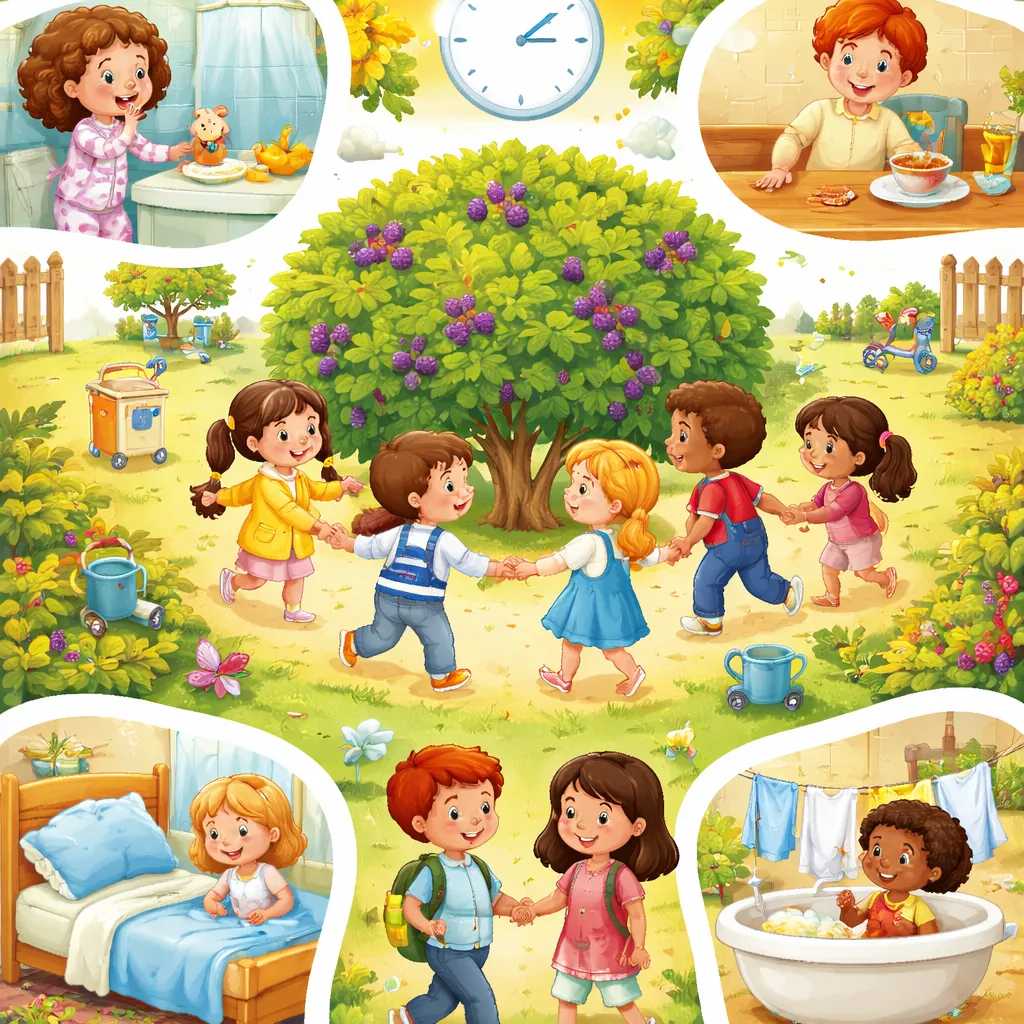

What is the Song "Mulberry Bush"? "Here We Go Round the Mulberry Bush" is a beloved English nursery rhyme that has been sung by children for generations. The song describes a group of children dancing around a mulberry bush while singing about their daily routines. The English song: Mulberry Bush has a cheerful, repetitive melody that makes it easy for young children to learn. Each verse describes a different part of the day, from waking up to going to school. Children love acting out the motions as they sing. Washing their face, brushing their teeth, combing their hair. The song turns everyday chores into a fun game. The mulberry bush itself is a real plant that produces tasty berries. This rhyme has been part of childhood for over a hundred years, teaching routines through joyful repetition.
The Complete Lyrics of the Nursery Rhyme Let us look at the words together. The song has many verses for different daily activities.
Here we go round the mulberry bush, The mulberry bush, the mulberry bush, Here we go round the mulberry bush, On a cold and frosty morning.
This is the way we wash our face, Wash our face, wash our face, This is the way we wash our face, On a cold and frosty morning.
This is the way we brush our teeth, Brush our teeth, brush our teeth, This is the way we brush our teeth, On a cold and frosty morning.
This is the way we comb our hair, Comb our hair, comb our hair, This is the way we comb our hair, On a cold and frosty morning.
This is the way we put on our clothes, Put on our clothes, put on our clothes, This is the way we put on our clothes, On a cold and frosty morning.
This is the way we go to school, Go to school, go to school, This is the way we go to school, On a cold and frosty morning.
Vocabulary Learning from the Song This English song: Mulberry Bush introduces children to words about daily routines, weather, and nature. Each word builds their understanding of everyday life.
First, the song teaches about a "mulberry bush." A mulberry bush is a plant that grows mulberries, which are small, sweet fruits. You can show your child pictures of mulberries and talk about how they grow.
The phrase "here we go round" means dancing in a circle around something. Children hold hands and walk in a circle while singing.
The song teaches about weather. "On a cold and frosty morning" describes a winter day when frost covers the ground. This teaches children about seasons and weather words.
The song teaches daily routine words. "Wash our face" means cleaning our face with water. "Brush our teeth" means cleaning teeth with a toothbrush. "Comb our hair" means making hair neat with a comb. "Put on our clothes" means getting dressed. "Go to school" means leaving for the day.
Phonics Points to Practice Let us listen for special sounds in the song. Phonics helps children connect letters to the sounds they hear. This English song: Mulberry Bush gives us many sounds to explore.
Listen to the "m" sound at the beginning of "mulberry." It is a humming sound made with lips together. Say "mulberry bush" slowly. Feel your lips press together. Practice other "m" words like "mommy," "milk," and "moon."
The "b" sound appears in "bush." It is a strong sound made by pressing lips together. Practice other "b" words like "ball," "book," and "baby."
Listen to the "r" sound in "round" and "morning." It is a rolling sound made with the tongue. Practice other "r" words like "rabbit," "red," and "run."
The "w" sound in "wash" and "way" is made with rounded lips. Practice other "w" words like "water," "window," and "wagon."
The "f" sound in "face" and "frosty" is made by putting top teeth on bottom lip and blowing air. Practice other "f" words like "fish," "fun," and "family."
Grammar Patterns We Can Learn This daily routine song teaches important grammar in a very natural way. The English song: Mulberry Bush introduces present tense verbs, the phrase "this is the way," and repetitive patterns.
The song uses present tense. "This is the way we wash our face." "We go to school." These describe things we do regularly. You can use present tense in daily life. "This is the way we eat our lunch." "This is the way we brush our teeth."
The phrase "this is the way" shows how to do something. It teaches children that there are proper ways to do daily tasks. You can use this phrase. "This is the way we tie our shoes." "This is the way we say please."
The song uses repetitive patterns. Each verse follows the same structure with a new action. This makes the song easy to learn and remember. Children can create their own verses using the pattern.
Learning Activities to Do at Home Bringing this English song: Mulberry Bush into your daily life is simple and joyful. Here are some activities you can try with materials you already have.
A wonderful activity is the "Morning Routine" game. Sing the song while actually doing your morning routine. Wash your face while singing the face verse. Brush your teeth while singing the teeth verse. This turns daily chores into a fun sing-along and helps children remember what to do.
Another activity is the "Mulberry Bush Circle" game. Hold hands with family members and walk in a circle while singing the chorus. Stop and act out each verse. This builds social skills and coordination.
You can also have a "Cold and Frosty Morning" discussion. Look out the window on a cold morning. Is there frost? What does frost look like? Talk about winter and cold weather. This builds science knowledge.
Printable Materials for Learning Creating simple printables can make this English song: Mulberry Bush more visual and engaging. You can make these materials together with your child.
Routine cards are perfect for this song. Draw simple pictures of each daily activity on separate cards. Washing face, brushing teeth, combing hair, putting on clothes, going to school. Hold up each card as you sing that verse. This builds vocabulary and sequencing.
A coloring page is always popular. Draw children dancing around a mulberry bush on a frosty morning. Add frost on the ground and bushes. Let your child color the scene. Write "Mulberry Bush" at the top. Display their artwork proudly.
You can also create simple word cards. Write words from the song on cards. "Mulberry," "bush," "round," "cold," "frosty," "morning," "wash," "face," "brush," "teeth," "comb," "hair," "put," "clothes," "school." Show each card as you sing that word. This builds early reading skills.
A daily routine chart helps with morning organization. Draw pictures of each step in order. Check them off as you complete them. This builds independence and routine.
Educational Games for Deeper Learning Games make learning active and exciting. They encourage children to use the language from the English song: Mulberry Bush in new and creative ways.
The "New Routine" game encourages creativity. Ask your child, "What other things do we do in the morning?" Eat breakfast? Pack our bag? Put on our shoes? Create new verses. "This is the way we eat our toast, eat our toast, eat our toast..." This shows children how to extend the pattern.
The "Evening Routine" game creates a new version. What do we do at night? Take a bath? Put on pajamas? Read a story? Sing "This is the way we take our bath" to the same tune. This builds understanding of daily schedules.
The "Frosty Morning" science experiment explores frost. On a cold morning, look at frost outside. If it's not cold enough, make frost in the freezer. Put a metal pan in the freezer, then breathe on it. Frost forms! This builds science understanding.
The "Mulberry Taste Test" is fun if you can find mulberries. Try a mulberry if available. Talk about how it tastes. If not, look at pictures of mulberries and other berries. This builds food vocabulary.
The "Left and Right" practice can be added. When walking in a circle, practice going left and right. "Here we go round to the left..." This builds direction skills.
The "Speed Round" game adds challenge. Sing the song faster and faster while doing the actions. Try to keep up! This builds coordination and listening skills.
The "Different Weather" game changes the song. What if it was a hot and sunny morning? A rainy and wet morning? A windy and blustery morning? Change the words and act out different weather. This builds vocabulary and imagination.
The "Community Helpers" version teaches about different jobs. "This is the way the teacher teaches..." "This is the way the doctor helps..." This builds understanding of community roles.