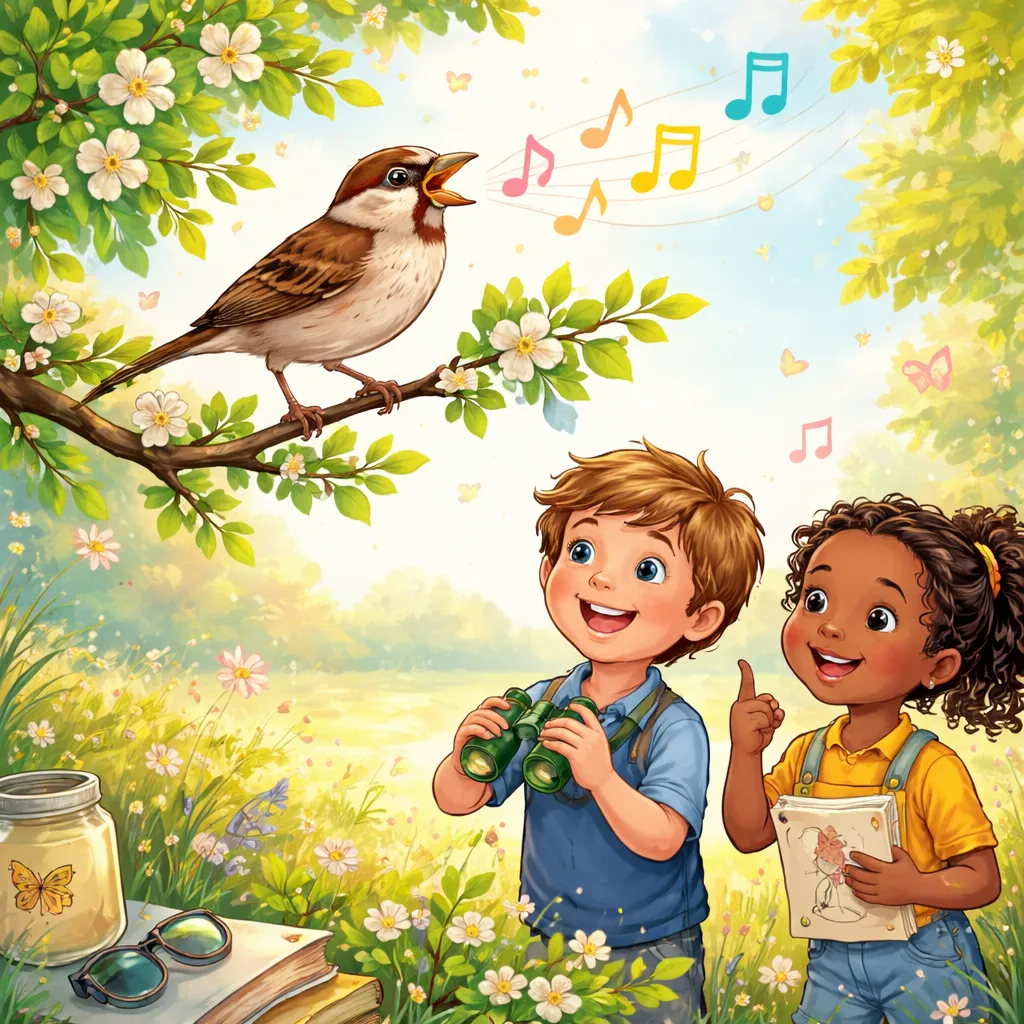

Have you ever heard a cheerful "chirp, chirp, chirp" outside your window in the morning? You might have a sparrow visiting! These small, brown birds with busy, hopping movements are common in cities, towns, and the countryside. They are full of energy and song. Learning about sparrows is a wonderful adventure that takes us to our own backyards and parks. Let’s begin our journey of learning about sparrow life and music.
English Language Learning
Vocabulary and Spelling Our small, chirping friend is called a sparrow. The word "sparrow" is a noun. A noun names a person, place, or thing. So, a sparrow is a thing—a small, living bird. Spelling "sparrow" is straightforward: S-P-A-R-R-O-W. The 'S' starts the word, the 'P' and 'A' are in the middle, and it ends with two 'R's and 'O-W'. S-P-A-R-R-O-W spells sparrow.
Sound and Pronunciation Let’s say the word correctly. It sounds like this: /ˈsper.oʊ/. We can say it in two clear parts. First, say "spare". It rhymes with "air" or "care". Next, say "oh". It’s the sound you make when you understand something. Now, put it together! "Spare" "oh". Sparrow! Great! The word "sparrow" has two beats, or two syllables. Clap your hands twice: Spar-row. It’s a soft, quick word.
Related Words Learning about sparrows is more fun with new words! Here are some important ones. Sound: The short, high sound a sparrow makes is a chirp. A group of sparrows is sometimes called a host. Baby: A baby sparrow is called a chick or a fledgling. Home: A sparrow’s nest is often a messy ball of grass and feathers in a tree, a bush, or even a building.
A Famous Saying There is a common phrase: "As cheerful as a sparrow." This means someone who is happy, lively, and full of energy. It comes from the sparrow’s busy, chirping nature. It reminds us to find joy in the little things and to share our cheerful voice with the world. Say the saying with me: "As cheerful as a sparrow." Isn’t that a lovely thought?
Now you know the word "sparrow"! Are you ready to learn about these everyday songbirds? Let’s hop from words to wonderful knowledge!
Animal Knowledge
Who Are They? – Family and Group What kind of animal is a sparrow? Sparrows are birds. They are warm-blooded, have feathers, and lay eggs. They are part of the Old World sparrow family, called Passeridae. The most common is the House Sparrow. There are many other species, like the Song Sparrow and the Tree Sparrow. They are all small, seed-eating birds.
What Do They Look Like? – Amazing Bodies Sparrows are small birds, about the size of your hand. They usually have brown, gray, and black feathers. Male House Sparrows have a gray cap and a black bib. Their most famous features are their stout, conical beaks and their constant, hopping movement. Their strong, cone-shaped beak is a perfect tool for cracking open seeds. This is their main food. They have strong feet for perching on branches and wires. They are not the flashiest birds, but their patterns are beautiful in a quiet way. Sparrows have special adaptations. They are incredibly adaptable and can live very close to people. They are social and often form large flocks, especially in winter. They are excellent at finding food in many different places.
Where Do They Live and How? – Home and Habits Sparrows live all over the world. They are found in cities, towns, farms, and grasslands. They thrive near people, making nests in buildings, streetlights, and trees. Sparrows are granivores. This means they mostly eat seeds. They love grass seeds, grains, and crumbs. They also eat insects, especially in the summer to feed their growing chicks. They hop on the ground, pecking at food. Sparrows are very social and live in flocks. They are active during the day. They spend their time hopping on the ground looking for seeds, taking dust baths to clean their feathers, chirping, and perching together. Their flocks can be very noisy and busy.
A Sparrow’s Life Story – Growing Up A baby sparrow is called a chick. Sparrows are birds, so chicks hatch from eggs. A pair of sparrows can raise several families in one year, with 3-5 eggs in each nest. Both parents work hard to feed the chicks. They bring them insects and seeds. The nest is often a messy dome of grass with a side entrance. The parents are very busy going back and forth with food. Chicks are born naked and helpless, with their eyes closed. They grow quickly and are covered in fluffy down in a few days. They leave the nest about two weeks after hatching. These young birds are called fledglings. They stay near their parents and beg for food while learning to find their own.
How Do They "Talk"? – Communication Sparrows talk a lot! They are famous for their constant chirps and chatters. Their songs are not very musical, but they are loud and full of different calls for contact, alarm, and mating. They use body language too. A sparrow might fluff its feathers or raise the feathers on its head to show how it feels. They are very active and their movements are a kind of communication too. Their best senses are their excellent eyesight and hearing. They have sharp eyes to spot seeds and predators. Their ears are good at hearing the calls of other sparrows, which helps the flock stay together and safe.
Are They Okay? – Taking Care of Them In many places, House Sparrow numbers are going down, which worries scientists. They are still common, but in some areas they are declining. The main threats are changes in how we build cities (fewer nesting holes), fewer insects for their chicks to eat, and pollution. Very clean gardens and parks with no weeds mean fewer seeds for them to eat. You can be a sparrow friend! You can plant native flowers and grasses that produce seeds. You can leave a small, messy patch in your garden for insects. You can put out a birdbath with clean water. If you feed birds, use appropriate bird seed. Most importantly, you can learn about them and appreciate their cheerful presence.
Life Connections and Inspiration
How to Be With Them – Safety and Love Sparrows are wild birds. They are small and can be scared easily. We must enjoy their company without disturbing them. The rule is: Enjoy from a distance and create a friendly space. Watch sparrows from a window or a few steps away. Never try to touch a sparrow or disturb its nest. Keep cats indoors to protect them. You can make your yard friendly by providing food, water, and safe bushes for them to hide in. We show our love by making our neighborhoods a little wilder and kinder for all small creatures. A world with sparrows is a cheerful world.
Super Qualities We Learn from Them Sparrows teach us wonderful things. One super quality is cheerful adaptability and community. Sparrows adapt to live right next to us, in our busiest cities. They find joy in simple things like a dust bath or a seed. They thrive in communities, chattering and working together. They teach us to adapt to changes, find happiness in everyday moments, and value our community. Another quality is the importance of small things. Sparrows are small and common, but they are very important for the environment. They eat insects and spread seeds. This reminds us that even small actions and seemingly small creatures have great value and an important role to play. Think about it: How can you find joy in a simple thing today, like a sparrow finds joy in a seed? How can you, in your own small way, help your community or environment?
Take Action! – Your "Sparrow Watch" Project Let’s do a cheerful and observant activity! Your project is to become a sparrow spotter for one week. Get a notebook. Each day, look outside for five minutes. Can you see or hear a sparrow? Draw a tally mark in your notebook for each one you see. Note what it is doing: is it hopping on the ground? Chirping on a fence? Bathing in dust? At the end of the week, count your tally marks. How many sparrows did you see? This makes you a careful observer of the nature right outside your door.
Closing Learning about sparrow songs is a delightful and close-to-home adventure! We learned the word "sparrow" and how to say its two-part name. We discovered amazing facts about their seed-cracking beaks, their constant chirping, and their life in busy flocks. We know that sparrows are adaptable, cheerful birds who remind us of the beauty in common things. You can use your new words to share the story of these feathered neighbors. You can use your knowledge to create a kinder space for wildlife in your own backyard. The animal world is full of cheerful and adaptable teachers. Always remember to respect wildlife from a safe distance, find joy in simple moments, and value your role in your community. Keep exploring with curious eyes, listen for the cheerful chirps around you, and be a friend to the small and common creatures. Your observant eyes and kind heart make you a true friend to the amazing sparrow.