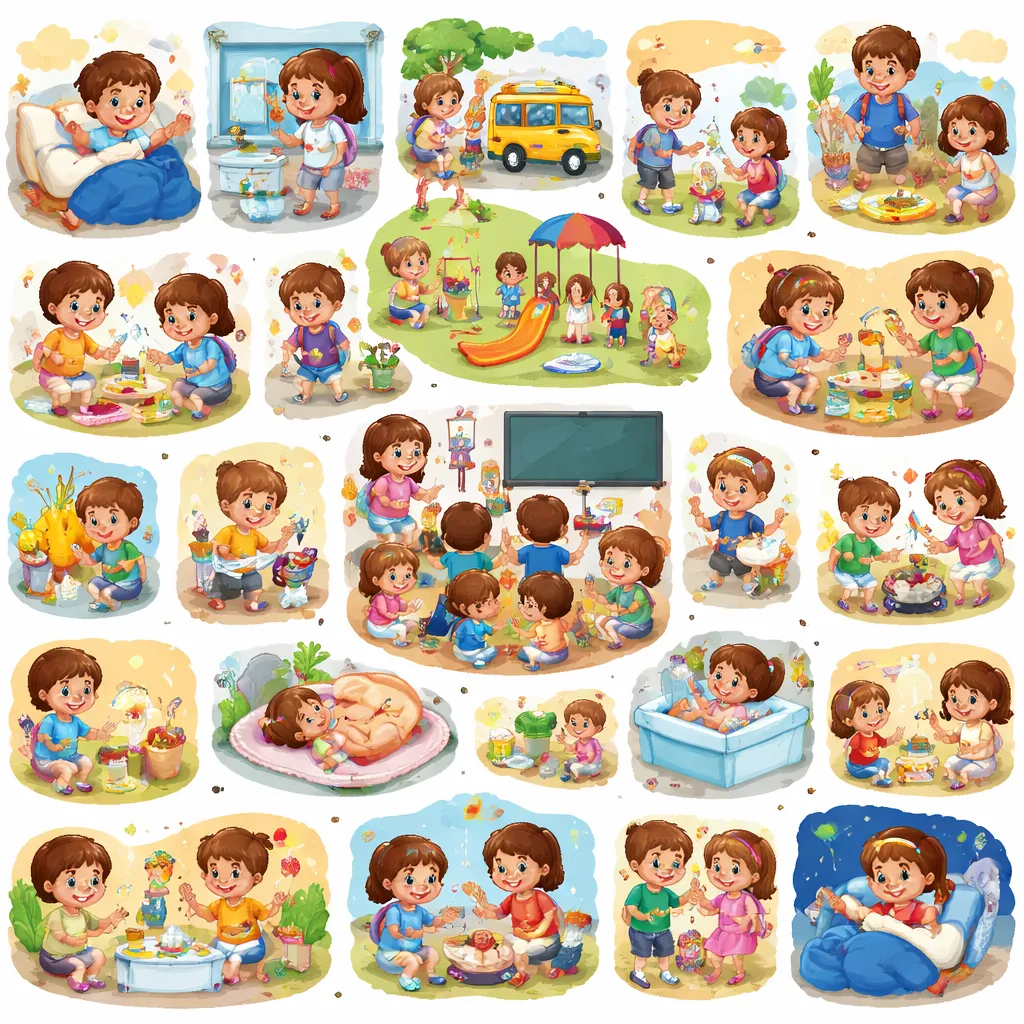

Hello, my friend! Do you brush your teeth every morning? Does the sun shine every day? We use a special way of talking about things we do always, often, or every day. This is called the simple present tense. It tells us about habits, routines, and things that are always true. Think of it as your daily schedule in words! Today, we will learn to use one hundred of the most common verbs in the simple present tense. Your guide is Sam the Schedule Star. Sam loves routines! He will show you his daily habits at home, school, the playground, and in nature. Let's talk about our always and often!
What Is the Simple Present Tense? The simple present tense is a verb form. It tells about actions that happen again and again. It tells about things that are always true. It is for habits and facts. Think of it like a beating heart. Your heart beats all the time. It is a fact. "My heart beats." That is simple present. "I brush my teeth every day." That is a habit. It is not happening right this second, but it is something I do regularly. We will use one hundred common action words this way.
Why Learn to Talk About Always and Often? The simple present helps you share your world. It helps your ears listen. You can understand daily routines. "Dad makes breakfast." You know it's his habit. It helps your mouth speak. You can tell people about yourself. "I like apples." "I go to school." It helps your eyes read. Many storybooks and facts use this tense. "The cat chases mice." It helps your hand write. You can write about your day or true things. Knowing the simple present tense lets you talk about your life.
When Do We Use This Tense? Sam says we use the simple present for two big reasons. Let's see them.
For Habits and Routines (Things we do often): These are actions we repeat. We do them every day, every week, or often. Words like 'always', 'usually', 'often', 'every day' are clues. "I wake up at seven. I wash my face. I eat breakfast." "We play at the park on Saturday."
For Facts and General Truths (Things that are always true): These are things that do not change. They are true in the past, now, and future. "The sun rises in the east. Water is wet. Dogs bark."
How Can You Spot the Simple Present? Look for clue words about frequency. Words like: always, usually, often, sometimes, never, every day, on Mondays. "I always drink milk." "She goes to school every day."
Ask: Is this happening right now? Or does it happen often? The simple present is not for actions happening at this exact moment. For "I eat lunch right now," we say "I am eating lunch." For a habit, we say "I eat lunch at noon every day."
Look at the verb form. For I, you, we, they: use the basic verb. "I like. You like. We like. They like." For he, she, it: we often add an 's' to the verb. "He likes. She likes. The dog likes."
See if it states a fact. "Birds fly." "Ice is cold." These are always true. They use the simple present.
Sam shows us. Look at "Sam brushes his teeth every morning." The clue is 'every morning'. The verb for 'he' (Sam) is 'brushes' (with 'es'). This is the simple present for a habit.
How Do We Make Sentences with It? The pattern changes a little bit. Let's look at the formulas.
For Positive Sentences (Telling something): With I, You, We, They: [I/You/We/They] + [Basic Verb]. "I play. You read. We sing. They run." With He, She, It: [He/She/It] + [Verb + s/es]. "He plays. She reads. The cat sleeps. Mom washes."
For Negative Sentences (Saying "no" or "not"): Use 'do not' (don't) or 'does not' (doesn't) + the basic verb. With I, You, We, They: [I/You/We/They] + do not (don't) + [Basic Verb]. "I do not like spinach. They don't play here." With He, She, It: [He/She/It] + does not (doesn't) + [Basic Verb]. "He does not eat meat. She doesn't run fast."
For Questions (Asking something): Start with 'Do' or 'Does' + the basic verb. With I, You, We, They: Do + [I/you/we/they] + [Basic Verb]? "Do you like school? Do they live here?" With He, She, It: Does + [he/she/it] + [Basic Verb]? "Does he have a dog? Does the sun shine?"
Let's Fix Some Common Mix-Ups. Sometimes we use the wrong form. Let's practice.
Forgetting the 's' for he/she/it. "He like dogs." For 'he', 'she', or 'it', we add 's'. "He likes dogs." "She plays ball." "The dog barks."
Using the simple present for right now. "I eat my sandwich." If you are holding the sandwich and eating it, this sounds odd. For actions happening right now, we say "I am eating my sandwich." Use the simple present for habits: "I eat a sandwich for lunch every day."
Using 'is' with a main verb. "He is goes to school." We do not need 'is' here. Just use the verb with 's'. "He goes to school." 'Is' is for the present continuous tense (I am going).
Mixing up 'do' and 'does' in questions. "Do she like cats?" For 'she', we must use 'Does'. "Does she like cats?"
Can You Be a Routine Reporter? You are great at this! Let's play. I say "I (brush) my teeth." What is the verb? 'Brush'. For 'I', we use the basic verb. "I brush my teeth." Good! Now, "Sam (brush) his teeth." For 'Sam' (he), we add 'es' because 'brush' ends in 'sh'. "Sam brushes his teeth." Perfect! Try a question. "Do you brush your teeth?" "Yes, I do." Excellent reporting!
Sam's Daily List: 100 Common Verbs in Simple Present. Here is a list of one hundred verbs we use often, shown in the simple present tense for 'I' and 'he'. Remember, for 'you/we/they', it's like the 'I' form. For 'she/it', it's like the 'he' form.
Daily Routine Verbs: I wake up. / He wakes up. I get up. / He gets up. I wash my face. / He washes his face. I brush my teeth. / He brushes his teeth. I take a bath. / He takes a bath. I get dressed. / He gets dressed. I eat breakfast. / He eats breakfast. I drink milk. / He drinks milk. I go to school. / He goes to school. I come home. / He comes home. I do homework. / He does homework. I help my mom. / He helps his mom. I set the table. / He sets the table. I clean my room. / He cleans his room. I make my bed. / He makes his bed. I feed the pet. / He feeds the pet. I watch TV. / He watches TV. I read a book. / He reads a book. I draw a picture. / He draws a picture. I write my name. / He writes his name. I color. / He colors. I listen to music. / He listens to music. I play a game. / He plays a game. I talk to my friend. / He talks to his friend. I see my teacher. / He sees his teacher. I hear a sound. / He hears a sound. I say "Hello". / He says "Hello". I ask a question. / He asks a question. I answer the teacher. / He answers the teacher. I think. / He thinks. I know the answer. / He knows the answer. I want a cookie. / He wants a cookie. I need a pencil. / He needs a pencil. I like candy. / He likes candy. I love my family. / He loves his family. I have a ball. / He has a ball.
Play and Action Verbs: I run. / He runs. I jump. / He jumps. I walk. / He walks. I skip. / He skips. I hop. / He hops. I dance. / He dances. I sing. / He sings. I play. / He plays. I swing. / He swings. I slide. / He slides. I climb. / He climbs. I throw a ball. / He throws a ball. I catch a ball. / He catches a ball. I kick a ball. / He kicks a ball. I ride a bike. / He rides a bike. I swim. / He swims.
Nature and Animal Verbs: The sun shines. / The bird flies. The moon glows. / The fish swims. The rain falls. / The dog barks. The wind blows. / The cat sleeps. A flower grows. / The lion roars. A tree stands. / The bee buzzes. Water flows. / The frog jumps. Fire burns. / The butterfly flaps. The Earth turns. / The snake slithers.
Other Useful Verbs: I work. / He works. I learn. / He learns. I teach. / He teaches. I find a toy. / He finds a toy. I open the door. / He opens the door. I close the door. / He closes the door. I start. / He starts. I finish. / He finishes. I put away toys. / He puts away toys. I look. / He looks. I see. / He sees. I touch. / He touches. I feel happy. / He feels happy. I live in a house. / He lives in a house. I use a spoon. / He uses a spoon.
Examples in Your World.
At Home (Habits): "I make my bed. Mom cooks dinner. Dad washes the car. We eat together. Our dog sleeps on the sofa."
At the Playground (Actions): "I swing high. My friend climbs the ladder. We run fast. Children laugh. The bell rings."
At School (Routines): "My teacher reads to us. We sing songs. I write my name. The clock shows the time. We raise our hands."
In Nature (Facts): "The sun rises in the east. Birds build nests. Flowers need sun. A river flows to the sea. Bears sleep in winter."
You Are a Routine Expert! You did it! You know that the simple present tells about habits and facts. You use it for things you do often. You use it for things that are always true. You know to add 's' or 'es' for he, she, and it. Sam the Schedule Star gives you a gold star for your chart. You have learned one hundred common verbs in the simple present tense. You can now talk about your daily life with confidence.
Here is what you learned from our day with Sam. You know the simple present tense is for habits and general truths. You can make sentences with I, you, we, they using the basic verb. You remember to add 's' or 'es' for he, she, and it. You have a big list of one hundred verbs to use every day.
Now, let's do some life practice! Your mission is today. Tell your family about your day using the simple present. Say three things you always do. "I brush my teeth. I eat breakfast. I go to school." Then, look outside and say one true fact. "The sun shines." Keep talking about your always and often!