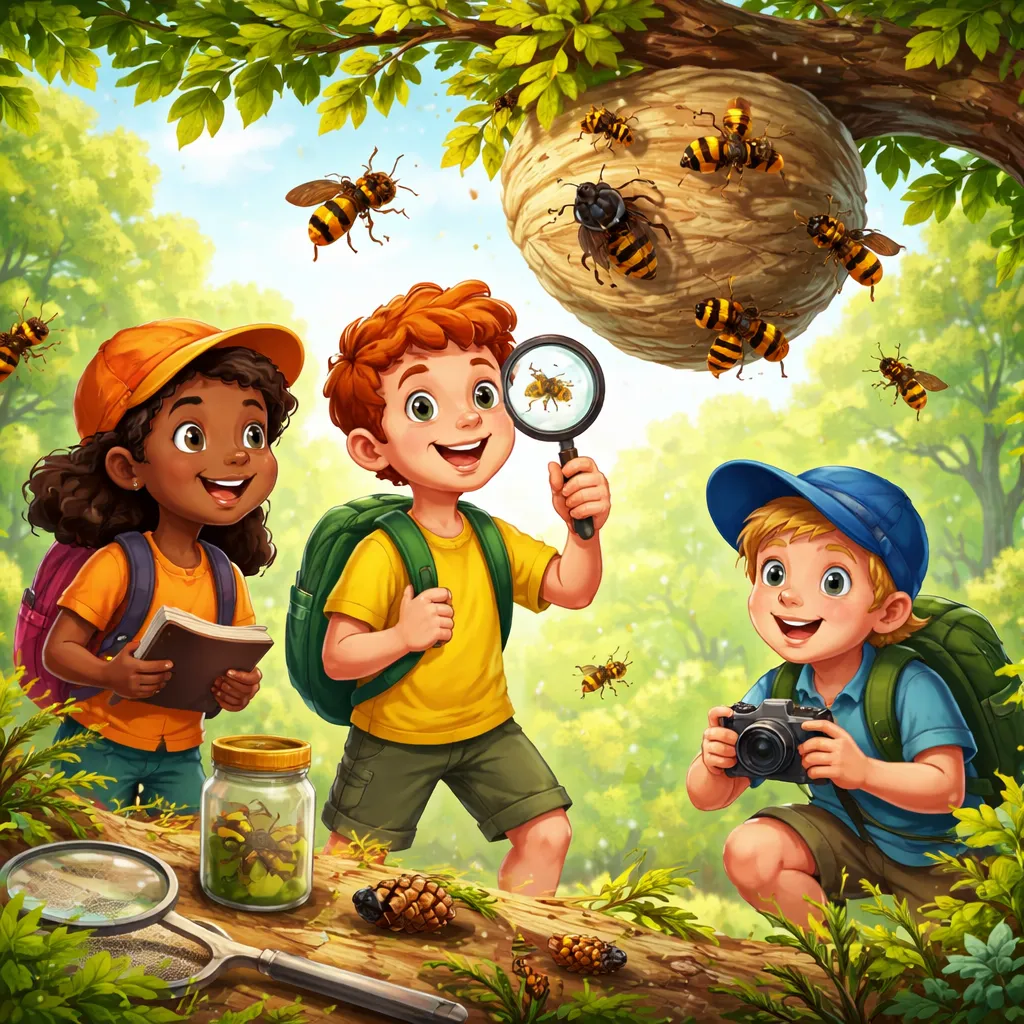

What Is This Animal?
A hornet is a large insect related to wasps. It has a thick body with yellow and black or brown stripes. Its head is wide. Its wings are long and clear. Hornets are bigger than most wasps and bees.
Hornets belong to the wasp family. They are social insects. They live in colonies with a queen. The colony builds a large paper nest. The nest is often high in trees or under building eaves. Hornets protect their nest with great care.
These insects live in forests and wooded areas. They build nests in sheltered spots. Hornets are active during the day. They hunt other insects. They also eat sweet liquids from fruit and flowers.
For children, hornets require special respect. They are wild animals with powerful stingers. Learning about hornets teaches children to appreciate nature from a safe distance and understand that all creatures have their place.
English Learning About This Animal
Let us learn the English word hornet. We say it like this: /ˈhɔːrnɪt/. The horn sounds like “horn.” The et sounds like “it.” Put them together: hornet. Say it three times. Hornet. Hornet. Hornet.
Now let us learn words about a hornet’s body. The head is large with strong mandibles. The thorax is the middle section where wings attach. The abdomen has yellow and black stripes. The stinger is at the end of the abdomen. The mandibles are powerful jaws for chewing. The wings are long and fold along the body when resting.
There is an old saying about hornets. It goes, “Do not stir the hornet’s nest.” This means do not disturb something that may cause trouble. Another saying is, “The hornet builds a castle of paper and guards it well.” This reminds us that protecting what we build takes care and courage.
These English words help children understand hornet anatomy. When they say mandibles, they learn about the strong jaws. When they say stinger, they understand the defense tool. Parents can practice these words while looking at pictures from a safe distance. Point to the parts. Say the words together.
Animal Facts and Science Knowledge
Hornets belong to the wasp family Vespidae. They are the largest social wasps. There are about twenty hornet species worldwide. The European hornet is common in many regions. The Asian giant hornet is the largest. Hornets are different from yellowjackets, which are smaller wasps.
Hornets live in forests and wooded areas. They build large paper nests from chewed wood fibers. The nest has a papery outer layer. Inside are layers of cells. A single nest can hold hundreds of hornets. The queen starts the nest in spring. Workers expand it throughout summer.
Hornets are predators. They hunt flies, caterpillars, and other insects. They chew the prey and feed it to their young. Adult hornets eat nectar, tree sap, and ripe fruit. They also collect sap from trees. Hornets help control insect populations in forests.
Hornets have special abilities. They can sting multiple times. Their stinger is smooth. It does not get stuck. A hornet sting is painful. Hornets release alarm chemicals when threatened. This signals other hornets to defend the nest. They are protective of their colony.
Hornet colonies last one season. In autumn, new queens and males leave the nest. They mate. The males die. The new queens find sheltered spots to hibernate. The old nest is abandoned. In spring, each queen starts a new colony. Old nests are not reused.
How to Interact With This Animal Safely
Hornets are wild insects that defend their nests. The safest way to interact is to watch from a distance. Do not approach a hornet nest. Do not throw things at it. Do not try to remove it yourself. If you see a nest, keep children away.
Teach children to stay calm if a hornet flies nearby. Do not wave arms. Do not run. Move away slowly. Hornets are usually not aggressive away from their nest. They are busy hunting or collecting food. A calm response helps them go on their way.
If you find a nest near your home, contact a professional. Do not attempt to remove it without proper training. Teach children that some jobs are for experts. This keeps everyone safe.
When eating outdoors, keep food and drinks covered. Sweet smells attract hornets. Use cups with lids. Clean up spills. Do not leave fruit or sweet foods out. This reduces the chance of hornets coming near.
If a child gets stung, stay calm. Wash the area with soap and water. Apply a cold pack. Watch for signs of allergy. Seek medical help if needed. Most stings cause pain and swelling that go away. Teach children that hornets sting to protect their colony, not to be mean.
What Can We Learn From This Animal
Hornets teach us about protection. They guard their nest with courage. Children learn that protecting family and home is important. Standing together, staying alert, and caring for those we love are valuable lessons.
Hornets teach us about building. They create large, strong nests from simple materials. Children learn that building takes time and effort. Building skills, building friendships, and building a safe place all require patience and care.
Hornets teach us about boundaries. They have a clear territory they defend. Children learn that respecting boundaries is important. Giving others space, asking before entering, and knowing when to step back show respect.
Hornets teach us about the value of distance. We can appreciate them without getting close. Children learn that some things are best admired from afar. Enjoying nature’s wonders does not always mean touching or approaching.
Fun Learning Activities
Let us make learning about hornet fun. One activity is the hornet nest observation. In winter, look for abandoned hornet nests in trees. Observe the paper layers. Notice the shape and size. Talk about how the colony built it. Do not touch nests that look active.
Another activity is drawing a hornet. Look at pictures of hornets. Notice the large head, striped abdomen, and clear wings. Draw a hornet. Label the head, thorax, abdomen, wings, mandibles, and stinger. Say the words aloud.
Create a story about a hornet’s season. Ask your child what the queen does in spring. Does she build a nest? Do workers help her? What happens in autumn? Write a few sentences together. Let your child draw pictures. Read the story aloud.
Make a paper nest craft. Use paper bags or brown paper. Shape it into a rounded form. Add layers of paper strips. Create small cells inside. Talk about how hornets chew wood to make paper for their nests. Use words like “nest,” “cells,” and “colony.”
Compare hornets to wasps and bees. Look at pictures of each. Notice the size differences. Talk about how each insect helps nature in its own way. Use words like “predator,” “pollinator,” and “social insect.”
These simple activities bring learning to life. Children build English vocabulary while playing. They learn science through observation. They connect with nature in thoughtful ways. Learning about hornet becomes a lesson in respect, distance, and the wonder of large, complex nests built high in trees. Each moment spent together strengthens language, curiosity, and a growing understanding that even creatures we keep our distance from play important roles in the forests and fields they call home.