
Opening Introduction
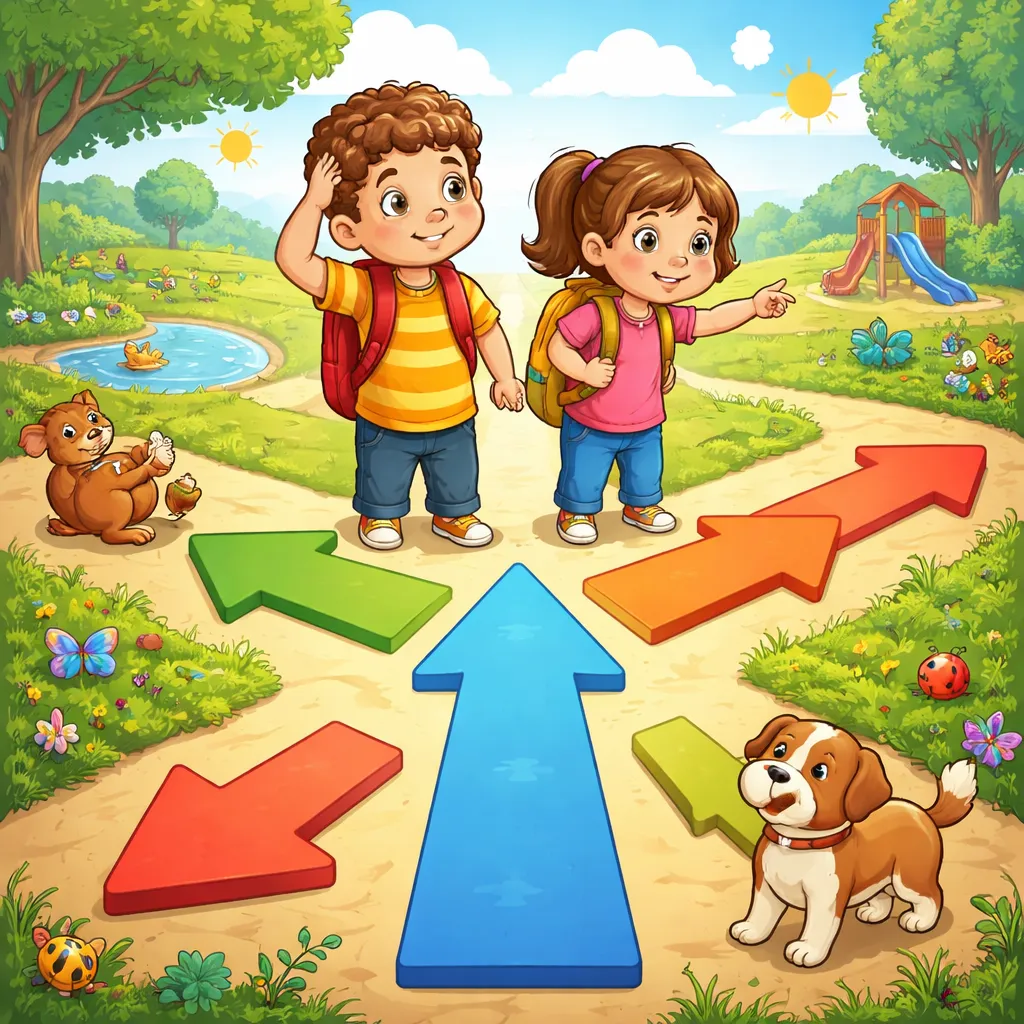
Leo and his sister Mia were in the backyard. Their dad gave them a simple map. "Find the hidden treasure!" he said. The map had an arrow and three steps. "Take two steps forward. Then, turn left. Take one step. The treasure is there!" Leo scratched his head. "Left? Which way is left?" Mia pointed to her left hand. "It's this side! But we have to know forward and backward too. Let's learn the words for directions left right forward backward. They are like magic words that tell us how to move. When you know them, you can follow any map!" Leo was excited. Magic words for moving? He wanted to learn them all. Let's start our direction adventure.
Core Knowledge Explanation
Directions are words that tell us which way to go or look. They help us move from one place to another. The four main directions for moving your body are left, right, forward, and backward. Knowing your directions left right forward backward is very important. It helps you follow instructions, play games, and stay safe. Let's learn each one. First, forward. Forward means ahead of you. It is the way you are facing. When you walk forward, you move toward what is in front of you. If you are looking at a tree, walking forward takes you to the tree.
Second, backward. Backward means behind you. It is the opposite of forward. When you walk backward, you move toward what is behind you. You must be very careful and look over your shoulder. Now, the tricky ones: left and right. Left and right are sides. They depend on which way you are facing. Your left side is the same as the left side of your body. How can you remember? Here is a trick. Hold your hands in front of you. Make an L shape with your thumb and index finger. Which hand makes a correct letter L? That is your left hand! The other is your right. Your left foot is on the same side as your left hand. Your right foot is on the same side as your right hand.
If you are facing forward, your left side is to your left. Your right side is to your right. If you turn around, your left and right sides are still the same, but what you see on your left changes. This is the key to directions left right forward backward. They are relative to you. When someone says, "Turn left," you turn to your left side. When someone says, "Move backward," you step back. These four words are the basics for moving through the world. You use them in dance, sports, and even when cleaning your room. "Move the chair to the left a little."
Fun Interactive Learning
Let's play a game called "Direction Dance." This is a fun way to practice. Stand in an open space. Now, listen to the commands. A grown-up or a friend can call them out. "Take two steps forward!" You walk forward two steps. "Take one step to the right!" You step to your right. "Jump backward once!" You jump back. "Hop on your left foot!" Try to make a sequence. "Forward, right, left, backward." This game gets your whole body moving and thinking about the directions left right forward backward. It is like being a robot that follows commands.
Another fun activity is the "Blindfold Direction Game." You need a partner and a soft toy. Place the toy somewhere in the room. One person is blindfolded. The other person must give directions to help them find the toy. Use only the words: left, right, forward, backward. "Take three small steps forward. Now, turn a little to the right. Take one step forward. Stop! The toy is at your left foot." This game teaches you to give clear directions. It is a great way to practice the directions left right forward backward in a real situation. You can also draw a simple maze on paper. At the start, write directions to get through. "Go forward three squares. Turn right. Go forward two squares." Then, see if a friend can follow your drawn directions.
Expanded Learning
Directions are used everywhere. When you play a video game, you press buttons to move a character forward, backward, left, and right. In sports, a coach might say, "Pass the ball to the left!" In traffic, cars must stay on the right side of the road in some countries. In other countries, they stay on the left. The directions left right forward backward are universal ideas. Long ago, explorers used the sun and stars to find directions: north, south, east, and west. But for moving your own body, left, right, forward, and backward are the first and most important.
Many animals also understand directions. A bird knows which way to fly south for the winter. A dog can find its way back home. They use different senses. We are lucky to have words for directions left right forward backward. These words help us work together. When you are on a team, you can tell your teammate, "Move to the left!" Knowing your left and right also helps you read and write. In English, we read from left to right. Let's make a direction chant. Chants are fun and help you remember.
Forward is the way ahead, where you look with your own head! Backward is the way behind, so be careful what you find! Left is the hand that makes an L, a story that the hands do tell! Right is the other, strong and true, for everything you like to do! These four words will guide your way, throughout the night and day!
What You Will Learn
You are learning about spatial awareness, movement, and following instructions. You are learning the four key directions left right forward backward. You are also learning related words like turn, move, step, side, and facing. You are learning the difference between left and right.
You are learning imperative and descriptive sentences. You can give an order: "Turn left at the tree." You can describe movement: "The car moved backward slowly." You can follow instructions: "I will take two steps forward." You are using English to control movement and understand simple commands. This builds listening comprehension and verbal skills.
You are building foundational cognitive and physical skills. You are building spatial reasoning. You understand how your body moves in space. You are building listening skills. You must listen carefully to directions. You are building coordination. You move your body as directed. You are building teamwork. You can guide others. You are building confidence. You are not afraid to move and explore.
Using What You Learned in Life
Use your direction words every day. When you are walking with your family, you can say, "Let's turn right here." When you are helping to set the table, you can say, "The spoon goes on the right side." In the car, you can be the navigator. "Our house is on the left, Mom!" When you are playing hide and seek, you can give directions to find someone. "Look behind the big chair to your left." Use the directions left right forward backward to make a game of cleaning your room. "Put the blue book on the shelf to your right."
At school, you can use these words in PE class. Your teacher will give directions for exercises. You can also use them in art. "Draw a circle on the left side of the paper." When you line up, you can help a friend. "Move forward a little." The more you use the words, the more they will be a part of your thinking. You are becoming a master of movement and space.
Closing Encouragement
You are a direction expert. You are a movement master. You are a careful and confident explorer. I am so proud of you. Learning the directions left, right, forward, and backward shows you have a sharp mind for space and a body ready for action.
May you always know which way to go and have the confidence to move forward, to step back when needed, and to help others find their way. You are learning the language of movement, and that is a language of freedom and fun.
You are aware, you are articulate, and you are ready to navigate your world. Great work, my wonderful direction detective.