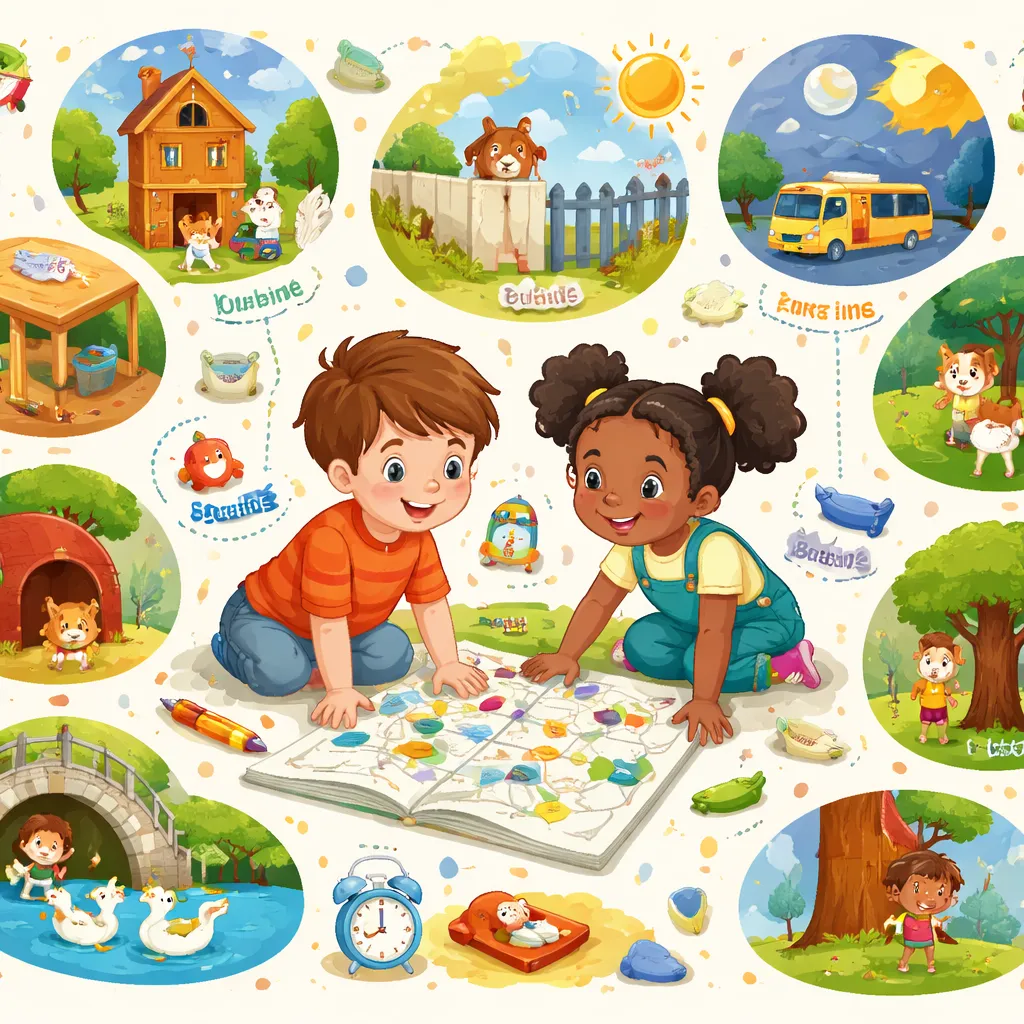

Prepositions are small words that show big relationships. They tell us where things are, when things happen, and how things connect. In, on, under, behind, before, after – these words are essential for clear communication. Without prepositions, we cannot describe where things are or when events occur. Today we explore the 90 essential prepositions for 8-year-old children and how mastering them builds precise language skills.
Eight-year-olds are writing more complex sentences and giving detailed directions. They need prepositions to describe locations, explain timing, and show relationships between ideas. Prepositions are the glue that connects words in meaningful ways.
What Are Prepositions? Let us begin with a clear definition we can share with our children. Prepositions are words that show relationships between other words. They often tell where something is, when something happens, or how things are connected.
Think of prepositions as relationship words. They connect nouns or pronouns to other words in the sentence. "The book is on the table." On shows the relationship between book and table. "I went after lunch." After shows the relationship between went and lunch.
Prepositions are usually small words, but they carry big meaning. In, on, at, for, to, with, by, from, about, until – these common prepositions appear constantly in English. Eight-year-olds need to understand and use them correctly.
Prepositions always have an object. The object is a noun or pronoun that follows the preposition. "In the house." House is the object. "With me." Me is the object. The preposition plus its object forms a prepositional phrase.
For eight-year-olds, we can explain it simply. Prepositions are little words that tell us where things are and when things happen. They connect ideas and show relationships. The 90 essential prepositions for 8-year-old learners are the words children need to describe their world accurately.
Meaning and Explanation for Young Learners How do we explain prepositions to an eight-year-old in ways they understand? We use examples from their world and show how these small words carry meaning.
Tell your child that prepositions are like little arrows pointing to relationships. They tell us where something is located. "The cat is under the bed." Under tells where. They tell us when something happens. "We eat after school." After tells when. They tell us how things connect. "I went with my friend." With tells who was together.
Here are some prepositions children use. "Put your shoes under the bed." Location. "I will come after dinner." Time. "This present is for you." Purpose. "She went to the store." Direction. "He came with me." Accompaniment.
Prepositions can show many different relationships. Location: in, on, at, under, over, between, behind, in front of. Time: before, after, during, until, since, for. Direction: to, toward, into, onto, through, across. Other relationships: with, without, about, for, against.
Children use prepositions constantly without thinking about it. "I'm going to school." "Meet me at the park." "This is for you." "Come with me." Each small preposition carries important meaning.
These explanations help children understand the 90 essential prepositions for 8-year-old speakers. They see that these little words do big jobs.
Categories of Prepositions Prepositions fall into several categories based on what they show. Understanding these categories helps children use them correctly.
Prepositions of place show location. In, on, at, under, over, above, below, beneath, underneath, behind, in front of, beside, between, among, near, next to, by, against, inside, outside, within, throughout. "The cat is under the table." "I sit beside my friend."
Prepositions of time show when. Before, after, during, until, till, since, for, at, on, in, by, past, to, from. "We eat before school." "I will wait until you come." "She arrived after dinner."
Prepositions of direction show movement. To, toward, into, onto, through, across, along, around, down, up, over, past, from, off, onto. "I walked to the store." "She ran through the park." "He fell off the bike."
Prepositions of manner show how. With, without, like, as. "She sang with joy." "He did it without help." "She swims like a fish."
Prepositions of purpose or reason. For, to. "This is for you." "I did it to help."
Prepositions of accompaniment. With, without. "I went with my mom." "He came without his brother."
Prepositions of possession. Of, with. "The cover of the book." "The man with the hat."
These categories make up the 90 essential prepositions for 8-year-old learners. Each shows a different kind of relationship.
Daily Life Examples Prepositions appear constantly in family conversations. Here are examples from a typical day with an eight-year-old.
Morning time brings many prepositions. "I woke up at 7 o'clock. I got out of bed. I put my feet on the floor. I walked to the bathroom. I brushed my teeth with my toothbrush. I went down the stairs. I sat at the table. I poured milk into my cereal." Prepositions show every relationship.
During school, prepositions multiply. "I walked into the classroom. I sat next to my friend. The teacher stood in front of the board. We wrote with pencils. We read from our books. We played on the playground during recess. We ate lunch in the cafeteria." School is full of prepositional relationships.
After school brings more prepositions. "I went to practice. I played with my team. The coach talked about the game. I came home after practice. I did homework at my desk. I talked on the phone with Grandma. I helped with dinner." Every activity needs prepositions.
Evening and bedtime have their own prepositions. "We ate dinner at the table. I put my dishes in the sink. I took a bath with bubbles. I read a book about dragons. I got into bed. I fell asleep under my blanket. I dreamed of faraway places." Prepositions are everywhere.
Throughout the day, children use prepositions constantly. The 90 essential prepositions for 8-year-old children appear again and again in these everyday moments.
Prepositions of Place Prepositions of place are among the most important. They tell where things are located. Eight-year-olds need these for giving directions and describing scenes.
Basic location prepositions: In, on, at. In means inside or within. "The milk is in the refrigerator." On means resting on top. "The book is on the table." At means a specific point. "I'll meet you at the corner."
Position prepositions: Under, below, beneath, underneath all mean lower than. "The cat is under the bed." "The basement is below the house." Over, above mean higher than. "The clock is above the door." "The plane flew over us."
Relative position: Behind, in front of, beside, next to, between, among. "The dog is behind the couch." "I sit beside my friend." "She sat between her parents." "He was among his friends."
Distance prepositions: Near, far from, close to, by. "The store is near my house." "The beach is far from here." "I live close to school." "Sit by me."
Inside/outside: Inside, outside, within, throughout. "Go inside the house." "Play outside." "It's within reach." "The news spread throughout the school."
Children use these constantly. "My shoes are under my bed." "I want to sit next to you." "The park is near our house." Place prepositions locate everything.
These place prepositions appear in the 90 essential prepositions for 8-year-old speakers. They help children describe where things are.
Prepositions of Time Prepositions of time tell when something happens. Eight-year-olds need these for schedules, plans, and storytelling.
Specific time prepositions: At, on, in. At for specific times. "School starts at 8 o'clock." On for days and dates. "We go on Monday." In for longer periods. "My birthday is in May." "I was born in 2016."
Sequence prepositions: Before, after, during, while. "Eat your dinner before dessert." "We play after school." "Be quiet during the movie." "I read while I wait."
Duration prepositions: For, since, until, till, by. "I slept for ten hours." "I've been waiting since noon." "Stay until I come back." "Finish by Friday."
Starting and ending: From, to, past, through. "I'm busy from 3 to 5." "It's ten past two." "We slept through the night."
Time relationships: About, around, approximately. "I'll come about noon." "We'll arrive around dinnertime."
Children use these constantly. "I'll do it after lunch." "We have gym on Tuesdays." "Wait until I'm ready." Time prepositions organize schedules.
These time prepositions appear in the 90 essential prepositions for 8-year-old learners. They help children talk about when things happen.
Prepositions of Direction Prepositions of direction show movement from one place to another. Eight-year-olds use these when giving directions and describing motion.
Movement toward: To, toward, into, onto. "I'm going to the store." "She walked toward me." "He went into the house." "The cat jumped onto the chair."
Movement away: From, off, out of. "I came from school." "Take your feet off the table." "She ran out of the room."
Movement through: Through, across, along, around, past. "We walked through the park." "She swam across the lake." "We strolled along the beach." "He ran around the block." "Drive past the school."
Movement up and down: Up, down, over, under. "Climb up the ladder." "Go down the stairs." "Jump over the puddle." "Crawl under the fence."
Children use these constantly. "Let's go to the park." "Come into my room." "Walk around the puddle." Direction prepositions guide movement.
These direction prepositions appear in the 90 essential prepositions for 8-year-old speakers. They help children describe motion.
Prepositions of Manner and Means Prepositions of manner and means tell how something is done. Eight-year-olds use these to describe methods and styles.
Manner prepositions: With, without, like, as. "She danced with joy." "He did it without help." "She swims like a fish." "He works as a teacher."
Means or instrument: By, with, through. "I go to school by bus." "Write with a pencil." "We succeeded through hard work."
Material: Of, from, out of. "The table is made of wood." "Cheese is made from milk." "She built it out of blocks."
Children use these constantly. "I came by car." "Draw with crayons." "She sings like an angel." Manner prepositions add detail to actions.
These manner prepositions appear in the 90 essential prepositions for 8-year-old learners. They help children describe how things happen.
Prepositional Phrases Prepositional phrases are groups of words that begin with a preposition and end with a noun or pronoun. Eight-year-olds should recognize and use them.
A prepositional phrase includes the preposition, its object, and any words that describe the object. "In the big red house." In is preposition. House is object. Big and red describe the object. The whole phrase acts as one unit.
Prepositional phrases can act as adjectives describing nouns. "The book on the table is mine." The phrase describes which book. "The girl with red hair is my friend." The phrase describes which girl.
Prepositional phrases can act as adverbs describing verbs. "She ran through the park." The phrase tells where she ran. "He arrived after dinner." The phrase tells when he arrived.
Multiple prepositional phrases can appear in one sentence. "I went to the store with my mom on Saturday in the afternoon." Each phrase adds different information.
Children use prepositional phrases constantly. "The dog under the table is sleeping." "We went to the beach with our cousins." "I'll meet you at the corner after school."
These prepositional phrase patterns appear in the 90 essential prepositions for 8-year-old speakers. They help children build detailed sentences.
Common Preposition Pairs Some prepositions often pair with certain verbs, adjectives, or nouns. Eight-year-olds need to learn these common combinations.
Verb + preposition combinations: Listen to, look at, wait for, ask for, belong to, depend on, think about, talk about, agree with, care for, hope for, search for. "I'm waiting for the bus." "She's looking at the picture."
Adjective + preposition combinations: Afraid of, proud of, good at, bad at, interested in, excited about, tired of, sorry for, different from, similar to. "I'm afraid of spiders." "She's good at math." "We're excited about the trip."
Noun + preposition combinations: Love of, reason for, interest in, difference between, answer to. "He has a love of animals." "What's the reason for the delay?" "The answer to the question."
Children need to learn these naturally through reading and conversation. "I'm interested in dinosaurs." "She's afraid of the dark." "We're waiting for Grandma." These combinations become automatic with exposure.
These common preposition pairs appear in learning the 90 essential prepositions for 8-year-old learners. They help children use prepositions naturally.
Prepositions in Questions Questions often begin with prepositions, especially in formal English. Eight-year-olds encounter these patterns in reading.
Prepositions at the beginning of questions: "In which house do you live?" "To whom should I give this?" "For what reason did you come?" These are formal and less common in speech.
Prepositions at the end of questions is more common in everyday speech. "Who are you going with?" "What are you looking at?" "Where did you come from?" "Which store did you go to?" This is natural and acceptable.
Children ask using both patterns. "Who did you play with?" "What is this for?" "Where are you from?" The preposition often comes at the end naturally.
In writing, some teachers prefer to avoid ending with prepositions, but in speech it's perfectly natural. Children will hear both.
These question patterns appear in the 90 essential prepositions for 8-year-old speakers. They help children ask complete questions.
Learning Tips for Parents Supporting your child's preposition use happens naturally through conversation. Here are gentle ways to encourage this growth.
Model rich preposition use in your own speech. Use varied prepositions naturally. "The remote is under the couch." "We're going to the store after lunch." "Put the milk in the refrigerator next to the juice." Your child hears these patterns.
Notice prepositions during read-aloud time. When you encounter prepositional phrases in books, discuss them. "Listen, the author says the treasure was hidden under the old oak tree beside the river. Those phrases tell us exactly where." Building preposition awareness.
Play preposition games. "I'm thinking of something in this room." Have your child guess using preposition questions. "Is it on the desk?" "Is it under the chair?" "Is it behind the lamp?" Great for place prepositions.
Practice following directions with prepositions. Give your child instructions using prepositions. "Put your book on the table, next to the lamp, under the picture." See if they can follow multiple prepositions.
Create preposition-rich environments. When cleaning up, use prepositions. "Put the blocks in the box." "Hang your coat on the hook." "Put your shoes under the bed." Daily routines reinforce preposition use.
These tips support mastery of the 90 essential prepositions for 8-year-old children through natural, positive interaction.
Printable Flashcards for Preposition Practice Flashcards can help children learn and remember prepositions. Here are ideas for making your own set.
Create picture cards showing preposition relationships. Draw a cat in a box, on a box, under a box, behind a box, next to a box. Pictures make prepositions visual and concrete.
Create category cards for different preposition types. Place, time, direction, manner. Sort prepositions into these categories.
Create word cards with the 90 essential prepositions. Practice reading them and using them in sentences. Review regularly.
Create sentence cards with blanks. "The cat is ___ the table." Fill in with place prepositions. "I'll come ___ school." Fill in with time prepositions. Practice choosing appropriate prepositions.
Create matching games with preposition pairs. Match "interested" with "in." Match "afraid" with "of." Match "good" with "at." Practice common combinations.
How to play with the cards. Spread cards out and take turns picking one. Use the preposition in a sentence. Identify its type. "Under is a preposition of place. The dog is under the bed."
These flashcards make the 90 essential prepositions for 8-year-old learners tangible and fun. Children learn to recognize and use all preposition types.
Learning Activities and Games Games make learning about prepositions playful and memorable. Here are some activities to enjoy together.
The Preposition Hunt finds prepositions everywhere. Go for a walk and call out prepositions that describe what you see. "The bird is on the branch." "The dog is behind the fence." "We're walking toward the park." See how many you can use.
The Simon Says Game practices following preposition directions. "Simon says put your hands above your head." "Simon says stand behind the chair." "Simon says put the book under the table." Fun for place prepositions.
The Hidden Object Game practices giving directions with prepositions. Hide an object and give clues using prepositions. "It's under something in the living room." "It's behind the couch, next to a pillow." Child finds it using preposition clues.
The Picture Description Game practices using multiple prepositions. Show a busy picture from a book or magazine. Take turns describing where things are using prepositions. "The cat is under the table." "The ball is between the chairs." "The clock is above the door."
The Time Line Game practices time prepositions. Create a timeline of your day. Describe when things happen using time prepositions. "I wake up at 7 o'clock." "I eat breakfast before school." "I play after school." "I do homework during the afternoon."
The Story Building Game uses prepositional phrases. One person starts a story with a simple sentence. Next person adds a prepositional phrase. "A dragon lived." "In a cave." "Near the mountains." "With a treasure." Continue building.
These games turn learning the 90 essential prepositions for 8-year-old children into active family fun. No pressure, just playful language exploration.
Prepositions are the small words that do big work. They tell us where things are, when things happen, and how things connect. Without prepositions, language would be disconnected and confusing. A strong preposition vocabulary helps children give clear directions, understand schedules, and describe relationships accurately. By age eight, children should use a wide range of prepositions comfortably. They should understand the different categories and when to use each. They should recognize prepositional phrases and use them to add detail to their writing. The next time your child uses a preposition correctly, recognize the spatial and temporal understanding behind that small word. They are learning to locate themselves and events in the world. They are learning to describe the relationships that give life meaning. This skill will serve them in every subject, every conversation, every story they tell.