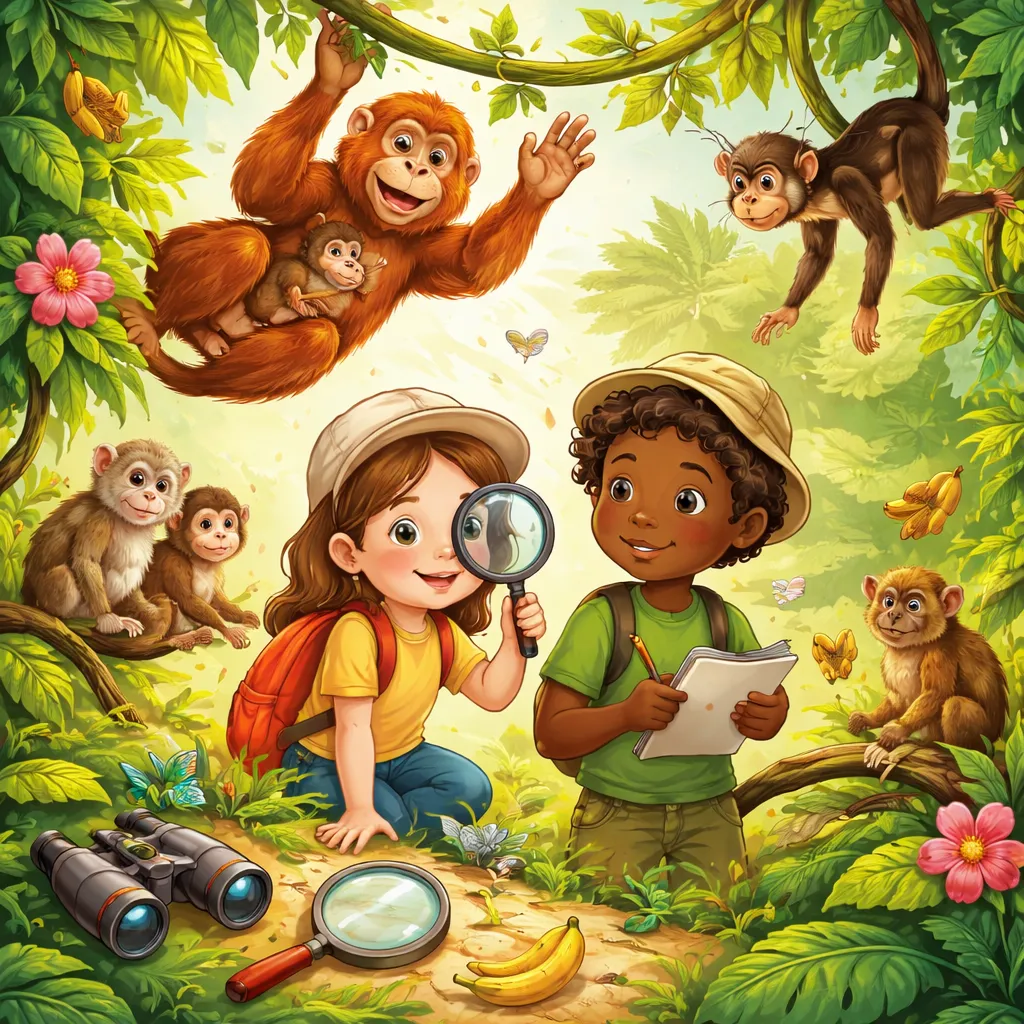

Have you ever watched a monkey swing through trees at the zoo or in a cartoon? They are funny, smart, and always seem to be playing! With their long tails, clever hands, and curious faces, monkeys are amazing animals. Learning about monkeys takes us on a trip to tall jungles and forests around the world. Let’s get ready for a playful adventure in learning about monkey friends!
English Language Learning
Vocabulary and Spelling The word for this playful creature is monkey. The word "monkey" is a noun. A noun names a person, place, or thing. So, a monkey is a thing—a smart and active animal. Let’s spell it: M-O-N-K-E-Y. The letter 'M' looks like two mountains to climb. The 'O' is round like a curious face. The 'N' and 'K' are in the middle, and the 'E-Y' at the end is like a happy ending. M-O-N-K-E-Y spells monkey!
Sound and Pronunciation Let’s say the word the right way. It sounds like this: /ˈmʌŋ.ki/. We can say it in two fun parts. First, say "munk". It rhymes with "bunk" or "sunk". Next, say "ee". It’s the happy sound at the end of "key" or "bee". Now, say it together! "Munk" "ee". Monkey! Perfect! The word "monkey" has two beats, or two syllables. Clap your hands twice: Mon-key. It’s a bouncy, fun word to say.
Related Words Learning about monkeys is more fun with new words! Here are some simple ones. Body Parts: A monkey’s clever, grasping hands and feet are great for climbing. Many monkeys have a long tail that can hold onto branches like a fifth hand! Action/Habit: Monkeys love to swing from branch to branch using their arms. This is called brachiating! Group: A family group of monkeys is called a troop.
A Famous Saying There is a very famous and funny saying: "Monkey see, monkey do." This means that monkeys, and sometimes people, love to copy what they see others doing. It’s all about imitation and learning by watching. It reminds us to be good role models because others might copy us! Say the saying with me: "Monkey see, monkey do." Can you think of something you learned by watching and copying someone?
Great! Now you know the word "monkey". Are you ready to learn about their wild and clever lives? Let’s swing from words to wonderful facts!
Animal Knowledge
Who Are They? – Family and Group What kind of animal is a monkey? Monkeys are mammals. They have fur, are warm-blooded, and mother monkeys feed their babies milk. They are part of a very smart animal group called primates. This group also includes apes like chimpanzees and gorillas, and even us, humans! Monkeys are our clever animal cousins.
What Do They Look Like? – Amazing Bodies Monkeys come in many sizes, from as small as your hand to as big as a toddler! They can have fur in colors like brown, black, gray, gold, or even bright blue and red on their faces. Many monkeys have a special tool: a long, grasping tail. This kind of tail can wrap around and hold onto branches tightly. It’s like having an extra hand! Not all monkeys have this, but it is a super cool feature. Monkeys have fantastic adaptations for tree life. They have flexible shoulders for swinging. Their hands and feet are great for grabbing. They have forward-facing eyes, which help them judge distances perfectly when jumping from tree to tree.
Where Do They Live and How? – Home and Habits Most monkeys live in warm, tropical places. Their homes are jungles, rainforests, and some live in grasslands or mountains. They need trees to live, play, and find food. Monkeys are omnivores. This means they eat both plants and animals. They love to eat fruit, leaves, nuts, seeds, and sometimes insects, bird eggs, or small lizards. Monkeys are very social and live in groups called troops. They are active during the day. They spend their time foraging for food, grooming each other, playing, and communicating. Grooming, or picking through each other’s fur, is a way to be friends and stay clean.
A Monkey’s Life Story – Growing Up A baby monkey is called an infant. Monkeys are mammals, so infants are born live from their mother. A mother usually has one baby at a time. Mother monkeys are very caring. The baby holds on tightly to its mother’s fur as she moves around. The mother feeds it milk, carries it, and protects it. Sometimes, other females in the troop will help take care of the baby too. The infant grows up in the troop. It learns everything by watching the adults—how to find food, what is dangerous, and how to swing. It will play with other young monkeys to practice all the skills it needs. It takes years for a monkey to grow into a full adult.
How Do They "Talk"? – Communication Monkeys are very chatty! They have a whole language of sounds, faces, and body moves. They chatter, screech, grunt, and howl. Different sounds can mean "Danger!" or "Here is food!" or "I’m happy." They also make faces, like showing their teeth in a "play face" for fun. They use their excellent eyesight and touch to communicate. Grooming is a quiet, friendly way to talk. Their world is very visual, so they pay close attention to each other’s movements and expressions.
Are They Okay? – Taking Care of Them Many types of monkeys are in trouble. Some are endangered because their forest homes are disappearing. The biggest problems are people cutting down the rainforests where they live. Some monkeys are also caught and sold illegally as pets, which is very bad for them. You can be a monkey hero! You can learn and teach others. You can choose products like recycled paper and sustainable palm oil to help save rainforests. You can support groups that rescue monkeys and protect their wild homes. Never, ever want a monkey as a pet; they belong in the wild with their troop.
Life Connections and Inspiration
How to Be With Them – Safety and Love Monkeys are wild animals. We must admire them with respect and from a safe distance. The rule is always: Look, don’t touch, and never feed. We watch them at good zoos that care for them well. We never try to touch a wild monkey or give it our food. Human food can make them very sick, and they can bite or scratch if they are scared. We show our love by protecting the beautiful, leafy jungles that are their real home. We can be friends to monkeys by being friends to the forest.
Super Qualities We Learn from Them Monkeys teach us wonderful things. One super quality is curiosity and playfulness. Monkeys are naturally curious. They explore, investigate, and play to learn about their world. This reminds us that asking questions, exploring, and having fun are great ways to learn! Another quality is social intelligence and friendship. Monkeys live in complex groups. They know how to make friends, solve problems together, and care for each other. They teach us about the importance of friendship, teamwork, and family. Think about it: How can you use your curiosity to learn something new today? How can you be a good friend and team player in your own "troop" at home or school?
Take Action! – Your "Curious Monkey" Project Let’s do a fun activity! Your project is to create a monkey hand puppet and tell a troop story. Find an old sock, some buttons or felt, and glue. Decorate the sock to be a monkey face. Glue on button eyes and felt ears. Now, your hand is inside, and the sock is your monkey! Make your monkey move. Now, gather a few toys or ask a friend to make puppets too. You now have a puppet troop! Act out a story. What is your monkey troop doing today? Are they searching for delicious fruit? Are they grooming each other? Use your imagination!
Closing Learning about monkey mischief is a joyful adventure! We learned the word "monkey" and how to say its playful, two-part name. We discovered cool facts about their clever hands, their social troops, and their life in the trees. We know that monkeys are curious, intelligent animals who need our help to protect their forest homes. You can use your new words to share stories about these amazing primates. You can use your knowledge to make smart choices for our planet. The animal world is full of playful and clever teachers. Always remember to respect wildlife and keep a safe distance. Keep exploring with curiosity, play with your friends, and care for your community. Your smart and caring actions help make sure these wonderful creatures can swing free for generations to come.