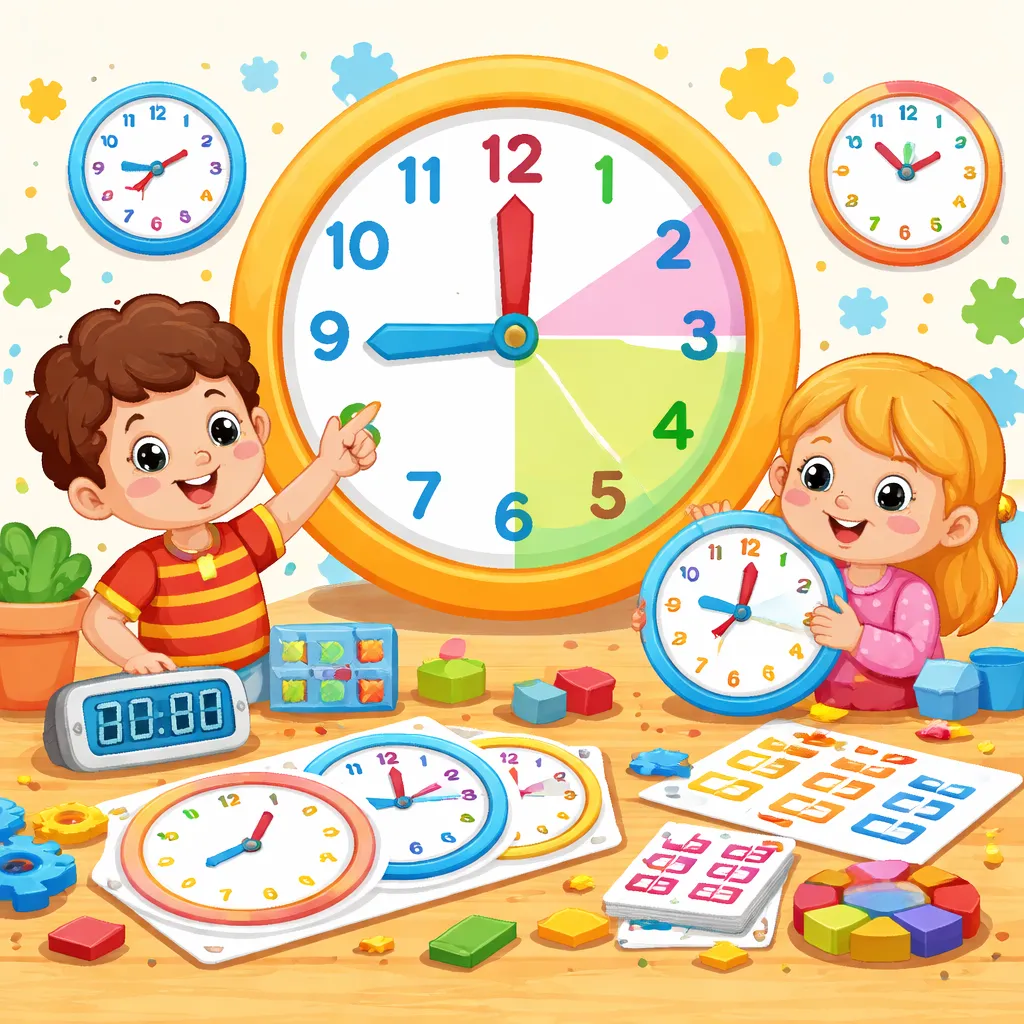

It’s a bright Monday morning, and your mom calls: “Hurry up! School starts at 8 o’clock!” You run to the wall clock, squinting at the two hands. “Is that 8? Or 9?” You mix up the short and long hands, feeling worried. Just then, mom pulls out a colorful paper clock: “This is a free printable clock for teaching time—we’ll learn to read it together, and you’ll never be late again!” Your fingers itch to move the hands. How do the hands work? How can you say time in English? Let’s dive into the world of printable teaching clocks—where time becomes a fun game!
Core Knowledge Explanation First, let’s talk about free printable clock for teaching time. They are simple, downloadable clock templates that you can print at home or school. They have a round face with 12 numbers, and movable hands (hour and minute) that let you practice telling time. These clocks are perfect for kids because they’re hands-on—you can touch, move, and play with them, making learning time feel like play, not work.
Telling time is a key life skill, and English time expressions are super useful for daily communication. Let’s start with the parts of a clock —every free printable clock for teaching time has these basic parts, and knowing them helps you read time easily:
-
Clock Face /klɒk feɪs/ : The round part with numbers 1 to 12. It’s like the clock’s “face” that shows the numbers. Example: “The numbers 1 to 12 are on the clock face.” Daily life: “Look at the clock face—can you find the number 3?”
-
Hour Hand /ˈaʊə(r) hænd/ : The short, thick hand that shows the hour (1-12). It moves slowly, one number at a time, every hour. Example: “The hour hand points to 8—it’s 8 o’clock.” Memory trick: “Short and slow, that’s the hour hand!”
-
Minute Hand /ˈmɪnɪt hænd/ : The long, thin hand that shows minutes (0-59). It moves faster, going around the clock once every 60 minutes (1 hour). Example: “The minute hand points to 12—it’s exactly on the hour.” Memory trick: “Long and fast, that’s the minute hand!”
-
Numbers 1-12 /ˈnʌmbəz wʌn tuː twelv/ : The numbers on the clock face. Each number stands for an hour (for the hour hand) and 5 minutes (for the minute hand—e.g., number 3 = 15 minutes, number 6 = 30 minutes). Example: “The number 6 on the clock means 30 minutes for the minute hand.”
Now, let’s learn basic time expressions that every free printable clock for teaching time helps you practice. We’ll start with the two easiest ones: on the hour (整点) and half past (半点) —these are the most common times kids need to know.
1. On the Hour
When the minute hand points directly to 12, it’s “on the hour.” We use “o’clock” (pronounced /əˈklɒk/) after the hour number. Structure: [Hour number] + o’clock Phonics and examples: 1 o’clock /wʌn əˈklɒk/: “It’s 1 o’clock in the afternoon.” 3 o’clock /θriː əˈklɒk/: “School ends at 3 o’clock.” 7 o’clock /ˈsevən əˈklɒk/: “I wake up at 7 o’clock in the morning.” 12 o’clock /twelv əˈklɒk/: “We eat lunch at 12 o’clock.” How to read with the printable clock: Move the hour hand to a number (e.g., 5) and the minute hand to 12. Say: “It’s 5 o’clock.”
2. Half Past
When the minute hand points to 6, it’s “half past” the hour. “Half past” means 30 minutes have passed since the hour started (half of 60 minutes). Structure: Half past + [Hour number] Phonics and examples: Half past 2 /hɑːf pɑːst tuː/: “The movie starts at half past 2.” Half past 4 /hɑːf pɑːst fɔː(r)/: “We have a snack at half past 4.” Half past 8 /hɑːf pɑːst eɪt/: “Bedtime is at half past 8.” Half past 10 /hɑːf pɑːst ten/: “My friend comes over at half past 10.” How to read with the printable clock: Move the hour hand halfway between two numbers (e.g., between 3 and 4) and the minute hand to 6. Say: “It’s half past 3.”
Next, let’s learn time-related vocabulary that helps you talk about when things happen. These words pair perfectly with your free printable clock for teaching time: Morning /ˈmɔːnɪŋ/: 6 AM to 12 PM (e.g., “I brush my teeth in the morning.”) Afternoon /ˌɑːftəˈnuːn/: 12 PM to 6 PM (e.g., “I play soccer in the afternoon.”) Evening /ˈiːvnɪŋ/: 6 PM to 9 PM (e.g., “I read books in the evening.”) Night /naɪt/: 9 PM to 6 AM (e.g., “I sleep at night.”) Wake up /weɪk ʌp/: “I wake up at 7 o’clock.” Eat breakfast /iːt ˈbrekfəst/: “I eat breakfast at half past 7.” Go to school /ɡəʊ tuː skuːl/: “I go to school at 8 o’clock.” Have class /hæv klɑːs/: “I have class at 9 o’clock.” Eat lunch /iːt lʌntʃ/: “I eat lunch at 12 o’clock.” Go home /ɡəʊ həʊm/: “I go home at 3 o’clock.” Do homework /duː ˈhəʊmwɜːk/: “I do homework at half past 4.” Eat dinner /iːt ˈdɪnə(r)/: “I eat dinner at 6 o’clock.” Go to bed /ɡəʊ tuː bed/: “I go to bed at half past 8.”
Now, let’s master 5+ core time句型 (sentence patterns) that you can use with your free printable clock for teaching time. These sentences are simple, easy to remember, and perfect for daily life:
- “What time is it? It’s [time].” (What time is it? It’s 3 o’clock.)
- “I [activity] at [time].” (I go to school at 8 o’clock.)
- “[Activity] starts at [time].” (Class starts at half past 8.)
- “Is it [time] yet?” (Is it 12 o’clock yet? I’m hungry!)
- “Let’s meet at [time].” (Let’s meet at half past 2 in the park.)
- “The clock shows [time].” (The clock shows half past 5.)
Understanding time also means learning clock reading rules to avoid common mistakes: Rule 1: The hour hand tells the hour—if it’s between 3 and 4, it’s still 3 o’clock (until the hour hand hits 4). Rule 2: The minute hand at 12 = 0 minutes (on the hour); at 6 = 30 minutes (half past). Rule 3: “O’clock” only comes with on-the-hour times—never say “half past 4 o’clock” (that’s wrong!). Common Mistake 1: Mixing up hour and minute hands. Fix: Remember the trick—“short = hour, long = minute!” Common Mistake 2: Saying “half past 12 o’clock” instead of “half past 12.” Fix: O’clock is only for on-the-hour! Common Mistake 3: Pointing the hour hand directly at 4 for half past 3. Fix: The hour hand moves halfway between 3 and 4 for half past 3—it’s “halfway to 4!”
A free printable clock for teaching time lets you practice these rules hands-on. You can move the hands, correct mistakes, and repeat until you’re confident—no pressure, just fun!
Fun Interactive Learning Let’s start with how to use your free printable clock for teaching time —follow these simple steps to practice telling time like a pro:
Step 1: Print and assemble the clock. Ask an adult to help print the free template. Cut out the clock face and the two hands (hour and minute). Use a brad (metal fastener) to attach the hands to the center of the clock face—make sure they can move easily!
Step 2: Decorate your clock (optional). Color the clock face with bright markers, add stickers, or draw your favorite characters around the numbers. Make it your own—you’ll love using it more!
Step 3: Practice on-the-hour times. Move the minute hand to 12 and the hour hand to 1. Say: “It’s 1 o’clock.” Repeat with all numbers 1-12. For extra practice, say a sentence: “It’s 7 o’clock—I wake up now!”
Step 4: Practice half-past times. Move the minute hand to 6 and the hour hand halfway between 2 and 3. Say: “It’s half past 2.” Repeat with other numbers—half past 5, half past 9. Add a sentence: “It’s half past 6—I eat dinner now!”
Step 5: Mix it up. Ask a friend or family member to move the hands, and you guess the time. Then switch—you move the hands, and they guess. Challenge each other to say a sentence with the time!
Now, let’s play “Daily Routine Clock Game” —a fun way to connect time with your daily activities using the free printable clock for teaching time:
Game Setup: Make a list of your daily activities (wake up, eat breakfast, go to school, etc.). Write each activity on a small card. Have your printable clock ready.
Game Rules:
- Sit with a friend or family member. Place the activity cards and clock on the table.
- Shuffle the activity cards and pick one (e.g., “eat breakfast”).
- Think about what time you do that activity (e.g., half past 7).
- Move the clock hands to that time and say a sentence: “I eat breakfast at half past 7.”
- If you’re correct, keep the card. If not, try again.
- The player with the most cards after 10 rounds wins a “Time Master” sticker!
Example Play: Player 1 picks “go to bed” → moves clock to half past 8 → says: “I go to bed at half past 8.” → keeps the card. Player 2 picks “go to school” → moves clock to 8 o’clock → says: “I go to school at 8 o’clock.” → keeps the card.
Next, let’s practice “Time Matching Game” —great for reinforcing on-the-hour and half-past times:
Game Setup: Print two copies of the free printable clock for teaching time. On one copy, draw the hands for different times (e.g., 3 o’clock, half past 5, 10 o’clock). On the other copy, write the time words next to the numbers (e.g., “3 o’clock” next to 3, “half past 5” next to 5). Cut out the clock faces into small squares (one square per number/time).
Game Rules:
- Spread all the squares on the table, face up.
- Look for matches between the clock face squares (with hands) and the time word squares.
- When you find a match (e.g., clock showing 3 o’clock and “3 o’clock” word), pick them up and say the time aloud.
- The player who finds the most matches wins!
Another fun activity: “Time Role-Play” —practice real-life conversations with your printable clock:
Dialogue 1: Kid and Mom (Morning Routine) Mom: “What time is it, honey?” Kid: (Looks at the printable clock) “It’s 7 o’clock, Mom!” Mom: “Great! It’s time to wake up and eat breakfast.” Kid: “What time do we go to school?” Mom: “We leave at half past 7. Can you set the clock to half past 7?” Kid: (Moves the hands) “Done! It’s half past 7.” Mom: “Perfect—let’s get ready!”
Dialogue 2: Kid and Friend (Meeting at the Park) Friend: “Let’s play soccer this afternoon!” Kid: “Sure! What time should we meet?” Friend: “How about half past 2?” Kid: (Checks the printable clock) “I can meet at half past 2. I’ll set my clock to remind me!” Friend: “Cool! See you at half past 2 in the park.” Kid: “See you then!”
Let’s do “Make Your Own Daily Schedule” —use your free printable clock for teaching time to create a personal schedule:
Step 1: Draw a blank schedule with two columns: “Time” and “Activity.” Step 2: For each activity (wake up, eat breakfast, class, playtime), use the printable clock to find the time. Step 3: Write the time and activity in the schedule. For example: Time: 7 o’clock → Activity: Wake up Time: Half past 7 → Activity: Eat breakfast Time: 8 o’clock → Activity: Go to school Step 4: Decorate the schedule and hang it in your bedroom. Use it every day to stay on track!
Expanded Learning Let’s learn about time around the world . Did you know that people in different countries use the same clock faces, but their daily routines might be different? For example: In the United States, many kids go to school at 8 o’clock in the morning and finish at 3 o’clock in the afternoon. In Japan, kids often start school at 8:30 o’clock and have lunch at school at 12 o’clock. In the United Kingdom, some schools start at 9 o’clock and end at half past 3.
Even though routines differ, the way we read clocks is the same! Your free printable clock for teaching time works no matter where you are in the world. You can practice telling time for different countries—“It’s 8 o’clock in New York, but it’s 2 o’clock in London!”
Let’s sing a “Telling Time Song” to remember the hour and minute hands, and on-the-hour/half-past times. Tune: “Hickory Dickory Dock” Hickory dickory dock, The clock hands go round the clock! Short hand for the hour, long for the minutes, Telling time is so much fun!
Hickory dickory dock, It’s 3 o’clock on the clock! Minute hand at 12, hour at 3, “I’m on time!” we all can see.
Hickory dickory dock, Half past 5, let’s take a walk! Minute hand at 6, hour halfway too, Telling time is easy for you!
Let’s expand our time knowledge with quarter times —a simple next step after on-the-hour and half-past. You can add these to your free printable clock for teaching time: Quarter past /ˈkwɔːtə(r) pɑːst/: When the minute hand points to 3 (15 minutes past the hour). Example: “It’s quarter past 4.” Quarter to /ˈkwɔːtə(r) tuː/: When the minute hand points to 9 (15 minutes before the next hour). Example: “It’s quarter to 6” (meaning 5:45).
Practice these with your printable clock: Move the minute hand to 3 and hour hand to 7 → “quarter past 7.” Move the minute hand to 9 and hour hand near 8 → “quarter to 8.” These are great for kids who want to learn more than just整点 and 半点!
Let’s learn about 12-hour vs. 24-hour time . Most clocks for kids use 12-hour time (with morning/afternoon/evening), but 24-hour time is used in hospitals, airports, and some countries (like France and Germany). For example: 12-hour time: 3 o’clock in the afternoon → 24-hour time: 15:00 12-hour time: half past 8 in the evening → 24-hour time: 20:30
You can use your free printable clock for teaching time to practice 24-hour time by writing the 24-hour numbers next to the 12-hour numbers (e.g., 13 next to 1, 14 next to 2). It’s a fun challenge and useful for when you travel!
Let’s connect time with seasons and holidays . Use your printable clock to talk about special times of the year: “Christmas morning starts at 7 o’clock—we open presents then!” “In summer, we go to the beach at 2 o’clock in the afternoon.” “On my birthday, the party starts at half past 3.”
Draw seasonal pictures on your clock—snowflakes for winter, flowers for spring—to make it more fun. You can even create a “holiday time schedule” for special days!
What You Will Learn From your free printable clock for teaching time, you will learn so many valuable skills and English tools! First, you’ll master the parts of a clock —clock face, hour hand, minute hand, and numbers 1-12. You’ll know how each part works to show time, and you’ll never mix up the short and long hands again.
You’ll learn basic time expressions : on-the-hour (o’clock) and half-past. These are the most important times for daily life, and you’ll be able to read and say them confidently. You can even expand to quarter times if you want!
You’ll master 6+ core time句型 that let you ask for time, talk about your daily routine, and make plans with friends. Sentences like “What time is it?” and “I go to school at 8 o’clock” will become second nature, and you’ll use them every day.
Your daily routine and time management skills will improve. You’ll learn to connect time with activities (waking up, going to school, doing homework), which helps you stay organized and on time. Making your own schedule teaches you responsibility and planning—skills that help you in school and life.
You’ll practice English vocabulary related to time and daily life. Words like morning, afternoon, evening, wake up, go to school, and eat lunch will become part of your active vocabulary. You’ll be able to talk about your day in English from start to finish!
You’ll develop hands-on learning skills . Moving the clock hands, decorating your clock, and playing games make learning interactive. You’ll remember time concepts better because you’re doing, not just listening.
You’ll build confidence in English communication . Being able to ask for time, talk about your schedule, and make plans in English shows you that English is useful in real life. You’ll be proud to use your English with family, friends, and even teachers!
Using What You Learned in Life You can use your free printable clock for teaching time every day to practice and apply your skills! Start your morning by checking your clock: “What time is it? It’s 7 o’clock—I need to wake up!” Say the time aloud and connect it to your morning routine.
When you’re getting ready for school, use your clock to stay on track. “It’s half past 7—I need to eat breakfast. It’s 8 o’clock—time to leave!” You’ll learn to manage your time and never be late for school.
Practice with family members. Ask your mom: “What time is dinner?” When she tells you, set your printable clock to that time and say: “Dinner is at 6 o’clock. I’ll help set the table!” Or plan a family activity: “Let’s watch a movie at half past 7. I’ll set the clock to remind us!”
Use your clock at school. If your teacher asks, “What time is it?” raise your hand and answer using your English skills: “It’s half past 9, teacher!” If you’re doing a group project, say: “Let’s finish this at 10 o’clock.” Your teacher will be impressed by your clear English and time management.
Create a “family schedule” with your clock. Sit down with your family and write down everyone’s daily activities (mom goes to work at 9 o’clock, dad comes home at 6 o’clock, sibling has soccer at half past 4). Use your printable clock to show each time, and hang the schedule on the fridge. You’ll all stay organized, and you’ll practice English together!
Take your clock on trips. When you’re at the airport or train station, use your clock to read departure times: “The train leaves at half past 2. We need to be there early!” Or at the zoo: “The animal show starts at 1 o’clock. Let’s go find a seat!” You’ll use your time skills in real-world situations.
Closing Encouragement Wow! You’ve turned telling time into a fun English adventure with your free printable clock for teaching time. You can read clocks, say time in English, talk about your daily routine, and stay organized—you’re a time and English star!
Every time you moved the clock hands, said a time sentence, or played a game, you got better at English and time management. It’s okay if you mixed up the hands or forgot a word at first—what matters is you kept trying and having fun.
Keep using your free printable clock for teaching time. Practice new times (like quarter past and quarter to), decorate it for holidays, or make a new clock for a friend. The more you practice, the more confident you’ll feel, and the easier telling time will become.
Remember, time is a precious gift, and knowing how to read it helps you make the most of every day. With your English time skills, you can communicate clearly, stay on track, and plan amazing things—from school projects to family adventures.
You’re a curious, responsible, and hardworking learner. We’re so proud of how you’ve turned a simple printable clock into a powerful learning tool. Keep practicing, keep playing, and keep loving English—your ability to tell time in English will open so many doors. Happy time-telling and learning