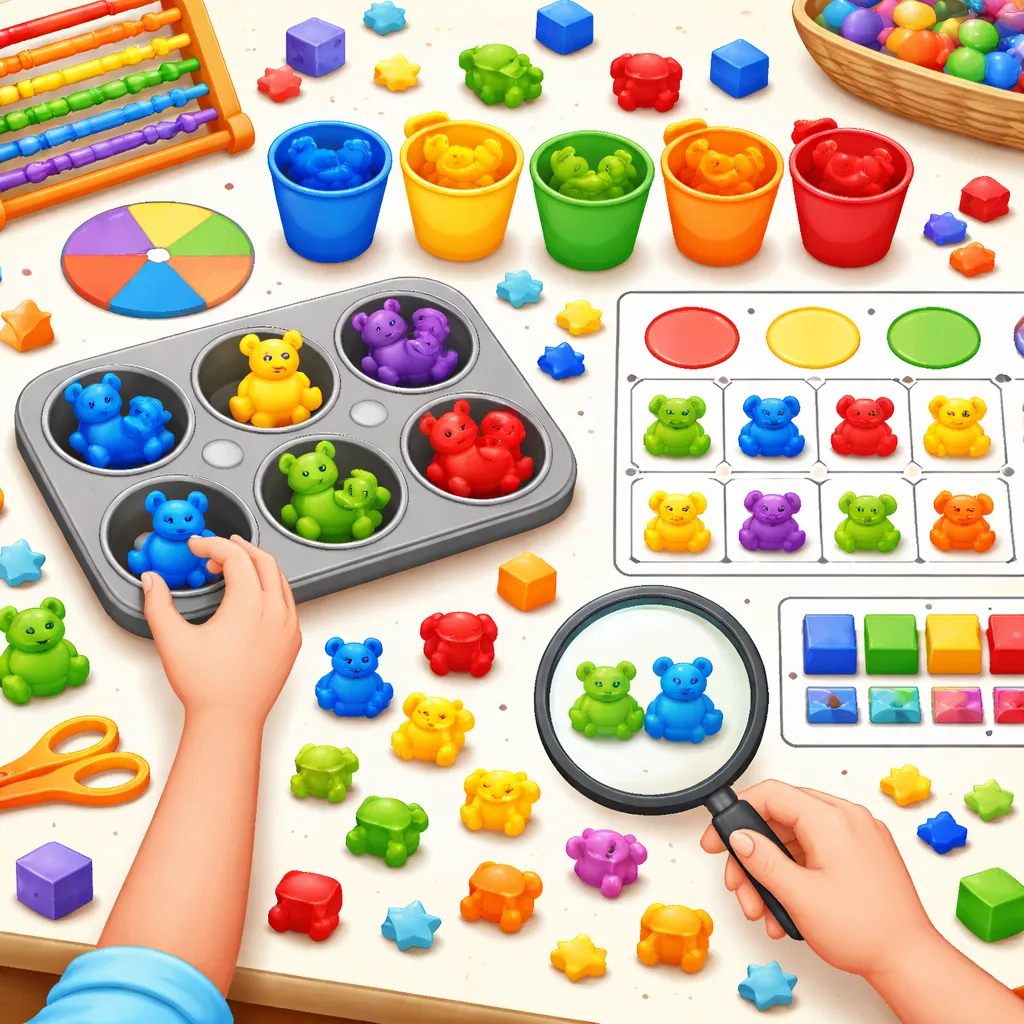

It’s a cozy evening, and you’re sitting on the floor with a jar of colorful counting bears—red, blue, yellow, and green. Mom asks: “How many red bears do you have?” You count with your fingers: “One, two, three…” but pause when she says: “Can you say that in English?” You giggle, not sure how to put the numbers into words. Just then, she pulls out a stack of bright, bear-themed papers: “These are counting bears activity sheets printable—we’ll count bears, learn English numbers, and play games all at once!” Your eyes light up as you grab a red bear. How will these sheets turn counting into fun? What English words will you learn to talk about numbers? Let’s dive into the world of printable counting bear activity sheets—where math meets English in the most playful way!
Core Knowledge Explanation First, let’s talk about counting bears activity sheets printable. They are downloadable, easy-to-use sheets designed for kids aged 6-10, featuring cute bear illustrations and simple tasks that combine counting practice with English learning. Each sheet usually has a fun theme—like “Bear Picnic,” “Bear Cave Adventure,” or “Colorful Bear Parade”—and includes activities like counting bears, sorting by color, comparing quantities, and writing or saying number words in English. These sheets are perfect for young learners because they’re visual, hands-on, and turn repetitive counting into an exciting game, all while building essential English vocabulary and math skills.
Numbers are the foundation of math, and knowing their English names is key for communicating in daily life—from counting toys to asking for snacks. Let’s start with the core number vocabulary (1-20) that every counting bears activity sheets printable focuses on. For each number, we’ll include phonics, a simple definition, a bear-themed example, and a daily life sentence to help you connect the number to real situations:
-
One /wʌn/ : The number for a single object. Bear example: “There is one brown bear on the sheet.” Daily life: “I have one teddy bear in my bed.”
-
Two /tuː/ : The number for two objects together. Bear example: “Two red bears are eating honey.” Daily life: “I have two shoes on my feet.”
-
Three /θriː/ : The number for three things in a group. Bear example: “Three yellow bears are climbing a tree.” Daily life: “My family has three people.”
-
Four /fɔː(r)/ : The number for four separate objects. Bear example: “Four blue bears are playing in the cave.” Daily life: “There are four wheels on a car.”
-
Five /faɪv/ : The number for half of ten. Bear example: “Five green bears are having a picnic.” Daily life: “I have five fingers on one hand.”
-
Six /sɪks/ : The number after five. Bear example: “Six orange bears are jumping over a log.” Daily life: “A dice has six sides.”
-
Seven /ˈsevən/ : The number between six and eight. Bear example: “Seven purple bears are watching birds.” Daily life: “There are seven days in a week.”
-
Eight /eɪt/ : The number for eight items. Bear example: “Eight pink bears are swimming in a stream.” Daily life: “I eat eight grapes for snack.”
-
Nine /naɪn/ : The number before ten. Bear example: “Nine black bears are sleeping in the cave.” Daily life: “There are nine players on a baseball team.”
-
Ten /ten/ : The number for ten objects (a full set for little hands!). Bear example: “Ten rainbow bears are having a party.” Daily life: “I can count to ten in English!”
-
Eleven /ɪˈlevən/ : Ten plus one. Bear example: “Eleven bears are walking in a line.” Daily life: “I am eleven years old.”
-
Twelve /twelv/ : Ten plus two. Bear example: “Twelve bears are sitting around a picnic blanket.” Daily life: “There are twelve months in a year.”
-
Thirteen /ˌθɜːˈtiːn/ : Ten plus three. Bear example: “Thirteen bears are picking berries.” Daily life: “I have thirteen stickers in my book.”
-
Fourteen /ˌfɔːˈtiːn/ : Ten plus four. Bear example: “Fourteen bears are playing hide-and-seek.” Daily life: “The clock shows fourteen minutes past two.”
-
Fifteen /ˌfɪfˈtiːn/ : Ten plus five. Bear example: “Fifteen bears are drinking honey.” Daily life: “I read fifteen pages of my book today.”
-
Sixteen /ˌsɪksˈtiːn/ : Ten plus six. Bear example: “Sixteen bears are climbing hills.” Daily life: “There are sixteen candles on the cake.”
-
Seventeen /ˌsevənˈtiːn/ : Ten plus seven. Bear example: “Seventeen bears are chasing butterflies.” Daily life: “My friend has seventeen toy cars.”
-
Eighteen /ˌeɪˈtiːn/ : Ten plus eight. Bear example: “Eighteen bears are building a den.” Daily life: “We walked eighteen steps to the park.”
-
Nineteen /ˌnaɪnˈtiːn/ : Ten plus nine. Bear example: “Nineteen bears are watching the sunset.” Daily life: “There are nineteen kids in my class.”
-
Twenty /ˈtwenti/ : Two times ten (a big number for little learners!). Bear example: “Twenty bears are having a big party.” Daily life: “I have twenty pieces of candy in my bag.”
Next, let’s learn quantity comparison vocabulary that pairs perfectly with counting bears activity sheets printable. These words help you talk about which group of bears is bigger, smaller, or the same size—key skills for both math and English: More /mɔː(r)/: A greater number of something. “There are more red bears than blue bears.” Less /les/: A smaller number of something. “There are less green bears than yellow bears.” Fewer /ˈfjuːə(r)/: Used for counting things (similar to less). “There are fewer black bears than white bears.” Equal /ˈiːkwəl/: The same number of something. “The number of red bears is equal to the number of blue bears.” Most /məʊst/: The greatest number of all. “Yellow bears are the most—there are ten!” Least /liːst/: The smallest number of all. “Purple bears are the least—only two!”
Now, let’s master 5+ core number句型 (sentence patterns) that you’ll use again and again with your counting bears activity sheets printable. These sentences are simple, easy to remember, and perfect for talking about counting, quantities, and bears:
- “How many [color] bears are there? There are [number] [color] bears.” (How many red bears are there? There are five red bears.)
- “I have [number] counting bears. They are [color].” (I have seven counting bears. They are green.)
- “There are more [color] bears than [other color] bears.” (There are more yellow bears than orange bears.)
- “The number of [color] bears is equal to [number].” (The number of blue bears is equal to six.)
- “Which color has the most bears? [Color] bears have the most.” (Which color has the most bears? Brown bears have the most.)
- “Count the bears and write the number in English.” (Count the bears and write the number “twelve” in English.)
Counting bears activity sheets printable also teach key counting rules to help you count accurately and avoid common mistakes: Rule 1: Count one bear at a time—point to each bear as you say the number to avoid skipping or counting the same bear twice. Rule 2: Sort bears by color first if the sheet asks for it—this makes counting easier (e.g., group all red bears together before counting). Rule 3: Start counting from one, not zero—“one, two, three” not “zero, one, two” for most activities. Common Mistake 1: Mixing up “thirteen” and “thirty” (or similar teen/tens numbers). Fix: Remember—teen numbers end with “teen” (thirteen) and tens end with “ty” (thirty)! Common Mistake 2: Forgetting that “equal” means the same number. Fix: Count both groups again to check—if they match, they’re equal! Common Mistake 3: Using “more” instead of “fewer.” Fix: “More” means more, “fewer” means less—say “fewer bears” when you have a smaller number!
These activity sheets make practicing these rules fun. You’ll count bears, sort them, and say sentences aloud—all while building confidence in both math and English.
Fun Interactive Learning Let’s start with how to use your counting bears activity sheets printable —follow these simple steps to get the most out of your sheets and have a blast learning:
Step 1: Print and prepare the sheets. Ask an adult to help print the free activity sheets (look for themes you love—picnics, adventures, or parties!). Gather your counting bears (or use small toys like buttons or pom-poms if you don’t have bears) and a pencil or crayon.
Step 2: Choose an activity sheet. Pick a sheet that matches your skill level—start with “Count the Bears (1-10)” if you’re new, or “Compare Bear Quantities (11-20)” if you want a challenge.
Step 3: Read the instructions (with help if needed). Each sheet will tell you what to do—e.g., “Color the red bears and count how many there are,” or “Draw a line from the number to the group of bears that matches.”
Step 4: Do the activity with your bears. For example: If the sheet says “Count the blue bears,” grab your blue counting bears and place them on the picture of blue bears. Count aloud: “One, two, three, four—four blue bears!” If the sheet asks “Which group has more bears?” compare two groups (e.g., red vs. green). Count both: “Five red bears, three green bears—red bears have more!” If the sheet has a blank space for writing, write the number word in English (e.g., write “seven” next to the seven yellow bears).
Step 5: Check your work. Ask a friend or family member to help you verify—did you count correctly? Is the number word spelled right? Celebrate when you get it right, and try again if you made a mistake (it’s all part of learning!).
Step 6: Make it a game. Set a timer for 5 minutes and see how many activities you can finish on the sheet. Say the number words aloud as you go—this helps you remember them faster!
Example Activity Sheet Tasks: “Bear Picnic”: Count the bears eating honey (6 bears) → write “six” → say: “There are six bears eating honey.” “Bear Cave Hide-and-Seek”: Count the bears hiding in the cave (12 bears) and the ones outside (8 bears) → say: “There are more bears in the cave than outside.” “Colorful Bear Parade”: Sort bears by color (red, blue, yellow) → count each group → say: “Red bears: 5, blue bears: 5, yellow bears: 5—they are equal!”
Next, let’s play “Counting Bears Treasure Hunt” —a fun game that combines your printable activity sheets with moving around and exploring:
Game Setup: Print an activity sheet with empty spaces for numbers 1-10 (or 1-20). Hide counting bears around the room—one bear for number 1, two bears for number 2, up to ten (or twenty) bears for the highest number. Write clues on small pieces of paper to help find the bears (e.g., “Look under the pillow for 3 red bears”).
Game Rules:
- Players take turns being the “hunter” and the “checker.”
- The hunter reads the clue (with help if needed) and finds the hidden bears.
- The hunter counts the bears aloud in English: “One, two, three—three red bears!”
- The hunter writes the number word (e.g., “three”) on the activity sheet next to the matching clue.
- The checker verifies the count—if correct, the hunter gets a sticker. If not, they hunt again.
- Switch roles after all clues are solved. The player with the most stickers wins a “Counting Champion” badge!
Example Play: Clue: “Look on the bookshelf for 4 blue bears.” Hunter finds 4 blue bears → counts: “One, two, three, four—four blue bears!” Hunter writes “four” on the sheet → gets a sticker. Next clue: “Look in the drawer for 7 yellow bears.” Hunter finds 7 yellow bears → counts: “One… seven—seven yellow bears!” → writes “seven” → gets another sticker.
Let’s practice counting bears role-plays —3+ fun dialogues to play with friends or family, using the句型 and vocabulary we learned:
Dialogue 1: Kid and Mom (Bear Picnic Activity Sheet) Mom: “Let’s do this counting bears activity sheet printable together—it’s a bear picnic!” Kid: “Yay! How many bears are having a picnic?” Mom: “Count them one by one and tell me in English.” Kid: (Points to each bear) “One, two, three, four, five, six—six bears!” Mom: “Great job! What color are the bears?” Kid: “Three are red, two are blue, and one is yellow.” Mom: “Which color has the most bears?” Kid: “Red bears have the most—three!” Mom: “Perfect! Let’s color the picnic blanket green to match the grass.”
Dialogue 2: Kid and Friend (Bear Cave Comparison Game) Friend: “I have my counting bears and activity sheet—let’s play ‘Who Has More?’” Kid: “Sure! I’ll count my red bears, you count your blue bears.” Friend: “Okay—one, two, three, four, five—five blue bears!” Kid: “One, two, three, four, five, six—six red bears! I have more red bears than you have blue bears.” Friend: “No fair! Let’s count yellow bears instead. I have seven!” Kid: “I have seven too—they are equal!” Friend: “Cool! Let’s write ‘seven’ on our activity sheets and draw a star next to it.”
Dialogue 3: Kid and Teacher (Class Activity Sheet) Teacher: “Class, we have counting bears activity sheets printable on your desks. Let’s practice numbers 11-20!” Kid: “Teacher, how do you say 15 in English?” Teacher: “It’s ‘fifteen’—say it with me: ‘fifteen.’” Kid: “Fifteen!” Teacher: “Good. Now, count the bears on your sheet—how many are there?” Kid: (Counts) “Eleven, twelve, thirteen, fourteen, fifteen—fifteen bears!” Teacher: “Excellent! Now, write ‘fifteen’ next to the bears. Which color has the least bears?” Kid: “Purple bears—only two! That’s the least.” Teacher: “Perfect—you’re a counting and English star!”
Another fun activity: “Counting Bears Storytime” —use your activity sheet and bears to create a story in English:
Step 1: Look at your activity sheet (e.g., “Bear Adventure”). Step 2: Use the number of bears and their colors to build a story. Step 3: Say the story aloud, using the number words and句型 we learned.
Example Story: “One sunny morning, three red bears and four blue bears went on an adventure. They walked through the forest and found five yellow bears eating honey. ‘Can we join you?’ asked the red bears. ‘Yes!’ said the yellow bears. Now there were twelve bears together. They played hide-and-seek—seven bears hid in the cave, and five hid behind trees. The red bears found the most friends, and the blue bears found the least. Everyone had fun, and they promised to meet again with twenty bears next time!”
Expanded Learning Let’s learn about numbers in different cultures —numbers have special meanings around the world, and your counting bears activity sheets printable can help you explore them! In China, the number 8 is considered lucky because it sounds like the word for “prosperity.” You might see 8 bears on a “lucky bear” activity sheet! In Western countries, the number 7 is often linked to magic (like seven dwarfs or seven days of the week). A sheet with seven bears could be a “magic bear adventure.” In Japan, the number 9 is sometimes avoided because it sounds like the word for “pain.” But counting nine bears on your sheet is still fun! Many cultures use base-10 counting (like we do with fingers), which is why counting bears often come in groups of 10—perfect for practicing tens and ones.
You can add these cultural facts to your activity sheets—draw a small lucky symbol next to the number 8, or a magic wand next to 7. Learning about numbers in different cultures makes English learning more interesting and helps you understand the world!
Let’s sing a “Counting Bears Song” to remember the number words 1-10, their pronunciation, and have fun while learning. Tune: “Row, Row, Row Your Boat” Count, count, count the bears, One by one we go! One, two, three, four, five, Say them nice and slow! (clap hands)
Count, count, count the bears, Six to ten we know! Six, seven, eight, nine, ten, Let’s count fast—go, go, go! (stomp feet)
Count, count, count the bears, More or less we see! More bears here, less there, Equal—you and me! (spin around)
Let’s expand our number knowledge with simple addition and subtraction using counting bears and your activity sheets. This is a great way to move from counting to basic math, all while using English: Addition /əˈdɪʃn/: “If you have two red bears and three blue bears, how many total bears do you have? Two plus three equals five.” Subtraction /səbˈtrækʃn/: “If you have seven yellow bears and take away two, how many are left? Seven minus two equals five.”
Practice these with your sheets: Draw two groups of bears (e.g., 3 red, 4 blue) → say: “Three plus four equals seven” → write “seven” on the sheet. Or cross out two bears from a group of six → say: “Six minus two equals four” → write “four.” Adding math to your English practice makes both skills stronger!
Let’s connect numbers to seasons and holidays with your counting bears activity sheets printable. Create or decorate sheets for special times of the year: “Christmas Bear Count”: Count 10 Christmas-themed bears (wearing Santa hats) → say: “There are ten Christmas bears.” “Summer Bear Picnic”: Count 8 bears eating watermelon → say: “Eight bears are eating watermelon in summer.” “Birthday Bear Party”: Count 12 bears with balloons → say: “Twelve bears are at the birthday party.”
Draw seasonal pictures on your sheets—snowflakes for winter, flowers for spring—to make counting more festive. You can even create a “holiday number book” by gluing your finished sheets together!
What You Will Learn From your counting bears activity sheets printable, you will learn so many valuable skills and English tools! First, you’ll master number vocabulary 1-20 —you’ll be able to say, spell, and recognize these numbers in English, both when counting bears and in daily life. You’ll never struggle to say “fifteen” or “twenty” again!
You’ll learn quantity comparison vocabulary like more, less, equal, most, and least. These words help you describe groups of objects, making your English more precise and useful for math. You’ll also master 6+ core number that let you ask about quantities, talk about counts, and compare groups—sentences like “How many bears are there?” and “There are more red bears” will become second nature.
Your math skills will improve dramatically. You’ll practice counting accurately, sorting objects by color, comparing quantities, and even basic addition and subtraction. These skills are the foundation of math, and using counting bears makes them fun to learn.
Your English speaking and writing skills will grow. Saying number words and sentences aloud improves your pronunciation and confidence. Writing number words on the activity sheets helps you remember their spelling and build literacy skills.
You’ll develop focus and attention to detail . Counting bears requires you to point to each bear, avoid skipping or double-counting, and stay focused on the task. This skill helps you in school, homework, and other activities.
You’ll build creativity and storytelling skills . Using your activity sheets and bears to create stories lets you use English in a creative way. You’ll learn to connect numbers to narratives, making learning more engaging and memorable.
You’ll learn to connect numbers to daily life . By counting bears, you’ll see that numbers are everywhere—from counting toys and snacks to telling time and celebrating birthdays. You’ll be able to use your English number skills in real-world situations, not just on paper.
Using What You Learned in Life You can use your counting bears activity sheets printable skills every day to practice and apply your learning! Start by counting objects around your house in English. After playing with toys, say: “I have eight toy cars—one, two, three… eight!” When eating snacks, count: “Six grapes—six!” You’ll practice English and counting without even trying.
At school, use your number skills in class. If your teacher asks, “How many pencils do you have?” say: “I have ten pencils” in English. During math class, use the comparison words: “There are more pencils than erasers.” Your teacher will be impressed by your English and math skills working together.
Go on a “number walk” with your family. As you walk around your neighborhood, count things in English: “Twelve houses on this street. Five dogs in the park. Eight flowers in the garden.” You’ll turn a simple walk into a fun English and math practice session.
Use your skills when playing with friends. If you’re playing with blocks, say: “I have seven red blocks—do you have more?” When sharing toys, say: “We have equal numbers of toys—ten each!” You’ll communicate clearly and practice English while having fun.
Help with chores using your counting skills. If you’re setting the table, count the plates in English: “Four plates for four people.” When folding laundry, count the socks: “Six pairs of socks—twelve socks total!” You’ll be helpful and practice English at the same time.
Create a “number journal” using your counting bears activity sheets printable. Each day, write down one thing you counted in English (e.g., “I saw nineteen birds today”). Draw a picture of the object and write the number word. Your journal will be a great way to track your learning and remember number words.
Closing Encouragement Wow! You’ve turned counting into a joyful English adventure with your counting bears activity sheets printable. You can count, say number words, compare quantities, and even tell stories—you’re a counting and English star!
Every time you counted a bear, wrote a number word, or played a game, you got better at both math and English. It’s okay if you mixed up a number or spelled a word wrong at first—what matters is you kept trying and having fun.
Keep using your counting bears activity sheets printable. Try new sheets with higher numbers (21-30), add addition and subtraction tasks, or create your own sheets with different themes (space bears, dinosaur bears). The more you practice, the more confident you’ll feel, and the easier numbers will be in English.
Remember, numbers are everywhere—they help you count, measure, and make sense of the world. With your English number skills, you can communicate with people from different countries, do well in school, and enjoy games and activities that require counting. Numbers are not just for math—they’re for connecting, creating, and exploring.
You’re a curious, hardworking, and creative learner. We’re so proud of how you’ve turned a simple activity sheet and some toy bears into a powerful learning tool. Keep counting, keep learning, and keep loving English—your ability to use numbers in English will open so many doors. Happy counting and learning