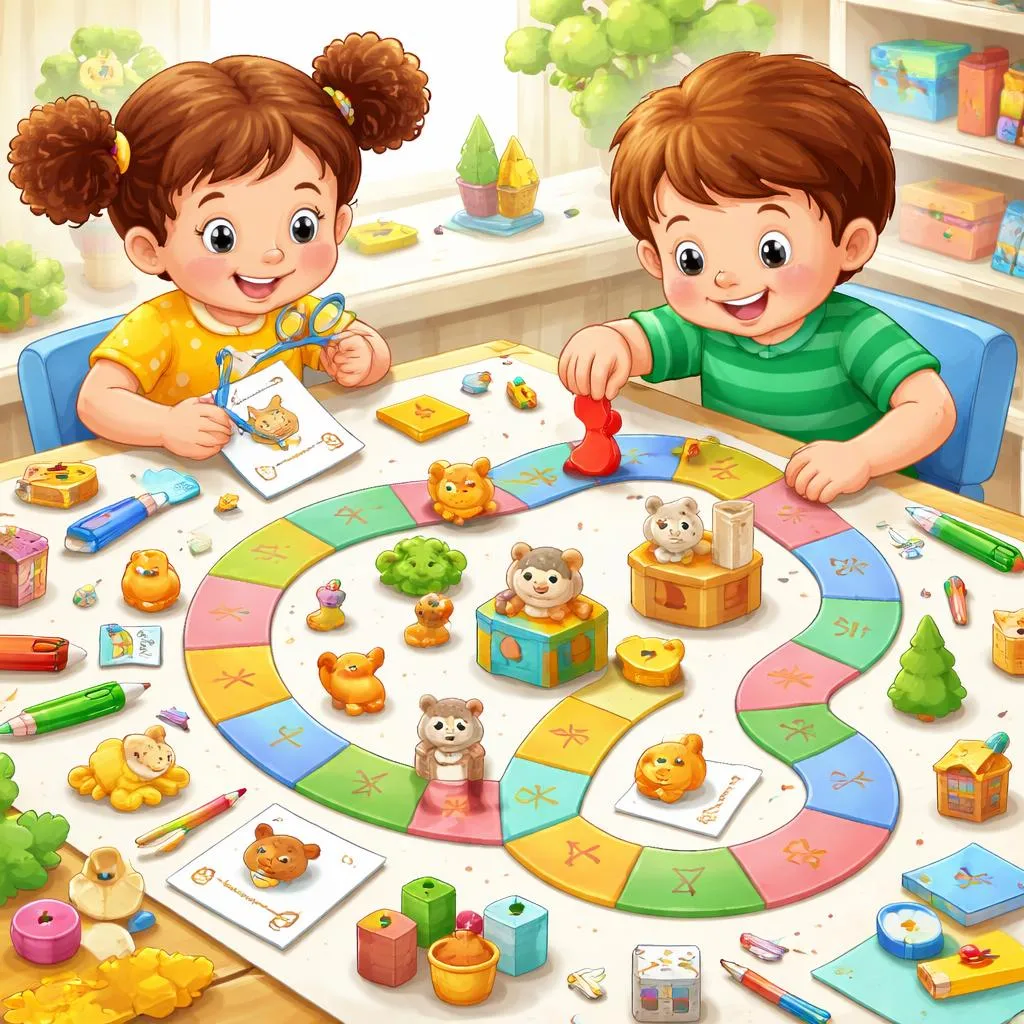

It’s a rainy afternoon, and you’re playing with toy cars and blocks on the floor. Your friend asks: “Where is the red car?” You pause, not sure how to say it—“under the box?” “on the box?” You mix up the words and laugh. Just then, Dad brings over cardboard, markers, and toy animals: “Let’s make a DIY board game for prepositions—we’ll learn to talk about where things are, while having fun!” Your eyes light up. What prepositions will you master? How will this game make learning easy? Let’s dive into the world of DIY preposition board games—where play meets English!
Core Knowledge Explanation First, let’s talk about DIY board game for prepositions. They are homemade games you create with simple materials (cardboard, markers, toys) that help you learn and practice prepositions—words that show where something is, or its position relative to other things. Prepositions like “in,” “on,” and “under” are super important for talking about daily life, and a DIY game makes practicing them feel like play, not work!
Prepositions are like “position words”—they tell us an object is. For 6-10 year olds, the most common and useful prepositions are easy to learn, especially when paired with a fun board game. Let’s explore each core preposition with phonics, clear definitions, and simple sentences that you can use in your DIY board game for prepositions:
-
In /ɪn/ : Means inside something, or enclosed by something. Example: “The cat is in the box.” (The cat is inside the box.) Daily life: “My toys are in my backpack.” “I put milk in the fridge.” Game idea: Draw a box on your board—land here, and you say, “I’m in the box!”
-
On /ɒn/ : Means resting on top of something, with no space between. Example: “The book is on the table.” (The book sits on top of the table.) Daily life: “My cup is on the counter.” “The clock is on the wall.” Game idea: Add a table image to your board—land here, and shout, “On the table!”
-
Under /ˈʌndə(r)/ : Means below something, or covered by something. Example: “The dog is under the chair.” (The dog is below the chair.) Daily life: “My shoes are under the bed.” “The rabbit is under the tree.” Game idea: Draw a chair on your board—land here, and say, “Under the chair!”
-
Beside /bɪˈsaɪd/ : Means next to something, or very close by. Example: “The flower is beside the tree.” (The flower is next to the tree.) Daily life: “I sit beside my friend at school.” “The bike is beside the door.” Game idea: Add a tree and flower to your board—land here, and say, “Beside the tree!”
-
Between /bɪˈtwiːn/ : Means in the middle of two things. Example: “The ball is between the two boxes.” (The ball is in the middle of box A and box B.) Daily life: “I stand between my mom and dad.” “The book is between the notebook and pencil.” Game idea: Draw two boxes on your board—land here, and say, “Between the boxes!”
-
Behind /bɪˈhaɪnd/ : Means at the back of something. Example: “The rabbit is behind the bush.” (The rabbit is at the back of the bush.) Daily life: “My backpack is behind the door.” “The car is behind the truck.” Game idea: Add a bush to your board—land here, and shout, “Behind the bush!”
-
In front of /ɪn frʌnt ɒv/ : Means at the front of something. Example: “The child is in front of the school.” (The child stands at the front entrance.) Daily life: “I wait in front of the supermarket.” “The cat is in front of the TV.” Game idea: Draw a school on your board—land here, and say, “In front of the school!”
-
Above /əˈbʌv/ : Means higher than something, not touching it. Example: “The bird is above the roof.” (The bird flies higher than the roof.) Daily life: “The picture is above the couch.” “The sun is above the trees.” Game idea: Add a roof to your board—land here, and say, “Above the roof!”
-
Below /bɪˈləʊ/ : Means lower than something, not touching it. Example: “The fish is below the boat.” (The fish swims lower than the boat.) Daily life: “The keys are below the shelf.” “The frog is below the leaf.” Game idea: Draw a boat on your board—land here, and say, “Below the boat!”
-
Near /nɪə(r)/ : Means close to something, but not right next to it. Example: “The park is near my house.” (The park is close, but not beside the house.) Daily life: “The café is near the library.” “My friend lives near the school.” Game idea: Add a house and park to your board—land here, and say, “Near the house!”
Now, let’s learn 5+ core position description句型 (sentence patterns) that are perfect for your DIY board game for prepositions. These sentences are simple, easy to remember, and work for all the prepositions above: “The [object] is [preposition] the [place].” (The ball is on the table.) “Where is the [object]? It’s [preposition] the [place].” (Where is the book? It’s under the chair.) “Put the [object] [preposition] the [place].” (Put the toy car beside the box.) “I am [preposition] the [place].” (I am in front of the school.) “Is the [object] [preposition] the [place]?” (Is the cat behind the bush?) “Find the [object] that is [preposition] the [place].” (Find the pencil that is between the books.)
Understanding prepositions also helps you avoid common mistakes that kids often make. For example: Mistake 1: Mixing up “in” and “on.” Saying “The apple is on the bag” instead of “in the bag.” Fix: Think—if something fits inside, use “in”; if it sits on top, use “on!” Mistake 2: Confusing “beside” and “between.” Saying “The cup is between the plate” instead of “beside the plate.” Fix: “Between” needs two things—“between the plate and bowl”—while “beside” is just next to one thing! Mistake 3: Forgetting “in front of” (two words) and saying “front of.” Fix: Practice saying the full phrase—“in front of the door,” not “front of the door!”
A DIY board game for prepositions helps you fix these mistakes by letting you practice in a fun, hands-on way. When you land on a space and have to say the preposition, you’ll remember the correct word and how to use it.
Fun Interactive Learning Let’s start with how to make your DIY board game for prepositions —it’s easy, uses materials you have at home, and you can customize it to your favorite themes (animals, cars, princesses, space)!
Materials You Need: A large piece of cardboard (from a cereal box or shipping box) Markers, crayons, or colored pencils Scissors (adult help!) Glue or tape Small toys or objects (toy cars, animals, blocks, or drawings) A die (or make one from cardboard) Game pieces (buttons, small toys, or colored circles cut from paper)
Step-by-Step Making Process:
- Design the board. Draw a path on the cardboard with 20-30 spaces (squares or circles). Start at one end (label “Start”) and finish at the other (label “Finish!”).
- Add preposition spaces. In each space, draw a picture that shows a preposition. For example: A square with a box—label “In the box” A square with a table and book—label “On the table” A square with a chair and dog—label “Under the chair” Mix in fun spaces too: “Go forward 2 spaces,” “Lose a turn,” “Pick a preposition card!”
- Make preposition cards (optional). Cut small pieces of paper, and write a preposition on each (in, on, under, beside…). You’ll use these for extra challenges.
- Decorate the board. Color the spaces with bright colors, draw your favorite characters (dinosaurs, unicorns, superheroes) around the path, and add stickers if you have them. Make it your own!
- Prepare the die and game pieces. Use a store-bought die or make one by folding a cardboard cube and writing numbers 1-6 on each side. Pick game pieces for each player.
- Gather small objects. Collect 5-10 small toys (e.g., a toy cat, ball, car, book) to use during the game—you’ll place them on the board to practice sentences.
Now, let’s learn how to play your DIY board game for prepositions —this game works for 2-4 players, and it’s full of practice and fun:
Game Rules:
- Sit around the board with friends or family. Each player picks a game piece and places it on “Start.”
- Decide who goes first (play rock-paper-scissors or go in order of age).
- Take turns rolling the die. Move your game piece forward the number of spaces shown on the die.
- When you land on a space: Look at the preposition picture (e.g., “Under the chair”). Pick a small toy (e.g., the toy car) and place it in the position shown. Say a sentence using the preposition: “The toy car is under the chair.” If you say the sentence correctly, you stay on the space. If not, go back one space and try again on your next turn.
- If you land on a “Pick a preposition card!” space: Draw a card with a preposition (e.g., “beside”). Choose two objects (e.g., the toy dog and box) and place the dog beside the box. Say a sentence: “The toy dog is beside the box.”
- The first player to reach “Finish!” wins. Cheer for everyone—you all practiced prepositions!
Example Game Play: Player 1 (Lily) rolls a 3. She moves to the “On the table” space. Lily picks the toy book, places it on a real table next to the board, and says: “The book is on the table.” Everyone claps—she said it correctly! She stays on the space. Player 2 (Tom) rolls a 2. He lands on “Pick a preposition card!” and draws “between.” Tom takes the toy ball and two boxes, places the ball between them, and says: “The ball is between the boxes.” Perfect! Tom moves forward 1 extra space as a bonus.
Next, let’s play “Preposition Treasure Hunt” —a fun extension of your DIY board game for prepositions that gets you moving:
Game Setup: Hide 5-10 small toys around the room (under a pillow, on the shelf, beside the lamp…). Make a “treasure list” with pictures of the toys and blank spaces for prepositions. Use your DIY board game as the starting point.
Game Rules:
- Players take turns rolling the die on the board. The number they roll is how many toys they can hunt for.
- When it’s your turn, hunt for the toys. When you find one, say a sentence with the preposition: “The toy rabbit is under the pillow.”
- Write the preposition on your treasure list next to the toy’s picture.
- The player who finds all their toys and says all sentences correctly wins a “Treasure Master” sticker!
Another fun activity: “Preposition Sentence Building Challenge” using your board game:
- Pick three spaces on your DIY board game for prepositions (e.g., “in the box,” “beside the tree,” “behind the bush”).
- For each space, make a longer sentence by adding adjectives (color, size) or verbs (action words): “The small red ball is in the blue box.” “The fluffy cat is beside the tall tree.” “The fast toy car is behind the green bush.”
- Say the sentences aloud to your friends or family. If they can picture the scene, you get a point!
Let’s practice position judgment exercises —these help you think quickly about prepositions:
- One player places a toy (e.g., a toy duck) in a position relative to another object (e.g., a cup).
- The other player must guess the preposition: “Is the duck on the cup?” “Is it under the cup?”
- If they guess correctly, they get to place the next toy. If not, the first player gives a hint: “It’s where you put things to hold them.” (In the cup!)
Expanded Learning Let’s learn about prepositions in different languages . Did you know that many languages have prepositions, but they don’t always translate the same way? For example: In Spanish, “on the table” is “en la mesa” (which literally means “in the table”!). In French, “under the chair” is “sous la chaise” (a direct translation, like English). In German, “beside the tree” is “neben dem Baum” (also a direct translation).
This is why practicing with a DIY board game for prepositions is so helpful—you learn the English preposition based on the position, not just a translation. Kids in English-speaking countries use similar games to learn prepositions, too! In US and UK schools, teachers often use DIY boards and toys to make grammar fun, just like you’re doing.
Let’s sing a “Preposition Song” to remember the core prepositions and their meanings. Tune: “Head, Shoulders, Knees, and Toes” In, on, under, beside, (clap hands) Between, behind, and in front! (stomp feet) Above, below, near—let’s go! (spin around) Prepositions tell us where! (point to a toy)
The ball is in the box, (pretend to put a ball in a box) The book is on the shelf, (pretend to place a book) The dog is under the chair, (crouch down) Now we know them well! (thumbs up)
Let’s expand our preposition vocabulary with more useful prepositions that you can add to your DIY board game for prepositions: Next to /nekst tuː/: Similar to beside—“The plant is next to the window.” Across from /əˈkrɒs frɒm/: On the opposite side—“The bank is across from the park.” Along /əˈlɒŋ/: Following a line—“Walk along the street to find the library.” Against /əˈɡenst/: Touching and leaning on—“The bike is against the wall.” Around /əˈraʊnd/: Surrounding something—“The children sit around the table.”
Add these to your board game by drawing new spaces: a window with a plant (“Next to the window”), a park with a bank (“Across from the park”), or a wall with a bike (“Against the wall”).
Let’s learn how to use prepositions in stories . Prepositions help make stories more vivid—they let readers picture where characters and objects are. Use your DIY board game for prepositions to create a short story: “One day, a little rabbit was hopping through the forest. It saw a carrot on the ground, but a big bird was above it! The rabbit hid behind a bush. When the bird flew away, the rabbit grabbed the carrot and ran to its burrow. It ate the carrot beside its friend, a squirrel. They laughed as they sat in front of the burrow, watching the sun set.”
Notice how prepositions like above, behind, beside, and in front of make the story easy to imagine. Try writing your own story using prepositions from your game—you’ll be a storyteller and a grammar expert!
Let’s try preposition art . Draw a picture of a room (bedroom, classroom, park) and label objects with prepositions. For example: “The lamp is above the desk.” “The shoes are under the bed.” “The books are on the shelf.” “The plant is beside the window.”
Hang your picture next to your DIY board game for prepositions—you can look at it for inspiration during gameplay!
What You Will Learn From your DIY board game for prepositions, you will learn so many valuable skills and English tools! First, you’ll master 15+ prepositions —from basic ones like in, on, and under to more useful ones like beside, between, and across from. You’ll know exactly when to use each preposition to describe where something is.
You’ll learn 6+ core that let you talk about positions clearly and confidently. Sentences like “The toy is under the chair” or “Where is the book? It’s on the table” will become second nature. You’ll be able to ask questions, give answers, and give directions using prepositions—skills that are useful in school and daily life.
Your spatial thinking skills will improve. Prepositions help you understand how objects relate to each other in space—this is important for math, science, and even playing sports! You’ll learn to visualize positions and describe them accurately.
You’ll develop hands-on creativity and problem-solving . Making your DIY board game for prepositions lets you use your imagination—designing the board, choosing themes, and decorating it. You’ll also solve small problems, like how to fit all the preposition spaces or how to make the game fair for players.
Your speaking and listening skills will get better. You’ll practice saying prepositions and sentences aloud, which makes your English easier to understand. You’ll also listen to other players’ sentences and help correct mistakes—great for communication!
You’ll learn to work with others and follow rules . Playing the game with friends or family teaches you to take turns, cheer each other on, and follow game rules. These social skills are just as important as English skills!
You’ll build confidence in learning grammar . Grammar can seem boring, but your DIY board game makes it fun. You’ll realize that learning prepositions isn’t a chore—it’s a game you can play and win. This confidence will help you learn more English skills in the future.
Using What You Learned in Life You can use your preposition skills every day—thanks to your DIY board game for prepositions! Start by describing objects around your house. Look at your bedroom and say: “My pillow is on the bed. My clothes are in the closet. My shoes are under the chair.” You’ll practice prepositions without even trying!
When you’re playing with friends, use prepositions to give directions. Say: “Put the toy car beside the box. Hide the ball between the two cushions. Meet me in front of the slide.” Your friends will understand exactly what to do, and you’ll be using English naturally.
At school, use prepositions in class activities. If your teacher asks, “Where is your notebook?” say: “It’s on my desk.” If you’re doing a craft project, say: “I need to glue the button on the paper. The scissors are under the table.” Your teacher will be proud of your clear English!
Go on a “preposition walk” with your family. As you walk around your neighborhood, point out objects and say sentences: “The tree is beside the sidewalk. The bird is above the roof. The café is near the library.” You’ll turn a simple walk into a fun English practice session.
Use prepositions when talking about pictures or videos. If you’re looking at a photo album, say: “In this picture, I’m in front of the Eiffel Tower. My mom is beside me. My dad is behind us.” When watching a cartoon, say: “The hero is hiding behind the wall. The treasure is in the chest.”
Practice writing with prepositions. Take a notebook and write 3 sentences every day using prepositions from your game: “I eat breakfast at the table. My backpack is beside the door. The moon is above the house.” Draw a picture next to each sentence to make it more fun.
Closing Encouragement Wow! You’ve turned grammar into play with your DIY board game for prepositions. You can name prepositions, describe positions, make sentences, and even create your own game—you’re an English and creativity star!
Every time you designed a board space, said a preposition sentence, or played with friends, you got better at English. It’s okay if you mixed up a preposition or forgot a sentence—what matters is you kept trying and having fun.
Keep playing with your DIY board game for prepositions. Add new prepositions, change the theme (try a space or dinosaur theme!), or make a new board with your friends. The more you play, the more confident you’ll feel using prepositions in daily life.
Remember, prepositions are everywhere—they help you talk about where things are, give directions, and tell stories. With the skills you’ve learned from your game, you can communicate clearly and confidently in English.
You’re a curious, creative, and hardworking learner. We’re so proud of how you turned simple materials into a fun learning tool. Keep making, keep playing, and keep loving English—your DIY board game is just the start of your amazing English journey. Happy playing and learning