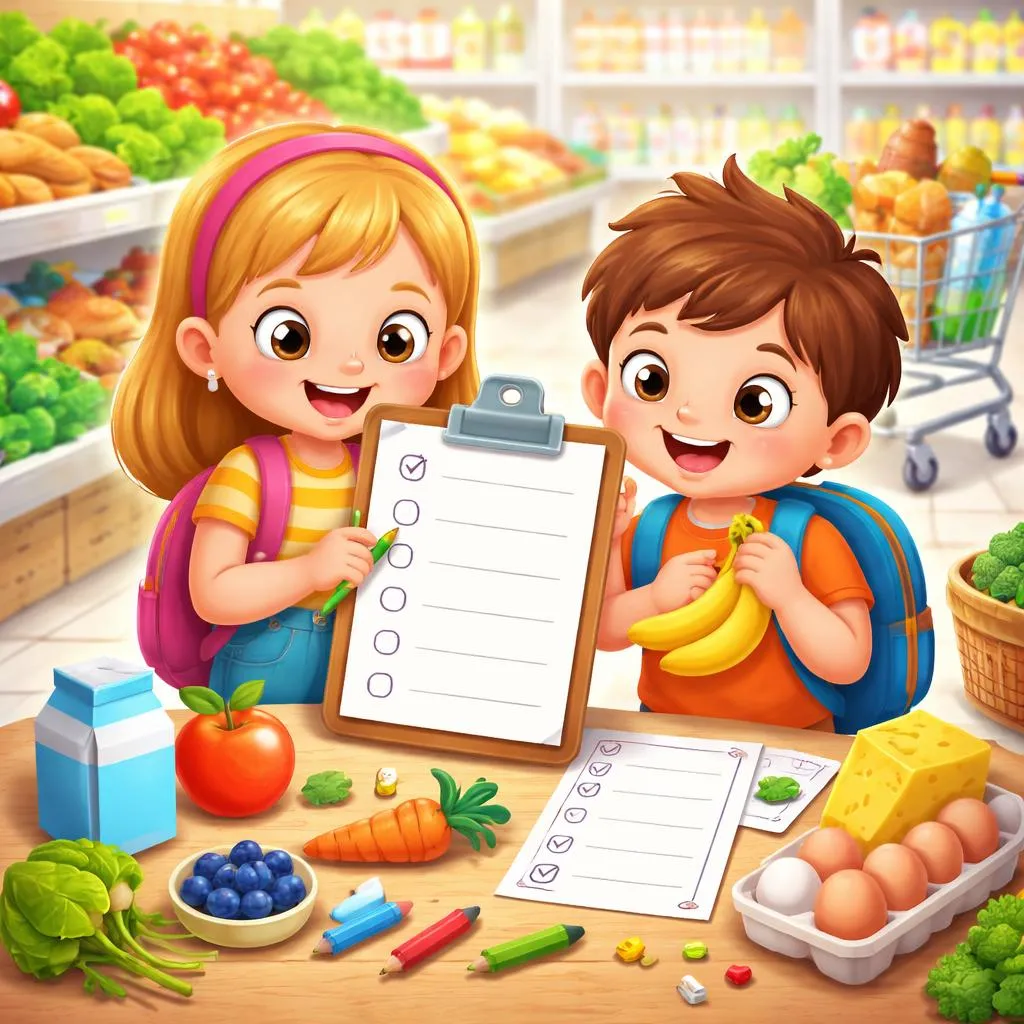

It’s a sunny Saturday morning, and Mom says: “We need to go grocery shopping—can you help me make a list?” You nod excitedly, but then pause—how do you write down the food you need? Just then, Mom pulls out a colorful sheet: “This is a printable grocery list for kids to fill—let’s learn, write, and shop!” Your pencil is ready. What food words will you learn? How will this list make shopping fun? Let’s dive into the world of grocery lists—where English meets daily life!
Core Knowledge Explanation First, let’s talk about printable grocery list for kids to fill. They are simple, printable sheets with empty spaces for writing food items, organized by categories (like fruits, vegetables, or snacks). They help you learn English food words, practice writing, and get ready for real grocery shopping—all while being helpful at home!
Grocery lists are super useful because they keep shopping organized. You won’t forget milk or apples, and you’ll learn to plan what you need. Best of all, they’re a perfect way to practice English in daily life—no boring textbooks required!
Let’s start with supermarket food categories —printable grocery lists for kids to fill are organized by these categories to make shopping easy. Each category has common food words with phonics, (phonetic symbols), and simple sentences:
-
Fruits : Apple /ˈæpl/: “I eat a red apple every day.” Banana /bəˈnɑːnə/: “Bananas are yellow and sweet.” Orange /ˈɒrɪndʒ/: “I squeeze orange juice for breakfast.” Grape /ɡreɪp/: “Grapes are small and round—red or green.” Strawberry /ˈstrɔːbəri/: “Strawberries have tiny seeds on top.” Mango /ˈmæŋɡəʊ/: “Mangoes are juicy and orange inside.” Pineapple /ˈpaɪnæpl/: “Pineapples have a spiky skin.” Watermelon /ˈwɔːtəmelən/: “Watermelon is red with black seeds.” Pear /peə(r)/: “Pears are soft and sweet—green or yellow.” Cherry /ˈtʃeri/: “Cherries are small and red, with a stem.”
-
Vegetables : Carrot /ˈkærət/: “Rabbits love to eat carrots—they’re orange.” Tomato /təˈmɑːtəʊ/: “Tomatoes are red—good in salads.” Potato /pəˈteɪtəʊ/: “Mom makes fries from potatoes.” Broccoli /ˈbrɒkəli/: “Broccoli is green and looks like small trees.” Spinach /ˈspɪnɪdʒ/: “Spinach is a leafy green—good for you.” Cucumber /ˈkjuːkʌmbə(r)/: “Cucumbers are crunchy and green.” Onion /ˈʌnjən/: “Onions make your eyes water when you cut them.” Pepper /ˈpepə(r)/: “Peppers are red, green, or yellow—some are spicy!” Carrot /ˈkærət/: “Carrots are long and orange—great for snacks.” Lettuce /ˈletɪs/: “Lettuce is a leafy green—used in sandwiches.”
-
Dairy : Milk /mɪlk/: “I drink milk to make my bones strong.” Cheese /tʃiːz/: “Cheese is yellow or white—good with bread.” Yogurt /ˈjəʊɡəʊt/: “Yogurt has probiotics—good for your stomach.” Butter /ˈbʌtə(r)/: “Mom puts butter on toast.” Eggs /eɡz/: “Eggs are round—we cook them for breakfast.” Cream /kriːm/: “Cream is thick and white—used in desserts.”
-
Snacks : Cookies /ˈkʊkiz/: “Cookies are sweet—chocolate or vanilla.” Chips /tʃɪps/: “Potato chips are crunchy and salty.” Chocolate /ˈtʃɒklət/: “Chocolate is brown and sweet—my favorite!” Candy /ˈkændi/: “Candy is sugary—eat it in small bits.” Popcorn /ˈpɒpkɔːn/: “Popcorn pops when you cook it—great for movies.” Crackers /ˈkrækəz/: “Crackers are crispy—good with cheese.”
-
Bakery : Bread /bred/: “I make sandwiches with bread.” Cake /keɪk/: “Cake is sweet—we eat it on birthdays.” Muffin /ˈmʌfɪn/: “Muffins are small cakes—blueberry or chocolate chip.” Toast /təʊst/: “Toast is crispy bread—good with jam.” Bagel /ˈbeɪɡl/: “Bagels are round—with a hole in the middle.”
Next, let’s learn shopping-related verbs —words you use when making a grocery list and shopping: Need /niːd/: “I need milk for cereal.” Buy /baɪ/: “We buy apples at the supermarket.” Pick /pɪk/: “I pick fresh strawberries from the bin.” Put /pʊt/: “Put the eggs in the shopping cart.” Find /faɪnd/: “Can you find the carrots?” Choose /tʃuːz/: “Choose ripe bananas—they’re yellow.” Check /tʃek/: “Check the list to see if we have all items.” Pay /peɪ/: “Mom pays for the groceries at the cash register.”
Now, let’s master quantity expressions —how to say how much of each item you need. Printable grocery lists for kids to fill have spaces for quantities, so these are perfect to practice: Numbers (1-10): One apple, two bananas, three eggs. “A bag of”: A bag of chips, a bag of rice. “A box of”: A box of cookies, a box of cereal. “A carton of”: A carton of milk, a carton of juice. “A bunch of”: A bunch of grapes, a bunch of carrots. “A head of”: A head of broccoli, a head of lettuce. “Some”: Some tomatoes, some yogurt. “Many”: Many crackers, many candies.
Here are 10+ core grocery shopping (sentence patterns) to use with your list: “I need [quantity] [food item].” (I need two apples.) “We buy [quantity] [food item] at the supermarket.” (We buy a carton of milk.) “How many [food item] do we need?” (How many eggs do we need?) “Put [food item] on the grocery list.” (Put carrots on the grocery list.) “Do we need [food item]?” (Do we need bread?) “Where can I find [food item]?” (Where can I find yogurt?) “This [food item] is [ripe/sweet/crunchy].” (This banana is ripe.) “We don’t need [food item]—we have some at home.” (We don’t need chips.) “Add [food item] to the list.” (Add strawberries to the list.) “Let’s check the list—did we forget anything?” (Let’s check the list.)
Printable grocery lists for kids to fill also teach organization skills . You’ll learn to group food by category (fruits with fruits, vegetables with vegetables), which makes shopping faster. You’ll also practice writing neatly so others can read your list—great for communication!
Fun Interactive Learning Let’s start with the grocery list filling steps —follow these to complete your printable grocery list for kids to fill like a pro:
Step 1: Choose a category. Look at the list’s categories (Fruits, Vegetables, Dairy, etc.). Pick one category to start with—like Fruits!
Step 2: Think about what you need. Ask your family: “Do we need any fruits?” If they say “Yes, we need apples and bananas,” write those down.
Step 3: Write the food item. Spell the word carefully—use the vocabulary we learned. For example, write “apple” under Fruits.
Step 4: Add the quantity. Next to the item, write how much you need. For apples, write “2” (two) or “a bag of.”
Step 5: Color the category (optional). Use a crayon to color the Fruits section red, Vegetables green—this makes the list look fun and organized!
Step 6: Move to the next category. Repeat steps 2-5 for Vegetables, Dairy, Snacks, and Bakery.
Step 7: Check your list. Read the list aloud to your family: “Fruits: 2 apples, 1 banana. Vegetables: a bunch of carrots…” Ask if you forgot anything.
Example filled list snippet: Fruits: 2 apples, 1 banana, some grapes Vegetables: a bunch of carrots, 3 tomatoes, a head of broccoli Dairy: a carton of milk, 6 eggs, some yogurt Snacks: a bag of chips, a box of cookies Bakery: 1 loaf of bread, 2 muffins
Next, let’s practice simulated grocery shopping dialogues —3+ groups to play with friends or family. These help you use the and vocabulary in real conversations:
Dialogue 1: Kid and Mom (Making the List) Kid: “Mom, can we make the grocery list together?” Mom: “Yes! Let’s start with Fruits. Do we need apples?” Kid: “Yes! We need two apples. I’ll write ‘2 apples’ under Fruits.” Mom: “Good. What about bananas?” Kid: “We have one banana at home—we need three more!” Mom: “Great. How many eggs do we need for breakfast?” Kid: “Six eggs! I write ‘6 eggs’ under Dairy.” Mom: “Perfect. Did we forget bread?” Kid: “Yes! Add ‘1 loaf of bread’ to Bakery.”
Dialogue 2: Kid and Supermarket Cashier Cashier: “Hello! Can I help you check out?” Kid: “Yes, please. Here’s my grocery list.” Cashier: “Let’s see—2 apples, 3 bananas, a carton of milk… Is that all?” Kid: “Wait, did we buy the carrots? Let me check my list.” Cashier: “Do you have carrots in your cart?” Kid: “No! I forgot. Can I go get a bunch of carrots?” Cashier: “Sure! Hurry back—I’ll wait.” Kid: “Thank you! I’ll check my list again next time.”
Dialogue 3: Kid and Friend (Pretend Shopping) Friend: “Let’s play supermarket! I’m the shopkeeper—what do you need?” Kid: “I have my printable grocery list for kids to fill. I need 2 apples, please.” Friend: “Here are two apples! Do you need anything else?” Kid: “Yes, a carton of milk and a box of cookies.” Friend: “Here you go! How many cookies do you want?” Kid: “One box, please. Let’s check my list—all items are here!” Friend: “That’s $5, please. Thank you for shopping!” Kid: “Thank you! I’ll come back soon.”
Let’s play “Supermarket Treasure Hunt” —a fun game to practice finding items and using the list:
Game Setup: Print a grocery list and fill it with 5-7 items (e.g., apple, carrot, milk, cookie, bread). Hide toy food items or real (unopened) food around the house. Give each player a list and a shopping bag.
Game Rules:
- Players race to find all items on their list.
- When they find an item, they say the sentence: “I found [quantity] [item]!” (I found 1 apple!)
- They put the item in their shopping bag and cross it off the list.
- The first player to find all items and return to the start wins!
Variation: For extra practice, have players say a full sentence about the item: “I found a carton of milk. We need milk for cereal.”
Another fun activity: “Food Category Match” . Print pictures of food items and cut them out. Spread the pictures on the table. Take your printable grocery list for kids to fill and match each picture to the correct category. Say the word and category aloud: “Apple goes to Fruits. Carrot goes to Vegetables.” For extra points, say a quantity: “One apple in Fruits.”
Let’s do “Count & Write” practice. On your grocery list, next to each item, write the correct quantity based on prompts: “We need 3 yellow fruits” → Write “3 bananas” under Fruits. “We need a carton of white drink” → Write “1 carton of milk” under Dairy. “We need 5 round eggs” → Write “5 eggs” under Dairy. “We need a bunch of orange vegetables” → Write “1 bunch of carrots” under Vegetables.
Expanded Learning Let’s learn about supermarkets around the world . Did you know supermarkets look different in other countries? But they all have grocery lists! USA: Big supermarkets like Walmart have huge sections for snacks and frozen food. Kids often help their parents make lists for weekly shopping. UK: Supermarkets like Tesco have small “express” stores for quick shopping. Grocery lists here often include tea, biscuits (cookies), and fish and chips ingredients. Japan: Supermarkets have fresh sushi, ramen, and matcha snacks. Lists might include rice, miso soup ingredients, and fruit like persimmons. China: Supermarkets have big vegetable and fruit sections, with many local fruits like lychees and longans. Lists often include soy sauce, noodles, and dumplings.
Add these facts to your shopping play: “I’m shopping in Japan—my list has matcha cookies and rice!”
Let’s sing a “Grocery Shopping Song” to remember food vocabulary and quantity expressions. Tune: “Old MacDonald Had a Farm” We’re going shopping, yes we are, Yes we are, yes we are! We’re going shopping, yes we are, With our grocery list!
We need two apples, on our list, On our list, on our list! We need two apples, on our list, Let’s write them down!
We need a carton of milk, on our list, On our list, on our list! We need a carton of milk, on our list, Shopping’s so much fun!
(Repeat with other items: bananas, carrots, cookies…)
Let’s expand our food vocabulary with specialty items you might see in supermarkets: Organic Food: Organic apple /ɔːˈɡænɪk ˈæpl/, organic milk /ɔːˈɡænɪk mɪlk/ (food grown without chemicals). Frozen Food: Frozen pizza /ˈfrəʊzn ˈpiːtsə/, frozen vegetables /ˈfrəʊzn ˈvedʒtəblz/ (food kept cold to stay fresh). Pantry Items: Rice /raɪs/, pasta /ˈpɑːstə/, oil /ɔɪl/, salt /sɔːlt/ (food stored in cupboards). Drinks: Juice /dʒuːs/, soda /ˈsəʊdə/, water /ˈwɔːtə(r)/, tea /tiː/, coffee /ˈkɒfi/.
Add these to your printable grocery list for kids to fill: “1 bag of rice, 1 bottle of juice, frozen vegetables.”
Let’s learn shopping etiquette (礼仪) —polite words to use at the supermarket: “Excuse me, where is the fruit section?” (Asking for help) “Thank you for your help!” (After someone helps you) “Please pass the carrots.” (Asking for an item) “Sorry, can I get past?” (When someone is in your way) “May I have a bag, please?” (Asking for a shopping bag)
Practice these in your simulated dialogues—being polite makes shopping nicer for everyone!
Let’s create a “Family Dinner Grocery List” . Work with your family to plan a dinner (e.g., spaghetti and salad), then fill your printable grocery list with the ingredients: Spaghetti pasta, tomato sauce, ground beef (for spaghetti) Lettuce, tomatoes, cucumber (for salad) Cheese, bread (side items) Juice (drink)
Then, “shop” for the items (use toys or real food) and pretend to cook—you’re a chef and a shopper!
What You Will Learn From printable grocery list for kids to fill, you will learn so many practical skills and English words! First, you’ll master over 40 food vocabulary words —fruits, vegetables, dairy, snacks, and more. You can say their names, spell them, and use them in sentences—perfect for real shopping.
You’ll learn shopping-related verbs like need, buy, pick, and check. These verbs help you talk about shopping and make your list useful. You’ll also know quantity expressions —how to say how much of each item you need, from numbers to “a carton of” or “a bunch of.”
You’ll master 10+ core that you can use with your family, friends, or even real cashiers. Sentences like “I need two apples” or “Where can I find yogurt?” are easy to remember and use in daily life.
Your organization and planning skills will improve. You’ll learn to group items by category, write neatly, and check your list for missing items. These skills help you in shopping and in school—like organizing your homework or toys!
You’ll practice counting and writing . Writing numbers and words on your list helps you remember them better. You’ll also count items when shopping, which improves your math skills too!
You’ll develop life skills . Grocery shopping is a daily activity—now you can help your family make lists and shop. You’ll learn to be responsible (not forgetting items) and helpful (supporting your family).
You’ll build confidence in English . Using English to make lists, talk to shoppers, and find items shows you that English is useful—not just for school. You’ll be proud to use your English in real life!
Using What You Learned in Life You can use your printable grocery list for kids to fill every time your family goes shopping! Ask your mom or dad to let you make the list. Write down the food you need, and take the list with you to the supermarket.
When you’re at the supermarket, use your list to find items. Say the words aloud: “We need apples—let’s go to the fruit section!” Ask the cashier or store worker for help using the polite phrases you learned: “Excuse me, where are the carrots?”
Practice at home with a “pretend supermarket.” Use toy food or empty boxes to set up a store. Fill your grocery list, then “shop” with your family. You can be the shopper, cashier, or shopkeeper—every role is practice!
Make a “weekly snack list” for school. Every Sunday, fill your printable grocery list with snacks you want for the week (e.g., apples, yogurt, crackers). Show it to your parents, and they can help you buy the items. You’ll practice English and be ready for school snacks!
Plan a family picnic. Use your list to write down picnic food: sandwiches (bread, cheese, lettuce), fruit (grapes, strawberries), drinks (juice, water), and snacks (cookies, popcorn). Then help pack the picnic—you’ll use your list and enjoy a fun day out!
Create your own personalized grocery list. Draw pictures of your favorite food next to the words (e.g., a small apple next to “apple”). This helps you remember the words and makes the list more fun. You can even color the list with your favorite colors!
Closing Encouragement Wow! You’ve turned grocery shopping into a fun English adventure with printable grocery list for kids to fill. You can name food items, write a list, talk to shoppers, and help your family—you’re a shopping and English star!
Every time you filled a list, practiced a sentence, or pretended to shop, you got better at English. It’s okay if you spelled a word wrong or forgot an item—what matters is you kept trying and learning.
Keep using your grocery list in daily life. The more you practice, the more food words you’ll learn, the better you’ll write, and the more confident you’ll feel using English. Shopping will no longer be just a chore—it will be a chance to learn and have fun.
Remember, English is everywhere—even in the supermarket! Every apple, carrot, and carton of milk is a word to learn and a sentence to practice. With your grocery list, you’ll turn every shopping trip into a learning adventure.
You’re a responsible, helpful, and curious learner. We’re so proud of how hard you’ve worked. Keep making lists, keep shopping, and keep loving English—your daily life is your best classroom. Happy shopping and learning