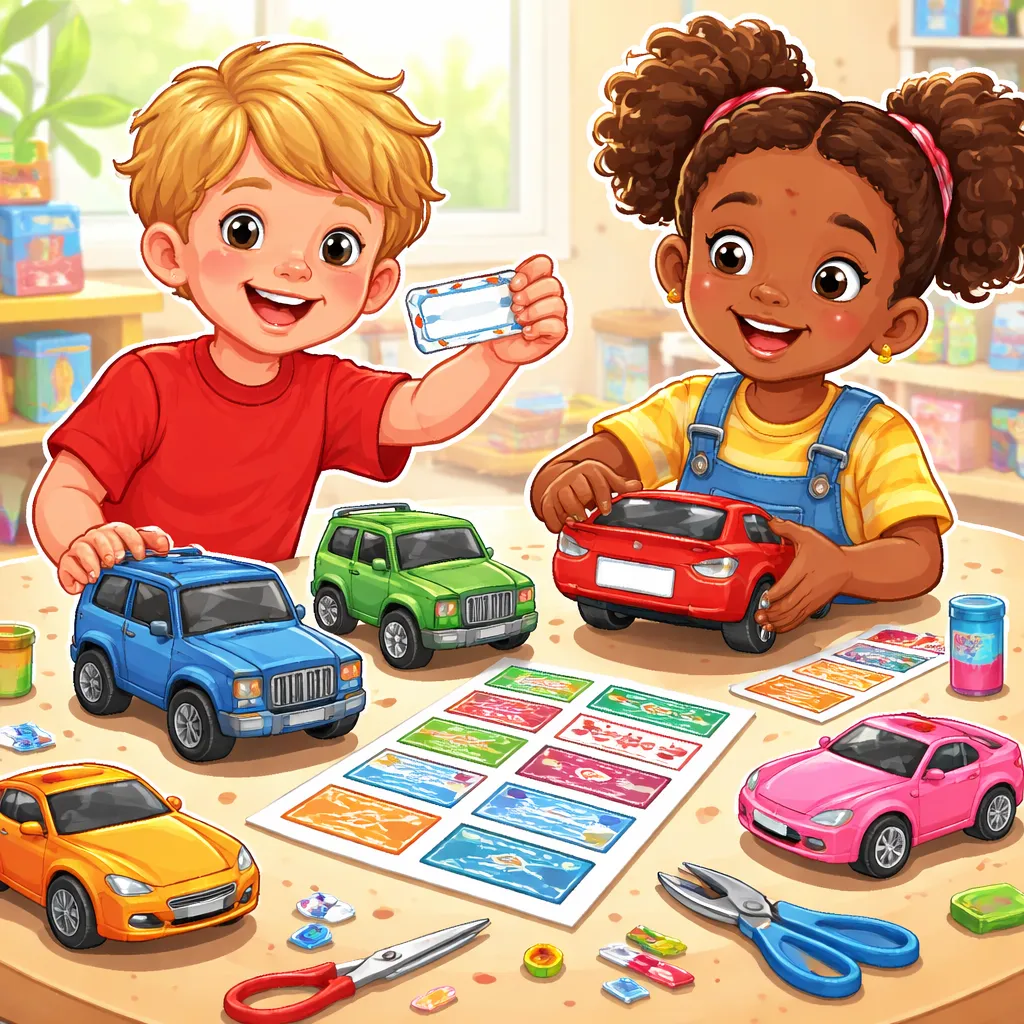

It’s a bright Saturday morning! You dump out your toy box and line up your cars—red race car, blue truck, yellow bus. But wait, something’s missing! None of them have license plates. Just then, Dad hands you colorful sheets: “These are printable license plates for toy cars—let’s make and play!” Your hands tingle with excitement. How do you design them? What words will you learn? Let’s rev up our engines for a fun English adventure!
Core Knowledge Explanation First, let’s talk about printable license plates for toy cars. They are special sheets you can print, decorate, and attach to your toy cars. They look like real license plates but are made just for play.
License plates have three key parts: numbers, letters, and colors. Every real car has one, and now your toy cars will too! These plates help you learn English while having fun.
Let’s start with common (vehicle words). These are cars, trucks, and other things that move. Each word has a simple pronunciation and sentence: Car /kɑː(r)/: A small vehicle for 1-5 people. “I drive a red car to the park.” Truck /trʌk/: A big vehicle for carrying things. “The truck carries boxes to the store.” Bus /bʌs/: A vehicle for many people. “I take the bus to school.” Bike /baɪk/: A two-wheeled vehicle you ride. “I ride my bike with friends.” Motorcycle /ˈməʊtəsaɪkl/: A two-wheeled vehicle with an engine. “The motorcycle goes fast.” Train /treɪn/: A long vehicle that runs on tracks. “The train takes people across the country.” Boat /bəʊt/: A vehicle that sails on water. “We ride a boat on the lake.” Plane /pleɪn/: A vehicle that flies in the sky. “We take a plane to visit grandma.” Van /væn/: A big car for families or things. “The van has seats for 7 people.” Taxi /ˈtæksi/: A car that takes you places for money. “We take a taxi to the restaurant.” Fire Truck /ˈfaɪə trʌk/: A truck that fights fires. “The fire truck has a loud siren.” Ambulance /ˈæmbjələns/: A vehicle that helps sick people. “The ambulance takes people to the hospital.”
Now, let’s learn numbers 0-9. License plates have numbers, so you need to know these well: 0 /ˈzɪərəʊ/ (zero): “There are 0 cookies left.” 1 /wʌn/ (one): “I have one red car.” 2 /tuː/ (two): “The truck has two big wheels.” 3 /θriː/ (three): “There are three buses at the stop.” 4 /fɔː(r)/ (four): “My bike has four gears.” 5 /faɪv/ (five): “The train has five cars.” 6 /sɪks/ (six): “There are six boats on the lake.” 7 /ˈsevən/ (seven): “The plane has seven windows.” 8 /eɪt/ (eight): “The van can hold eight bags.” 9 /naɪn/ (nine): “There are nine taxis on the street.”
Next, let’s learn letters A-Z. License plates use uppercase letters (big letters) because they’re easy to read. Let’s practice each letter’s name and a simple word: A /eɪ/: Apple “A is for apple—red and sweet.” B /biː/: Ball “B is for ball—bounce, bounce, bounce.” C /siː/: Car “C is for car—vroom, vroom!” D /diː/: Dog “D is for dog—woof, woof!” E /iː/: Elephant “E is for elephant—big and gray.” F /ef/: Fish “F is for fish—swim in the sea.” G /dʒiː/: Girl “G is for girl—sing and play.” H /eɪtʃ/: House “H is for house—warm and cozy.” I /aɪ/: Ice “I is for ice—cold and white.” J /dʒeɪ/: Juice “J is for juice—sweet and tasty.” K /keɪ/: Kite “K is for kite—fly in the sky.” L /el/: Lion “L is for lion—roar, roar!” M /em/: Monkey “M is for monkey—swing in trees.” N /en/: Nest “N is for nest—home for birds.” O /əʊ/: Orange “O is for orange—juicy and bright.” P /piː/: Pen “P is for pen—write your name.” Q /kjuː/: Queen “Q is for queen—wear a crown.” R /ɑː(r)/: Rabbit “R is for rabbit—hop, hop, hop.” S /es/: Sun “S is for sun—shiny and hot.” T /tiː/: Tree “T is for tree—tall and green.” U /juː/: Umbrella “U is for umbrella—keep you dry.” V /viː/: Van “V is for van—big and roomy.” W /ˈdʌbəl.juː/: Water “W is for water—drink and play.” X /eks/: Box “X is for box—hold your toys.” Y /waɪ/: Yellow “Y is for yellow—like the sun.” Z /zed/ (or /ziː/): Zebra “Z is for zebra—black and white.”
License plates also have colors. Let’s learn color words to make your plates bright: Red /red/: “The car has a red license plate.” Blue /bluː/: “My favorite plate is blue.” Yellow /ˈjeləʊ/: “The bus has a yellow plate.” Green /ɡriːn/: “The bike’s plate is green.” Orange /ˈɒrɪndʒ/: “The taxi’s plate is orange.” Purple /ˈpɜːpl/: “The van has a purple plate.” Pink /pɪŋk/: “My sister’s plate is pink.” Black /blæk/: “The truck’s plate is black.” White /waɪt/: “The plane’s plate is white.” Brown /braʊn/: “The motorcycle’s plate is brown.”
Now, let’s learn (basic traffic commands). These are words people use to drive safely. You’ll use them when playing with your toy cars: Stop /stɒp/: “Stop the car at the red light.” Go /ɡəʊ/: “Go when the light is green.” Slow down /sləʊ daʊn/: “Slow down near the park.” Turn left /tɜːn left/: “Turn left at the corner.” Turn right /tɜːn raɪt/: “Turn right at the stop sign.” Go straight /ɡəʊ streɪt/: “Go straight down the street.” Park here /pɑːk hɪə(r)/: “Park your car here.” Wait /weɪt/: “Wait for the bus to pass.” Look left /lʊk left/: “Look left before crossing.” Look right /lʊk raɪt/: “Look right before crossing.”
Here are 8+ core (traffic sentence patterns) to use with your toy cars: “Stop the [vehicle] at the red light.” “Go straight with your [vehicle].” “Turn left when you see the [sign].” “Slow down—there are kids ahead.” “Park your [vehicle] next to the tree.” “Wait for the [vehicle] to go first.” “Is the [vehicle] going fast or slow?” “Where do you want to drive your [vehicle]?” “Can you turn right with your [vehicle]?” “Let’s drive our [vehicles] to the park.”
Fun Interactive Learning Let’s start with the (license plate design task). Get your printable license plates for toy cars and follow these steps:
- Choose a color for your plate. Use crayons or markers to color the whole plate—red, blue, yellow, or any color you like!
- Pick 3 numbers from 0-9. Write them in the first three boxes. Make sure they’re big and clear.
- Pick 2 letters from A-Z. Write them in the last two boxes (uppercase letters work best!).
- Add a small picture on the side—like a car, star, or heart. Draw it gently so it doesn’t cover the numbers or letters.
- Cut out the plate carefully (ask an adult for help with scissors).
- Glue the plate onto a piece of cardboard to make it strong.
- Attach it to your toy car with tape or glue. Now your car has a cool license plate!
Example license plate: Red plate with numbers 3, 7, 1 and letters B, Z. Picture of a race car on the side. Say: “This is my red plate—3, 7, 1, B, Z. It’s for my race car!”
Now, let’s play the “ (Pretend Driving Traffic Game)”. You’ll need your toy cars with printable license plates for toy cars, a play mat or floor with “roads” (draw with chalk or tape), and toy traffic lights (or paper ones you make).
Game Rules:
- Set up the “road” on the floor. Draw a start line and finish line. Add a red/green/yellow traffic light in the middle.
- Each player picks a toy car with their designed license plate.
- Take turns being the “traffic controller” and the “driver.”
- The traffic controller says a traffic command. The driver must follow it with their car.
- If the driver follows the command correctly, they move forward 10 cm. If not, they stay in place.
- The first driver to reach the finish line wins!
Sample Game Play: Traffic Controller: “Start your engines! Go straight with your car.” Driver: (Drives car straight) “I’m going straight!” Traffic Controller: “Good! Now slow down—there’s a bike ahead.” Driver: (Slows car down) “I’m slowing down!” Traffic Controller: “Turn right at the next corner.” Driver: (Turns car right) “I turned right!” Traffic Controller: “Stop at the red light.” Driver: (Stops car) “I stopped!” Traffic Controller: “Green light—go! You’re at the finish line. You win!”
Let’s play “License Plate Game (License Plate Recognition Game)”. Gather all your toy cars with their plates.
- Line up the cars on a table.
- One player says a number, letter, or color.
- The other player must find the car whose license plate has that number, letter, or color.
- When they find it, they say: “I found it! This plate has [number/letter/color].”
- Switch roles and play again.
Example: Player 1: “Find a plate with the letter G!” Player 2: (Looks through cars) “Here it is! This blue plate has G. The numbers are 2, 5, 9.” Player 1: “Great job! Now find a plate with the number 4.”
Another fun game: “Traffic Command Relay”. You’ll need 2 teams and 2 sets of toy cars with printable license plates for toy cars.
- Set up two identical roads with traffic lights and signs.
- Each team lines up behind the start line.
- The first player in each team takes their car and waits for the traffic controller’s command.
- The traffic controller says a command (e.g., “Turn left, go straight, park here”).
- The player follows the command and drives to the finish line. Then they run back and tag the next player.
- The first team to have all players finish wins!
Let’s practice license plate “Talk”. Look at your plate and make sentences: “My license plate is [color]. It has numbers [1,2,3] and letters [X,Y].” “I drive a [vehicle] with a [color] plate.” “Can you read my plate? It’s [numbers] and [letters].” “My friend’s plate is [color]—it has different numbers and letters.”
Expanded Learning Let’s learn about license plates from different countries. Did you know plates look different around the world? USA: Most US plates have 6-7 characters (numbers and letters). Each state has a different design—some have pictures of animals or landmarks. UK: UK plates have 7 characters. They start with two letters for the region, then two numbers, then three letters. Japan: Japanese plates are white for cars and green for trucks. They have black characters and a small symbol for the region. Australia: Australian plates have different colors for each state. Some have cute animals like kangaroos on them!
Add these facts to your play: “My toy car is from the USA—its plate has 7 characters!” or “This truck is from Australia—look at the kangaroo on the plate!”
Let’s sing a fun “License Plate Song” to remember numbers, letters, and commands. Tune: “Bingo” There’s a plate on my toy car, and it has numbers too, 1, 2, 3, A, B—let’s drive and sing with you! (Chorus) Vroom, vroom, go straight, Vroom, vroom, turn right, Vroom, vroom, stop at the light, With my license plate!
There’s a plate on my toy truck, and it has letters too, C, D, 4, 5, 6—let’s drive and sing with you! (Chorus) Vroom, vroom, go straight, Vroom, vroom, turn right, Vroom, vroom, stop at the light, With my license plate!
Let’s expand our vehicle vocabulary with more fun words: Scooter /ˈskuːtə(r)/: “I ride a scooter to the store.” Roller Skates /ˈrəʊlə skeɪts/: “She wears roller skates in the park.” Skateboard /ˈskeɪtbɔːd/: “He rides a skateboard down the street.” Helicopter /ˈhelɪkɒptə(r)/: “The helicopter flies over the city.” Ferry /ˈferi/: “The ferry takes cars across the river.” Submarine /ˌsʌbməˈriːn/: “The submarine swims under the sea.” Tractor /ˈtræktə(r)/: “The tractor helps farmers in the field.” Golf Cart /ɡɒlf kɑːt/: “They drive a golf cart on the golf course.”
Let’s learn about traffic signs. Traffic signs help drivers stay safe. Here are common ones: Stop Sign (red octagon): “Stop at the stop sign.” Yield Sign (yellow triangle): “Yield to other cars.” Crosswalk Sign (white with people): “Look for the crosswalk sign.” Speed Limit Sign (white with numbers): “Follow the speed limit.” No Parking Sign (red circle with line): “Don’t park here—no parking sign.”
Draw these signs and add them to your play road. Say: “Stop at the stop sign before turning right.”
Let’s make “License Plate Stories”. Use your toy cars and their plates to tell a story: “One day, my red car (plate 3, 7, B, Z) wanted to go to the park. It followed the traffic rules: stopped at red lights, went straight, and turned left. On the way, it met a blue truck (plate 2, 5, C, X). ‘Let’s drive together!’ said the car. They followed the ‘Go straight’ sign and arrived at the park. They parked their cars and played all afternoon—so fun!”
What You Will Learn From printable license plates for toy cars, you will learn so many useful things! First, you’ll master 15+ vehicle words like car, truck, bus, and plane. You can say their names, spell them, and talk about what they do.
You’ll know numbers 0-9 perfectly. You can read them, write them, and use them in sentences. You’ll also learn all 26 letters of the alphabet (uppercase), so you can recognize and write them easily.
You’ll learn 10+ color words and 10+ traffic commands. You can use words like stop, go, turn left, and slow down to play and talk about driving.
You’ll master 10+ core (sentence patterns) like “Stop the car at the red light,” “My plate has numbers 3, 7, 1,” and “Where do you want to drive?” These sentences help you talk about your toy cars and play games.
Your thinking skills will get better too! You’ll learn to follow rules (traffic rules in the game), match numbers and letters (license plate recognition), and be creative (designing your own plates).
You’ll develop great learning habits. You’ll practice writing by filling in numbers and letters on your plates. You’ll learn to be patient when cutting and gluing. You’ll also learn to take turns when playing games with friends—teamwork is important!
You’ll get better at speaking English. Playing with toys makes speaking fun, so you’ll be brave to use new words and sentences. You’ll also learn to listen to commands and follow them—this helps with focus.
Using What You Learned in Life You can use your new English skills at home every day! Play with your printable license plates for toy cars and practice traffic commands with family. Say to your dad: “Dad, can you say a command? I’ll drive my car!”
When you’re in the car with your family, look at real license plates. Point out numbers and letters: “Mom, look! That car’s plate has the letter B and number 5!” You can also count the cars you see: “I see three red cars!”
Go for a walk in your neighborhood. Look for vehicles and say their names: “There’s a bus! That’s a taxi!” You can also practice traffic commands: “Stop—we need to cross the street. Look left and right!”
Have a “Toy Car Parade” at home. Invite friends to bring their toy cars with printable license plates for toy cars. Line up the cars and take turns driving them. Say: “My car is first! It’s going straight. Now turn right!”
Practice writing numbers and letters. Use your license plate design as practice—write numbers 0-9 and letters A-Z on paper. Say the words as you write: “A is for apple, B is for ball.”
When you draw, include vehicles and license plates. Draw a road with cars, trucks, and buses. Add license plates with numbers and letters. Show your drawing to family and say: “This is a fire truck. Its plate has numbers 1, 9, 4 and letters F, T.”
Closing Encouragement Wow! You’ve had an amazing time with printable license plates for toy cars. You can name vehicles, read numbers and letters, follow traffic commands, and design cool plates—you’re a superstar!
Every time you designed a plate, followed a command, or played a game, you got better at English. It’s okay if you mixed up a letter or forgot a command—trying your best is what counts.
Keep playing with your toy cars and plates. The more you practice, the more confident you’ll feel using English. You can design new plates with different numbers and letters, or make plates for all your toys—even your bike or scooter!
Remember, English is everywhere—on real license plates, signs, and toys. Keep looking for numbers, letters, and vehicle words. Talk about them with your friends and family.
You’re a brave and smart learner. We’re so proud of how hard you’ve worked. Keep driving, keep playing, and keep learning—you’re on your way to being an English driving master! Happy driving and learning