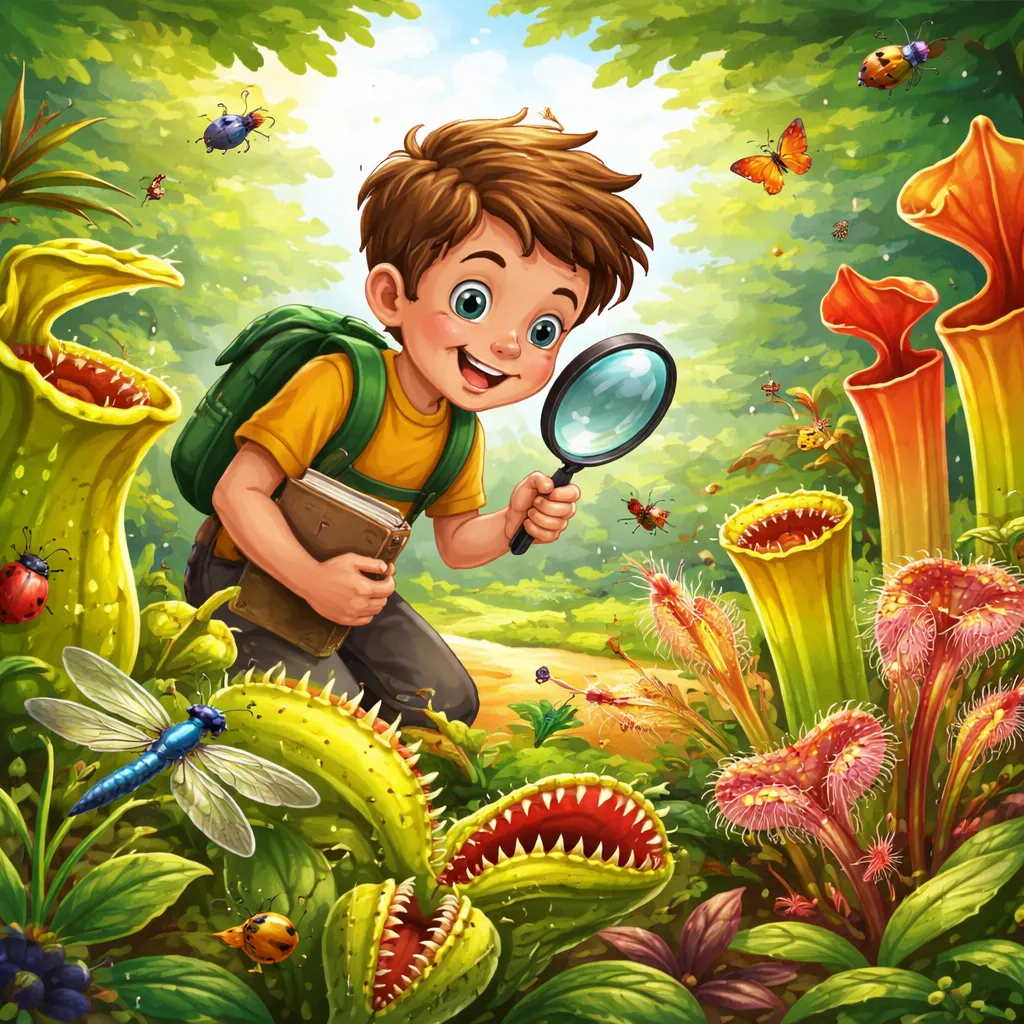

Have you ever imagined a plant that could catch its own lunch? Not with hands or a net, but with its own beautiful, clever leaves! In the magical world of plants, there exists a special group of hunters who don't wait for food to come to them. They are the carnivorous plants! Right now, at the Beijing National Botanical Garden, a wonderful exhibition called "The共生纪: Wonderful Encounters between Animals and Plants" is showcasing over 500 kinds of these amazing green hunters, like the Venus Flytrap and the Pitcher Plant. Today, let's put on our explorer hats and discover the secrets of these plants that seem to have jumped right out of a fairy tale!
Let‘s Learn the Word! – The Hunter's Name Tag
First, let's get to know their special name. They are called carnivorous plants (pronounced: /kɑːrˈnɪvərəs plænts/). It's a big word, but we can break it down! "Car-ni-vor-ous" comes from Latin words meaning "meat-eating." So, they are meat-eating plants! Isn't that fascinating? Plants that eat tiny bits of "meat" from insects!
Here are some key words to become a carnivorous plant expert: Trap: This is their special "tool" for catching food. Different plants have different kinds of traps.
Prey: The small insects they catch, like flies, ants, or tiny beetles.
Digest: After catching the prey, the plant slowly dissolves it to get nutrients, just like how our stomachs work.
Nectar: A sweet liquid some carnivorous plants make to attract insects. It's like putting out candy to invite guests over... but it's a tricky invitation!
Tentacles: Tiny hair-like parts on some plants (like the Sundew) that are sticky and can move!
In different cultures, people have been amazed by these plants for a long time. There isn't a famous proverb about them, but Charles Darwin, a great scientist who studied nature, called the Venus Flytrap "one of the most wonderful plants in the world." In Chinese, they are called 食虫植物 (shí chóng zhí wù), which literally means "insect-eating plants."
Now that we know their name and some special words, let's become nature detectives and see how these incredible hunters live!
Discover the Plant’s Secrets! – Inside the Green Hunter's Den
Carnivorous plants are like the superheroes of the plant world. They live in places where the soil is very poor, often in bogs or swamps, where it's hard to find enough food (nutrients like nitrogen) from the ground. So, they evolved a superpower: getting food from the air!
Let's meet some of the most famous hunters and learn their tricks:
-
The Venus Flytrap The Snap Jaws This is the most famous hunter! Its leaves are shaped like a mouth with long "teeth." Inside, there are tiny sensitive hairs. When an unsuspecting fly touches two of these hairs quickly, SNAP! The leaf closes in less than a second, trapping the insect inside. It's like a green bear trap!
-
The Pitcher Plant The Slippery Pitfall This plant is a master of disguise. Its leaves form a deep, beautiful pitcher or tube filled with sweet-smelling nectar and rainwater at the bottom. Insects are attracted to the sweet smell and bright colors. When they land on the slippery rim to drink, they fall into the water and can't climb back out. The plant then slowly digests them.
-
The Sundew The Sticky Flypaper The Sundew looks like it's covered in morning dew that sparkles in the sun. But that's not water—it's super sticky glue! Each dewdrop is on the end of a tiny tentacle. When a bug gets stuck, the tentacles slowly curl around it, holding it tight while the plant feeds.
-
The Bladderwort The Underwater Vacuum This hunter lives in water! It has tiny, balloon-like traps with a door. When a water flea swims by and touches the trigger hairs, the door flies open, water rushes in, and the prey is sucked inside in just one-thousandth of a second! It's the fastest trap in the plant world.
Why don't they eat people? Don't worry! Their traps are only strong enough for small insects. They are very important for the environment because they help control insect populations naturally. Scientists are even using special technology called plant tissue culture to grow and protect rare kinds of these amazing plants.
Did you know? The exhibition in Beijing shows how these plants live together with small animals and insects in a balanced way, which is called 共生 (gòng shēng), or symbiosis. It's a delicate and wonderful relationship in nature.
Let’s Grow It Together! – Become a Plant Hunter's Helper
Would you like to care for a tiny, patient hunter at home? Some carnivorous plants, like certain Sundews or Venus Flytraps, can be grown in pots! It's a wonderful way to learn about nature, responsibility, and the miracle of life.
Before You Start: Is it right for you? Yes! They are safe, fascinating, and don't need much space. A small pot on a sunny windowsill is perfect.
The Hunter's Care Kit: You will need:
1.  A wide, shallow pot with drainage holes (not too deep).
2.  Special soil: Never use normal potting soil. They need nutrient-poor, acidic soil. A mix of sphagnum moss and perlite or sand is perfect. You can buy this from a garden store.
3.  A small Venus Flytrap or Sundew plant (buy from a reputable nursery, don't take from the wild!).
4.  A spray bottle for water.
5.  A sunny spot.
The Care Guide:
Step 1: Planting Your Hunter Gently place your plant in the special soil mix. Don't bury it too deep. Give it a gentle watering with the spray bottle to settle the soil around its roots.
Step 2: The Golden Rules for a Happy Hunter Water: This is the most important rule! Carnivorous plants are very picky about water. They need rainwater, distilled water, or reverse osmosis water. Never use tap water because the minerals in it will harm and eventually kill your plant. Keep the soil damp all the time, like a wrung-out sponge. You can even place the pot in a shallow tray with a little bit of the right water in it.
Sunlight: They love the sun! Give them at least 4-6 hours of bright, direct sunlight every day. A south-facing window is ideal. The more sun they get, the redder and healthier their traps will become.
Food: Here's the fun part! You do not need to feed them insects. They can live perfectly healthy lives just from sunlight, water, and air. If you want to feed them as a special treat, only give them one tiny, live insect (like a fruit fly) every few weeks. Never feed them human food like meat or cheese—it will rot and kill the trap!
Step 3: What to Do If... Leaves turn black? Don't panic! Old traps naturally die back after catching food a few times. Just trim the black part off with clean scissors.
No new traps growing? It might need more sunlight. Move it to a brighter spot.
Seeing tiny bugs on the soil? These are probably harmless. Your carnivorous plant might even catch them itself!
The Rewards of Patience: Watching your plant grow new, tiny traps is incredibly exciting. You'll learn firsthand about adaptation, patience, and the unique ways life survives. You can keep a "Hunter's Journal" to draw your plant each week and write down any changes you see.
Remember, by caring for one of these special plants, you are helping to protect and understand a unique part of our world's biodiversity. Scientists work very hard to save rare plants, like the 大(Dà huánghuā xiājǐlán), an orchid known as the "Golden Monkey" of the plant world. Every plant is precious!
The Never-Ending Adventure
So, our journey is complete! We started by knowing their amazing name—carnivorous plants. We moved to understanding their incredible hunting tricks and why they live the way they do. Finally, we learned how to apply this knowledge by becoming a caring guardian for one of these green hunters.
These plants teach us that nature is full of surprises and clever solutions. They remind us to look closer, ask questions, and appreciate every living thing, no matter how small or strange it may seem. The next time you're in a garden or park, look carefully—you might just discover another one of nature's wonderful secrets waiting to be found. Keep exploring, little scientist!