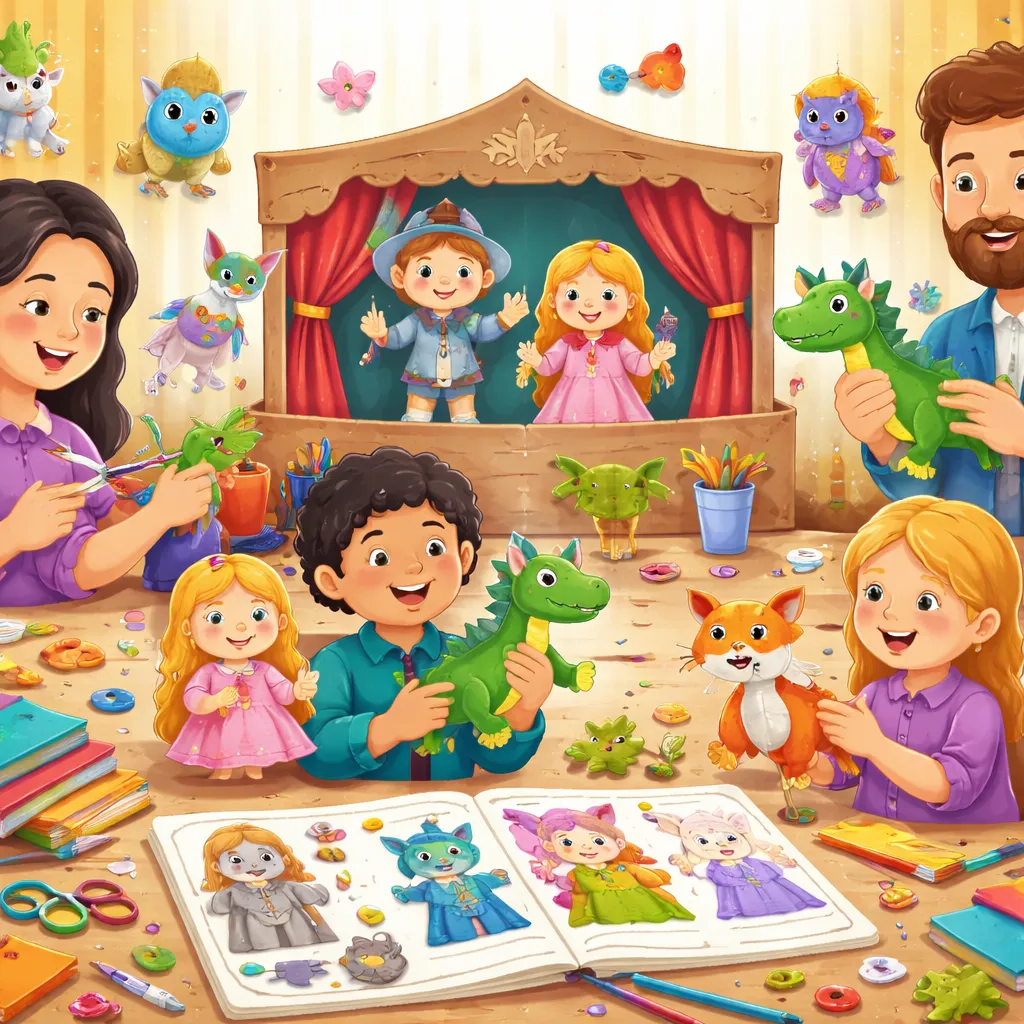

It’s a cozy Friday evening! You and your best friend want to tell a fun story, but you need characters to bring it to life. Suddenly, Mom pulls out colorful paper sheets: “These are DIY puppet templates for storytelling—let’s make and play!” Your eyes sparkle as you touch the outlines of animals and kids. How do you make these puppets? What stories will you tell? Let’s dive into this creative adventure of crafting, talking, and storytelling!
Core Knowledge Explanation First, let’s talk about DIY puppet templates for storytelling. They are special printable sheets with outlines of different characters. You can cut, color, and decorate them to make your own puppets. Then, use these puppets to act out stories in English—how exciting!
Let’s meet common puppet characters. These characters are easy to make and perfect for simple stories: Rabbit /ˈræbɪt/: A small animal with long ears and a fluffy tail. “The rabbit hops fast in the grass.” Cat /kæt/: A furry pet with soft paws and a long tail. “The cat likes to sleep in the sun.” Little Boy /ˈlɪtl bɔɪ/: A young child (boy). “The little boy plays with his toy car.” Little Girl /ˈlɪtl ɡɜːl/: A young child (girl). “The little girl sings a happy song.” Bird /bɜːd/: A small animal with wings that can fly. “The bird sings in the tree.” Dog /dɒɡ/: A loyal pet that barks and wags its tail. “The dog runs to greet its owner.” Turtle /ˈtɜːtl/: A slow animal with a hard shell. “The turtle walks slowly on the ground.” Fox /fɒks/: A clever animal with a bushy tail. “The fox has bright orange fur.”
Now, let’s learn body parts vocabulary—these words help you describe your puppets and their actions: Head /hed/: The top part of the body. “The rabbit has a round head.” Eyes /aɪz/: The parts used to see. “The cat’s eyes are big and green.” Nose /nəʊz/: The part used to smell. “The dog’s nose is wet and black.” Mouth /maʊθ/: The part used to eat and talk. “The little girl’s mouth has a big smile.” Ears /ɪəz/: The parts used to hear. “The rabbit’s ears are long and soft.” Arms /ɑːmz/: The parts that hang from the shoulders. “The little boy waves his arms.” Legs /leɡz/: The parts used to walk or run. “The turtle’s legs are short and strong.” Hands /hændz/: The parts at the end of arms. “The little girl claps her hands.” Feet /fiːt/: The parts at the end of legs. “The bird’s feet are small and sharp.” Tail /teɪl/: The long part at the back of some animals. “The fox’s tail is bushy.”
Next, let’s master basic action vocabulary. Actions make your stories lively—puppets can move and do things just like real characters! Run /rʌn/: To move fast. “The dog runs in the park.” Jump /dʒʌmp/: To push off the ground with feet. “The rabbit jumps over the stone.” Walk /wɔːk/: To move slowly on feet. “The turtle walks in the garden.” Fly /flaɪ/: To move through the air (for birds or insects). “The bird flies high in the sky.” Eat /iːt/: To take food into the mouth. “The cat eats a bowl of milk.” Drink /drɪŋk/: To take liquid into the mouth. “The little boy drinks water.” Talk /tɔːk/: To speak. “The little girl and boy talk about their toys.” Smile /smaɪl/: To show happiness with the mouth. “The rabbit smiles at the bird.” Cry /kraɪ/: To shed tears (when sad). “The dog cries when it’s lost.” Sleep /sliːp/: To rest with eyes closed. “The turtle sleeps in its shell.” Climb /klaɪm/: To go up something. “The cat climbs the tree.” Dance /dɑːns/: To move to music. “The little girl dances to the song.” Sing /sɪŋ/: To make musical sounds with the voice. “The bird sings a pretty song.” Hop /hɒp/: To jump on one foot (or both for small animals). “The rabbit hops along the path.”
Now, let’s learn simple story structure. Every good story has three parts: beginning, middle, and end. Beginning: Introduce the characters and the setting (where the story happens). For example: “This is Lila, a little girl. She is in the park. Her friend is Bunny, a white rabbit.” Middle: Tell what happens—this is the fun part! There can be a small problem or an adventure. For example: “Bunny loses her favorite carrot. Lila helps Bunny look for it.” End: Solve the problem or finish the adventure. Everyone is happy! For example: “They find the carrot under a tree. Lila and Bunny eat the carrot together. They are so happy!”
Let’s learn the steps to make puppets from DIY puppet templates for storytelling. You’ll need simple materials: printable templates, scissors (with adult help!), glue, markers, crayons, yarn, and googly eyes (optional).
Step 1: Print the template. Ask an adult to help you print the DIY puppet template. Choose your favorite character—rabbit, cat, or little girl!
Step 2: Color the template. Use markers or crayons to add color. For a rabbit, color the fur white or brown. For a cat, use orange or black. Be creative—your puppet can be any color you like!
Step 3: Cut out the puppet. Ask an adult to help with scissors. Cut along the black outline of the template. Be careful not to cut your fingers or the puppet’s small parts (like ears or hands).
Step 4: Add details. Glue on googly eyes for a silly look. Use yarn for hair—glue it on the top of the puppet’s head. Draw a mouth or nose with a marker. You can add clothes too—draw a dress on the little girl or a scarf on the rabbit.
Step 5: Make it easy to hold. Glue the puppet onto a popsicle stick or a paper bag. If using a paper bag, slide your hand inside—your fingers can move the puppet’s “mouth” to talk!
Step 6: Let it dry. Leave the puppet on a flat surface for a few minutes. Let the glue dry so all parts stay in place. Now your puppet is ready to tell stories!
Here are useful character introduction句型 (sentence patterns) for your puppets: “Hello! I am [Puppet Name]. I am a [animal/boy/girl].” “My favorite color is [color]. I like to [action].” “I live in [place—park/forest/home]. I have [body part—long ears/big eyes].” “This is my friend, [Friend’s Name]. They are a [animal/boy/girl].” “I am [happy/sad/excited] today because [reason].”
Fun Interactive Learning Let’s start with hand (puppet self-introduction). Take your finished puppet and use the introduction to make it talk. Here are examples to inspire you:
Puppet 1 (Rabbit named Floppy): “Hello! I am Floppy. I am a rabbit. My favorite color is pink. I like to hop and eat carrots. I live in a forest. I have long ears and a fluffy tail. I am happy today because I want to find new friends!”
Puppet 2 (Little Girl named Mia): “Hi everyone! I am Mia. I am a little girl. My favorite color is blue. I like to sing and dance. I live in a small house with my mom and dad. I have brown hair and big eyes. I am excited today because I am going to the park!”
Puppet 3 (Dog named Max): “Woof! Hello! I am Max. I am a dog. My favorite color is brown. I like to run and play fetch. I live in a yard with my owner. I have a wet nose and a waggy tail. I am sad today because I lost my toy ball.”
Now, let’s act out 2+ short stories with your puppets. These stories are simple and use the action words and story structure we learned.
Story 1: “Floppy the Rabbit’s Carrot Adventure” Beginning: Floppy (rabbit puppet): “Hello! I am Floppy. I am a rabbit. I live in a forest. I love to eat carrots. Today, I want to find a big, juicy carrot!”
Middle: Floppy (hops around): “Hop, hop, hop! Where is a carrot? I am hungry.” Bird (bird puppet, flying down): “Hi Floppy! What are you looking for?” Floppy: “I am looking for a carrot. Do you know where I can find one?” Bird: “Yes! There are carrots near the river. Follow me!” Floppy (hops fast): “Thank you! Let’s go!”
End: Floppy (stops by river): “Wow! Look at the big carrots! Thank you, Bird.” Bird: “You’re welcome, Floppy. Let’s eat together!” Floppy and Bird (pretend to eat): “Yum, yum! This carrot is delicious.” Floppy: “I am happy now. You are my new friend!” Bird: “I am your friend too! Let’s play after eating.”
Story 2: “Mia and Max’s Toy Hunt” Beginning: Mia (little girl puppet): “Hi! I am Mia. I am at the park. Look, that’s Max the dog. He looks sad.” Max (dog puppet): “Woof, woof. I lost my toy ball.” Mia: “Don’t be sad, Max. I will help you find it!”
Middle: Mia (walks around): “Where is Max’s ball? Let’s look under the tree.” Max (sniffs the ground): “Sniff, sniff. I don’t smell it here.” Mia (looks near the swing): “Look, Max! Is that your ball near the swing?” Max (runs over): “Yes! That’s my ball! Thank you, Mia.” Mia: “You’re welcome! Let’s play fetch with it.”
End: Max (wags tail): “Run, Mia! Throw the ball!” Mia (throws ball): “Catch it, Max!” Max (catches ball): “Woof! I got it!” Mia: “This is fun! Do you want to play again?” Max: “Yes, yes! You are my best friend, Mia.” Mia: “You are my best friend too, Max!”
Now, let’s create your own story! Follow these steps to (create) a new story with your puppets:
- Choose 2-3 puppets from your DIY puppet templates for storytelling. Write their names down.
- Pick a setting: park, forest, home, or playground.
- Think of a small problem or adventure: lost toy, looking for food, meeting a new friend.
- Write the beginning: Introduce the characters and setting.
- Write the middle: Tell what happens—how they solve the problem or go on the adventure.
- Write the end: Happy ending with friends together or problem solved.
- Act it out! Move your puppets and use their voices to tell the story.
Example of a kid-created story outline: Characters: Mia (little girl), Floppy (rabbit), Max (dog) Setting: Forest Problem: They want to find a place to have a picnic. Beginning: Mia, Floppy, and Max are in the forest. They are hungry and want to picnic. Middle: They look for a quiet spot. They find a clearing with flowers. They bring out pretend food (apple, carrot, cookie). End: They eat together and play games. They have a great picnic and promise to come back.
Let’s play “Puppet Dialogue Practice.” Pair up with a friend or family member. Each person takes a puppet and has a conversation. Use these prompts to start: “What do you like to do for fun?” “Where do you live?” “What is your favorite food?” “Can we be friends?” “Let’s go on an adventure!”
Example Dialogue: Mia (puppet): “Hi Floppy! What do you like to do for fun?” Floppy (puppet): “I like to hop and eat carrots. What do you like to do, Mia?” Mia: “I like to sing and dance. Can we be friends?” Floppy: “Yes! Let’s go to the river. I know where to find carrots.” Mia: “Great! Let’s ask Max to come with us.” Max (puppet): “Woof! I want to come too. I like to run by the river.” Mia, Floppy, Max: “Let’s go! Adventure time!”
Expanded Learning Let’s learn about puppets from different countries. Puppets are loved all over the world, and each country has special types: China: Shadow puppets . They are made of thin leather. People hold them behind a screen with light. The shadows tell stories—so cool! India: Glove puppets. They fit on your hand like gloves. The fingers move the puppet’s head and arms. Indonesia: Wayang kulit. These are also shadow puppets, but made of buffalo skin. They tell old stories about kings and heroes. France: Marionettes. They are controlled by strings from above. The puppeteer pulls the strings to make them move.
Add these puppet facts to your stories. For example: “Floppy heard about Chinese shadow puppets. He wants to make a shadow puppet too!”
Let’s sing a fun “Puppet Action Song” to remember the action words. Tune: “Row, Row, Row Your Boat” Puppets jump, jump, jump so high, Hop along the way. Run and dance and sing with joy, Let’s play all day!
Puppets walk, walk, walk so slow, Fly up to the sky. Eat and drink and smile with friends, Oh, what a fun day!
Let’s expand our character and action vocabulary. Here are more words to make your stories richer: More characters: Bear /beə(r)/ (“The bear is big and furry.”), Fox /fɒks/ (“The fox is clever.”), Fish /fɪʃ/ (“The fish swims in the lake.”), Butterfly /ˈbʌtəflaɪ/ (“The butterfly has colorful wings.”) More actions: Skip /skɪp/ (“Mia skips in the park.”), Slide /slaɪd/ (“The little boy slides down the slide.”), Swing /swɪŋ/ (“Mia swings on the swing.”), Dig /dɪɡ/ (“The dog digs a hole in the yard.”) More feelings: Excited /ɪkˈsaɪtɪd/ (“Floppy is excited to find carrots.”), Scared /skeəd/ (“The bird is scared of the cat.”), Angry /ˈæŋɡri/ (“Max is angry when someone takes his ball.”), Tired /ˈtaɪəd/ (“The turtle is tired after walking.”)
Let’s learn story starters to help when you’re stuck. Use these to begin a new story: “One sunny morning, [Puppet Name] went to the [setting].” “[Puppet Name] woke up and found a surprise: [surprise].” “It was a rainy day, so [Puppet Name] decided to [action].” “[Puppet Name] met a new friend in the [setting]. Their name was [Friend’s Name].”
Example story starter in action: “One sunny morning, Mia went to the forest. She heard a small voice saying, ‘Help! Help!’ Mia looked around and saw Floppy the rabbit stuck in a bush.”
Let’s make “Puppet Props” to go with your stories. Props make the story more real. Use simple things around the house: A small bowl for “milk” (for the cat puppet). A carrot toy or drawn carrot (for the rabbit puppet). A small ball (for the dog puppet). A flower (for the little girl puppet to pick).
Use the props in your story: “Mia picked a pink flower and gave it to Floppy. Floppy smelled the flower and smiled.”
What You Will Learn From DIY puppet templates for storytelling, you will learn so many wonderful things! First, you’ll master over 20 character words (rabbit, cat, little boy, bear, etc.) and 15+ body part words (head, eyes, ears, arms, etc.). You can name and describe puppets easily.
You’ll learn 20+ action words (run, jump, hop, fly, eat, etc.) and use them to make stories lively. You’ll also know feeling words (happy, sad, excited, scared) to show what your puppets feel.
You’ll master useful (sentence patterns) like “I am [Name]. I like to [action].”, “Where is [something]?”, “Let’s [action] together.”, and story structure sentences (beginning, middle, end). These help you talk with puppets and tell stories.
Your creativity will grow so much! You can make unique puppets with colors and details. You can create your own stories, choosing characters, settings, and adventures—this is what storytelling is all about!
You’ll get better at speaking English. Acting with puppets makes speaking fun and not scary. You’ll practice talking in front of others and using new words in sentences.
You’ll develop great learning habits. You’ll be patient when cutting and gluing puppets. You’ll learn to work with friends when acting out stories—teamwork is important! You’ll also be brave to try new things, like creating your own story.
You’ll learn to listen too. When your friend acts with their puppet, you’ll listen to their lines. This helps you understand stories and respond in English.
Using What You Learned in Life You can use your puppet skills at home! Have a “Family Puppet Night” once a week. Gather your DIY puppet templates for storytelling, make puppets with your family, and take turns telling stories. Mom and dad can be characters too—you’ll all laugh and learn together!
When you have friends over, play “Puppet Theater.” Set up a stage with a blanket over a chair. Each friend brings a puppet and acts out a story. You can even make tickets for family members to watch—so fun!
Use puppets to practice English daily. When you eat breakfast, make your rabbit puppet say: “I like to eat carrots for breakfast. What do you like to eat?” You can answer with your own voice or another puppet.
Take your puppets to the park. Sit on a bench and tell stories to your friends. Use the park as the setting—“Look, Floppy! We are in the real park, just like in our story!” You can even act out the story with the park’s trees and benches as props.
Use puppets to help with chores. Make your dog puppet say: “Mia, let’s clean your room together! I’ll help you pick up toys.” This makes chores fun and lets you practice English at the same time.
Share your puppets and stories at school. If your class has a talent show, perform a puppet story. You can also teach your classmates how to make puppets from DIY puppet templates for storytelling—spread the fun!
Closing Encouragement Wow! You’ve done something amazing—you made puppets, learned new words, and told wonderful stories with DIY puppet templates for storytelling. You’re a creative, brave, and smart learner!
Every time you colored a puppet, practiced a line, or created a story, you got better at English. It’s okay if your story was short or your puppet had a “silly” color—what matters is you tried and had fun.
Keep making puppets and telling stories. Your imagination is endless—you can create any character and any adventure. The more you practice, the more confident you’ll feel speaking English.
Remember, puppets are your friends that help you learn. Take them with you, talk to them, and let them be part of your English journey. You can tell stories anywhere—at home, park, or school.
We’re so proud of you for being curious and creative. You’re not just making puppets—you’re making memories and building English skills that will help you forever. Keep shining, keep storytelling, and keep being the amazing learner you are. Happy crafting and telling tales