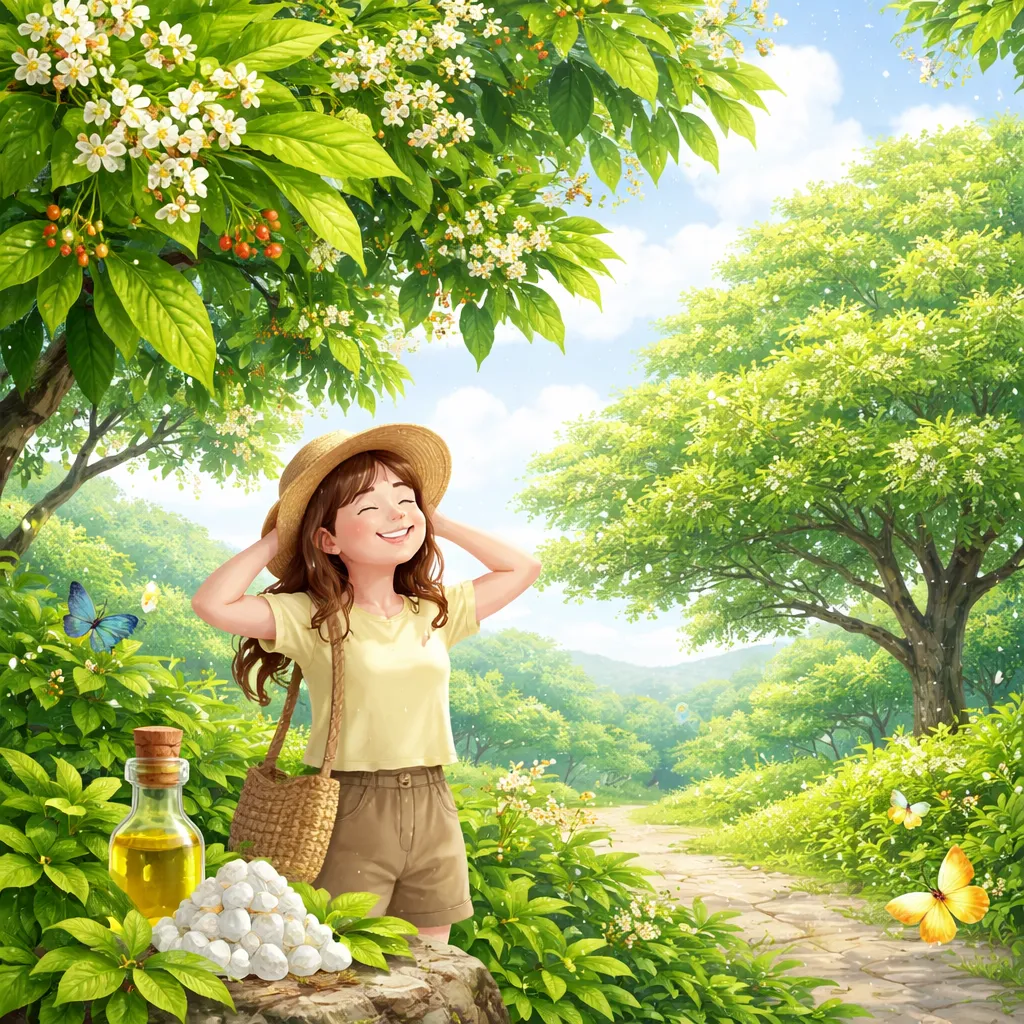

Have you ever opened a wooden chest or a box and smelled a very clean, sharp, and refreshing scent? That smell might be coming from a special kind of tree. Have you ever seen a very large, round tree with shiny, dark green leaves that stay on all year? In spring, it has small, yellowish flowers, and in autumn, it gets clusters of black berries. This tree is not just beautiful; it is a walking medicine cabinet and a natural air freshener! Let’s meet the aromatic and ancient Camphor Tree plant.
Let’s Learn the Word! – Open the Treasure Box of Language
Formal Name and Pronunciation
This fragrant giant is called a Camphor tree. Its scientific name is Cinnamomum camphora. You can say it like this: /ˈkæm.fər triː/ (KAM-fer tree). The first part, “Cam,” sounds like “ham,” and “phor” rhymes with “for.” Cam-phor. Say it: Camphor. It’s a crisp, clear-sounding word.
The Etymology Tale
The word “Camphor” has traveled the world! It comes from the old French word “camphore,” which came from the medieval Latin “camphora.” That word was borrowed from the Arabic “kāfūr,” which ultimately came from the Sanskrit “karpūra.” For thousands of years, people in Asia have known and used this tree. The name has crossed oceans and languages, always meaning this special, fragrant substance.
Nicknames and Friendly Aliases
The Camphor tree is known by names that tell of its gifts. In its native home, it is simply called the Camphor Laurel. Because it is a type of cinnamon tree, it is sometimes called Camphor Cinnamon. People also call it the Gum Camphor tree, named for the solid, waxy camphor that comes from its wood. In some places, it’s known as the True Camphor tree.
Building Your Word Web: Core Parts
Let’s learn the words for a Camphor’s body. The Leaf is oval, pointed, and glossy green. It feels leathery and has three main veins that run from the base, like a trident. When you crush it, it releases the strong camphor scent. The Bark is pale brown, rough, and vertically fissured (split into long cracks). The Flower is tiny, creamy yellow, and grows in loose clusters. The Berry is a small, round, black drupe that birds love. The Wood is soft and reddish-brown, and it is full of aromatic oils. A Sapling is a young camphor tree.
Action and State Words
Camphor trees are constant and protective. They release a distinctive, clean scent into the air. They provide dense, year-round shade as an evergreen tree. They grow into a broad, domed shape. The tree repels many insects naturally with its smell. A camphor tree is aromatic, stately, broad-canopied, and long-lived.
Ecosystem Friends Vocabulary
The camphor tree is a wildlife haven. Birds like robins and cedar waxwings feast on the black berries. Bees and other insects visit the spring flowers for nectar. The dense foliage provides excellent shelter and nesting sites for birds. In its native home, it is a host plant for the larvae of beautiful butterflies like the Blue Triangle. Even in new places, its berries are an important food source for birds in winter.
Cultural Imprint in Language
In many cultures, camphor is a symbol of purity and cleanliness. In Hindu traditions, camphor is burned in ceremonies, representing the burning away of ego and ignorance, just as it burns with a bright, clean flame. An old saying in traditional medicine highlights its value: “Camphor is a friend in the medicine chest.” The famous poet Dante Alighieri even mentioned the “camphor ice” in his writings, showing its long-known cooling properties.
Ready for Discovery
We know its clean, sharp name. Are you ready to be a nature detective and uncover the healing secrets of this ancient tree? Let’s explore the world of the Camphor Tree plant.
Discover the Plant’s Secrets! – A Nature Detective’s Notebook
The Plant Passport
The Camphor tree belongs to the Laurel family, Lauraceae. Its scientific group is Cinnamomum. This tree is a giant, round, evergreen umbrella. It can grow as wide as it is tall, creating a huge dome of shade. The leaves are its signature: glossy, dark green, and smelling strongly of camphor when crushed. The flowers are small and not very showy. The fruit is a pea-sized, black berry. It is an evergreen, keeping its leaves all year, and can live for over a thousand years, becoming a vast, historic giant.
Survival Smarts
The camphor tree’s secret weapon is its chemical defense. All parts of the tree contain camphor oil. This strong-smelling oil repels many insects, fungi, and herbivores that might want to eat it. This is why the tree has few pests. Another trick is its dense, wide canopy. It blocks sunlight from reaching the ground beneath it, reducing competition from other plants. It is a tough, resilient tree that can grow in various soils and withstand drought once established.
Its Role and Gifts
The camphor is a generous giant. Its berries are a vital winter food for birds. Its thick foliage provides crucial shelter. As an environmental engineer, its massive canopy helps cool urban areas. Its roots help prevent soil erosion. It is a fantastic air purifier; the camphor oil it releases may even have mild antibacterial properties. It is a living, breathing piece of a healthy ecosystem.
Human History and Cultural Symbol
For millennia, the camphor tree has been sacred in Asia, symbolizing longevity, purity, and protection. Huge, ancient camphor trees are often found at Shinto shrines in Japan and temples in China, where they are revered. The solid camphor extracted from the wood was a precious trade item on the Silk Road. Historically, it was used in embalming, as incense, and in traditional medicine for colds and pain. Today, camphor oil is used in ointments, inhalants, and as a moth repellent.
Fun “Wow!” Facts
Get ready for a cool fact! Natural camphor is harvested by steaming chips of the wood. The vapor turns into white crystals that look like snow or salt! These crystals burn with a bright, smoky flame. And here’s a giant fact: one of the oldest and largest camphor trees in Japan, the “Kusunoki” in Kamakura, is over 1,000 years old. Its trunk is so huge, it would take more than ten children holding hands to circle it!
From Ancient Grove to Your Garden
The Camphor Tree plant’s story is one of healing and history. Would you like to grow a piece of this living legacy? You can help a little camphor tree start its long life. Let’s see how.
Let’s Grow It Together! – A Little Guardian’s Action Guide
Good for Home Growing?
You must have a very large space. Camphor trees become forest giants with wide, spreading roots. They are not for pots or small gardens. They are best planted as a legacy tree in a large park, schoolyard, or a very big garden where they have room to become a magnificent, shading giant. You can start seeds in a pot as a short-term project to observe germination.
Little Gardener’s Toolkit
You will need fresh camphor berries (to extract seeds) or seeds from a garden store. Get a deep pot. Use a well-draining potting mix. Have a watering can, a plastic bag, and a pair of gloves (for handling berries) ready. A cold place, like a fridge, is needed for stratification.
Step-by-Step Growing Guide
Planting Your Fragrant Friend
First, remove the black pulp from the berries to get the seed. Soak the seed in water for a day. Then, place it in a damp paper towel in a plastic bag in the fridge for 4-6 weeks. This is cold stratification. In early spring, plant the seed about half an inch deep in your pot. Water it and place it in a warm, bright spot.
Care Calendar
Keep the soil consistently moist but never soggy. Germination can be slow and uneven, so be patient. Once the seedling appears, it will grow slowly at first. It loves full sun to partial shade. As a potted seedling, a little liquid fertilizer in the growing season can help. Remember, this is a tree for the ground, not a pot.
Watch and Be Friends
This is a lesson in patience. Watch for the first two leaves, called seed leaves. Then, watch for the first true leaves. Crush a tiny piece of a leaf very gently and smell that famous camphor scent. Measure its growth every few months. Draw the distinctive three-veined pattern on the leaves. Imagine your tiny tree as a future giant.
Problem Diagnosis
If leaves turn yellow, it might be getting too much water. Let the soil dry out a bit more between waterings. Camphor trees are very pest-resistant because of their oil. If you see few insects, that’s the tree doing its job! The main problem is giving it enough space to grow.
Your Rewards and Gifts
Your gift is planting a future landmark. You are growing a tree that is a piece of living history and a natural pharmacy. Caring for a camphor tree teaches you about patience, the value of slow growth, and the incredible ways plants protect and heal themselves and others. You become a guardian of an ancient scent.
Creative Fun
Start an Evergreen Journal. Draw your seedling and describe its clean smell. Make leaf rubbings to capture the vein pattern. Collect a few fallen leaves (with permission) and dry them to make a fragrant sachet for a drawer. Research ancient camphor trees around the world and create a travel poster for them. Write a short poem about the clean, fresh smell of the forest.
Growing a Legacy of Wellness
By planting a camphor tree, you are not just planting a tree. You are planting a natural air freshener, a future shelter for wildlife, and a living link to ancient healing traditions. You are a planter of well-being.
Conclusion and Forever Curiosity
What an aromatic journey through time! You started by learning the word “Camphor,” you discovered its secrets as a self-protecting, fragrant giant of the forest, and you learned how to help a tiny seed begin its centuries-long life. You now know the Camphor Tree is not just an evergreen; it is a walking medicine chest, a symbol of purity, a cleaner of the air, and a friend to birds. Remember, its gift is its clean, protecting scent. Your curiosity helps you discover the hidden chemistries of the plant world. Keep crushing leaves to smell their secrets, looking for glossy evergreen trees, and wondering about the ancient stories trees hold. Your adventure to learn about the Camphor Tree plant shows us that nature is the original scientist and pharmacist, and we are its students.